
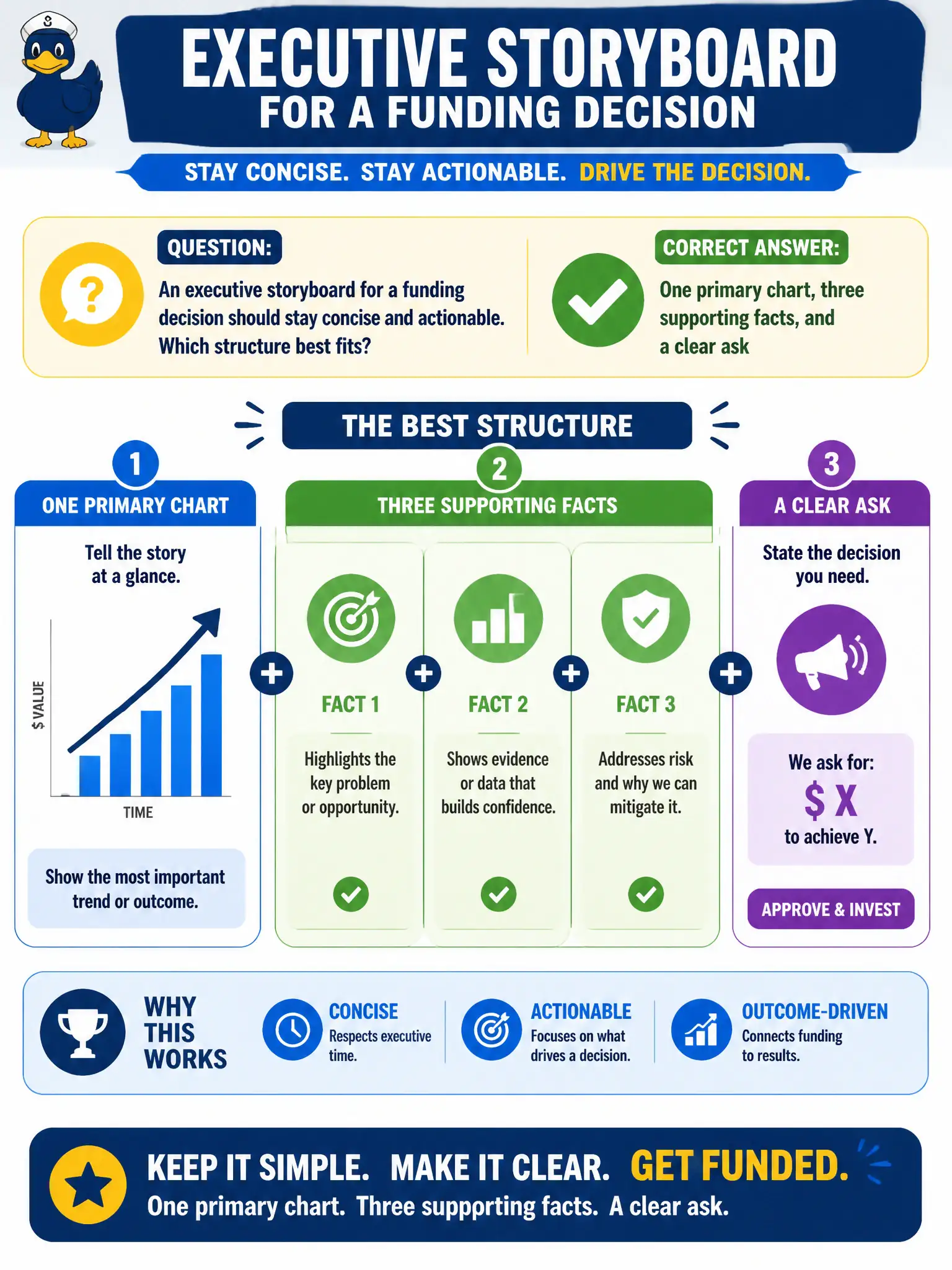
An executive storyboard for a funding decision should stay concise and actionable. Which structure best fits?
Select an answer to reveal the explanation.
Short Explanation
Executives buy clarity, not a scrapbook. One strong chart, a few supporting facts, and a clear ask beats forty orphan plots. End with what you need them to decide.
Full Explanation
An executive storyboard for a funding decision should stay concise and actionable: one primary chart, three supporting facts, and a clear ask. Senior civic audiences decide under time pressure; analytic storytelling that centers the decision, evidence, and request outperforms exhaustive exploration dumps that leave leaders without a path to act. Forty exploratory plots with no recommendation fail by transferring unfinished analysis to executives without closure. A full extract of every warehouse table used in the analysis fails by confusing raw data access with decision support suitable for funding choices. A glossary-only deck without evidence or a request fails by providing definitions without the decision case a budget vote requires. Exam caveat: appendices can hold detail for specialists, and material uncertainty should still appear briefly near the ask; concision is not a license to hide risks that change the funding recommendation. Operational check: rebuild the storyboard around one primary chart tied to the funding question, three supporting facts with sources, an explicit ask and owner, move exploratory plots to an appendix, and rehearse a five-minute delivery that ends with a decision request.