
Before modeling membership churn for recreation centers, what should the analyst verify first about the source data?
Select an answer to reveal the explanation.
Short Explanation
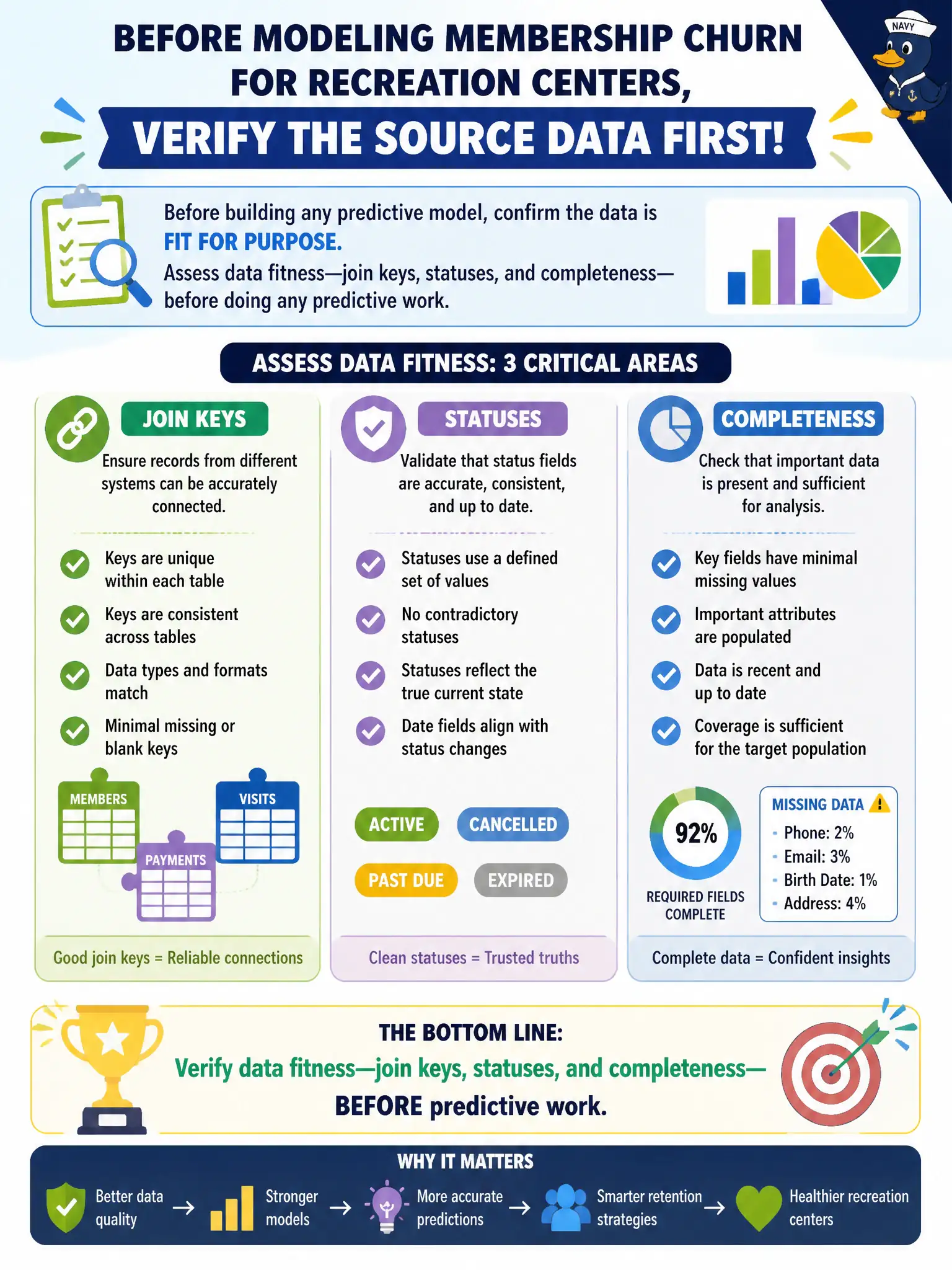
Modeling churn on messy keys and statuses is like racing on a half-paved road—you mostly learn about the potholes. Check fitness of joins, statuses, and completeness first. Fancy models do not fix broken inputs.
Full Explanation
Before modeling membership churn for recreation centers, the analyst should first verify that data fitness—join keys, statuses, and completeness—is assessed for the modeling grain. Predictive work depends on reliable identity joins across membership systems, coherent active/cancelled statuses, and adequate completeness; otherwise models fit integration defects rather than true churn behavior that parks managers can act on. Using the deepest neural network available regardless of data quality fails by prioritizing model fashion over fit-for-purpose inputs. Inventing churn labels randomly to increase training volume fails by destroying the supervision signal. Treating join keys as optional if column names look similar fails by inviting false matches and leakage across people. Exam caveat: fitness assessment can be proportionate—profile keys, statuses, and missingness, and document known limitations—but skipping it before predictive work is a common cause of civic analytics failure. Operational check: profile membership identifiers and status fields, measure match rates across source systems, quantify completeness at the chosen grain, remediate dominant defects or scope the model to fit data, and only then proceed to churn modeling with documented assumptions.