
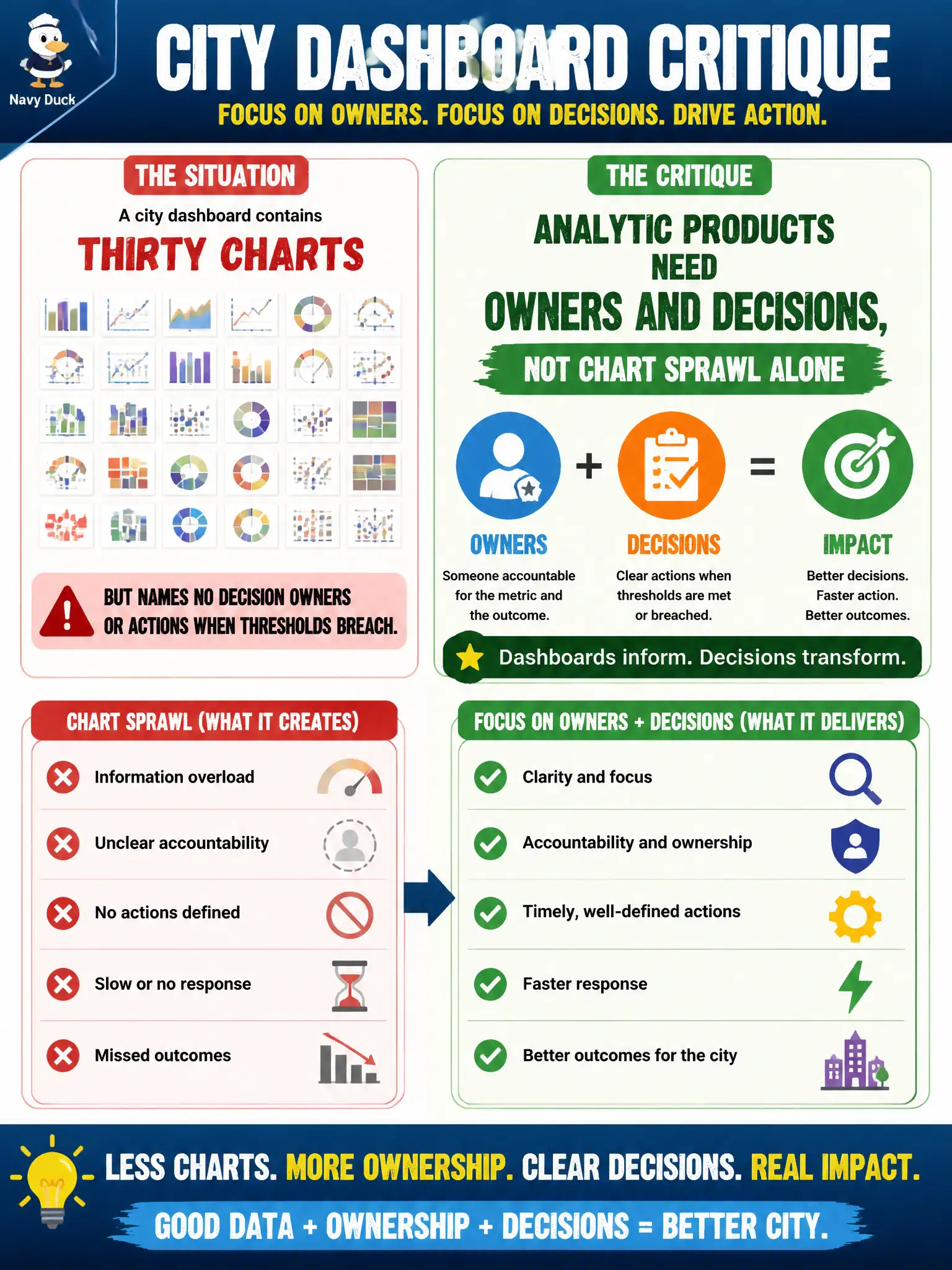
A city dashboard contains thirty charts but names no decision owners or actions when thresholds breach. What critique should an information-management practitioner make?
Select an answer to reveal the explanation.
Short Explanation
Thirty charts with nobody on the hook is a museum wall, not a management system. Tie each critical signal to a decision and an owner. Sprawl without action is just expensive wallpaper.
Full Explanation
A city dashboard with thirty charts but no decision owners or actions when thresholds breach fails as a management instrument; analytic products need owners and decisions, not chart sprawl alone. Actionable civic BI connects measures to thresholds, accountable owners, and playbooks so breaches trigger response rather than passive viewing by busy municipal teams. Adding thirty more charts so every system field is visible fails by increasing noise without creating accountability or clearer next steps. Removing all thresholds so nobody is accountable for breaches fails by eliminating the triggers that make metrics operational. Replacing owners with an anonymized shared mailbox for all metrics fails by diffusing responsibility until no one acts on red tiles. Exam caveat: not every exploratory chart needs an owner, but operational and official civic products that claim to manage performance do; distinguish sandboxes from managed products with explicit ownership. Operational check: for each official dashboard KPI, name an owner, define breach thresholds, document the first response action, review orphan charts for retirement or ownership assignment, and measure whether breaches actually produce timely responses rather than unread alerts.