
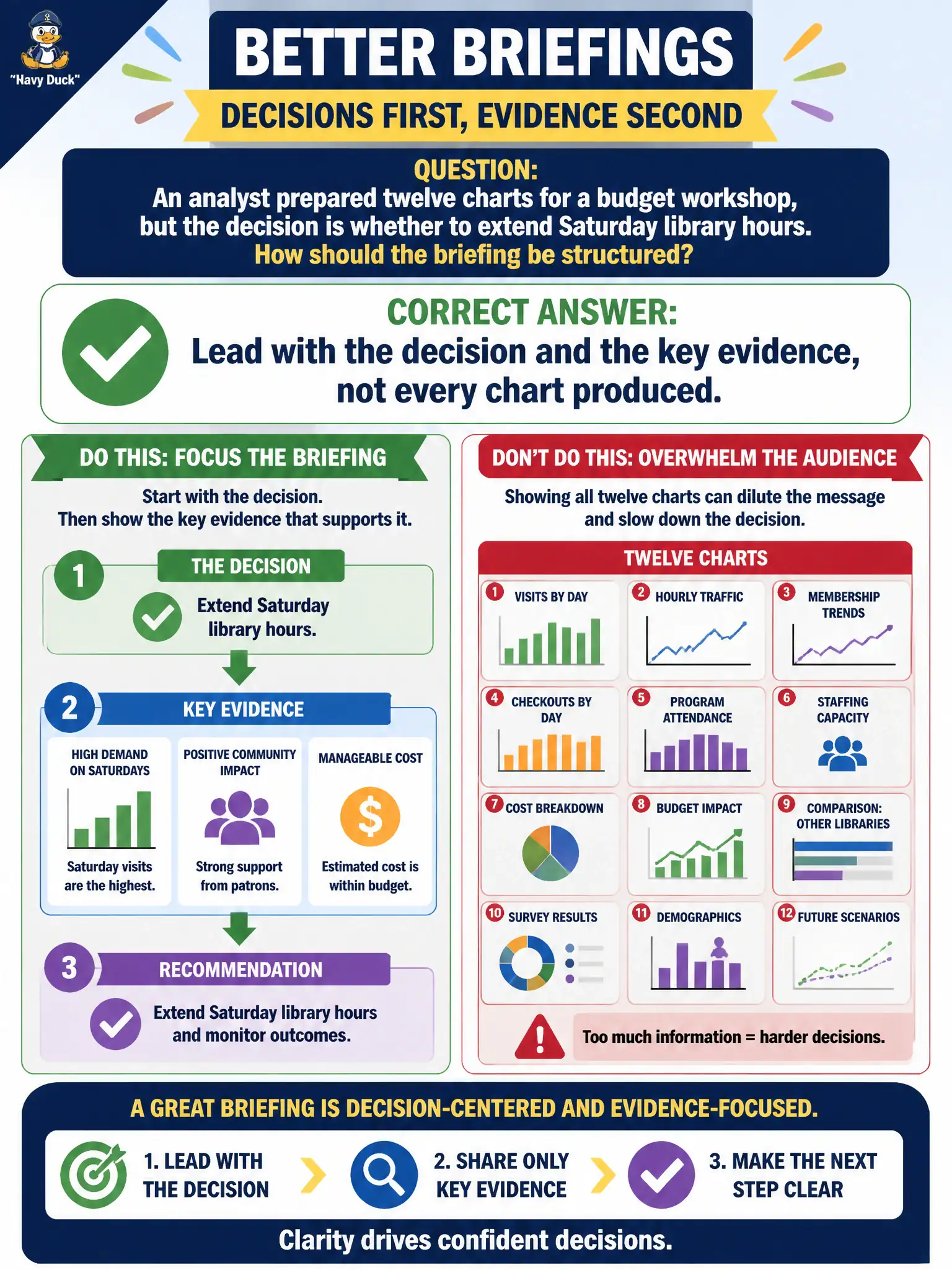
An analyst prepared twelve charts for a budget workshop, but the decision is whether to extend Saturday library hours. How should the briefing be structured?
Select an answer to reveal the explanation.
Short Explanation
Twelve charts with no through-line is a garage sale, not a briefing. Put the decision up front and bring only the evidence that bears on Saturday hours. Everything else can stay in the appendix.
Full Explanation
When the decision is whether to extend Saturday library hours, the briefing should lead with the decision and the key evidence—demand patterns, cost, staffing, equity of access, and outcome measures—not every chart the analyst produced along the way. Analytic storytelling for civic decisions organizes communication around the choice and the evidence that informs it so leaders can act under time pressure. Presenting every chart in production order fails by forcing stakeholders through workflow archaeology instead of decision support. Opening with thirty minutes of data-quality caveats before any finding fails by burying the signal, even though material caveats still belong near the conclusion when they change the choice. Leading with model hyperparameters and exploratory plots fails by prioritizing methods theater over actionable understanding. Exam caveat: supporting detail and quality notes can live in appendices; decision-first does not mean hiding material uncertainty—state uncertainty briefly where it changes the recommendation. Operational check: rewrite the deck to open with the Saturday-hours decision, three evidence points, and a clear recommendation; move exploratory charts to an appendix; time a rehearsal to confirm leaders can decide without the full chart dump; and record the decision owner.