
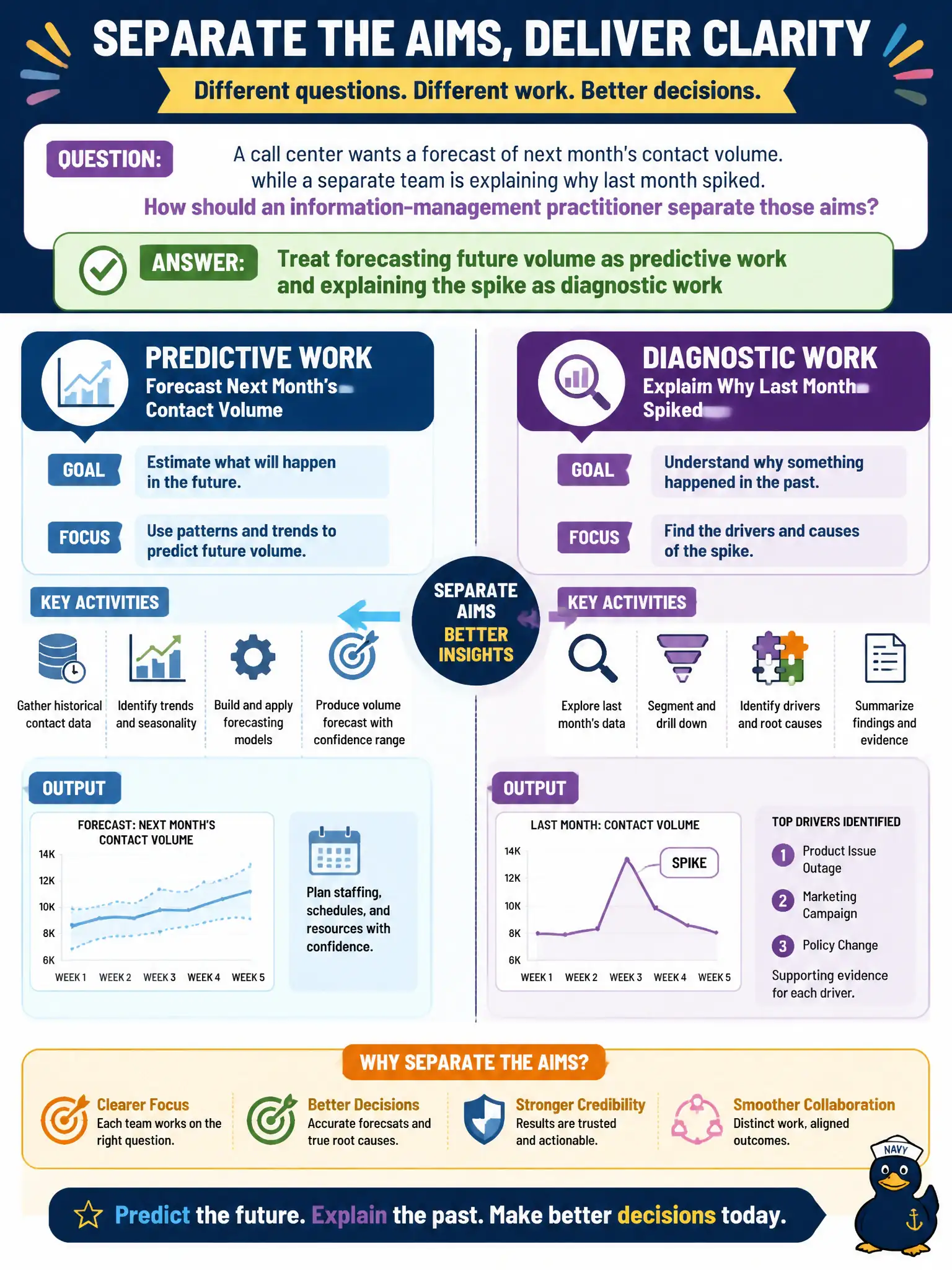
A call center wants a forecast of next month's contact volume, while a separate team is explaining why last month spiked. How should an information-management practitioner separate those aims?
Select an answer to reveal the explanation.
Short Explanation
Forecasting next month is looking down the road; explaining last month's spike is looking in the rear-view mirror. Same call logs can feed both, but prediction and diagnosis are different jobs. Mixing them muddies methods and decisions.
Full Explanation
An information-management practitioner should separate a call-center forecast of next month’s contact volume (predictive) from explaining why last month spiked (diagnostic). Shared call logs do not collapse those aims into one method or one deliverable: forecasting estimates future values under assumptions and needs error tracking, while diagnosis investigates historical causes with contextual evidence such as change history, outages, and campaign effects. Treating both as the same diagnostic problem because they share sources fails by confusing purpose and success criteria. Replacing both with a vanity dashboard of average handle time fails by answering neither the forecast nor the cause question. Skipping diagnosis and using forecast model coefficients as the official cause list fails by misreading association and model structure as causal proof. Exam caveat: some organizations run both workstreams from one team, but they still need distinct success criteria, validation approaches, and stakeholder communications so council and operations are not misled. Operational check: charter two outputs—a forecast with horizon, metrics, and error tracking, plus a diagnostic brief with candidate causes and evidence—and refuse to present coefficients as the sole official cause list without causal validation.