
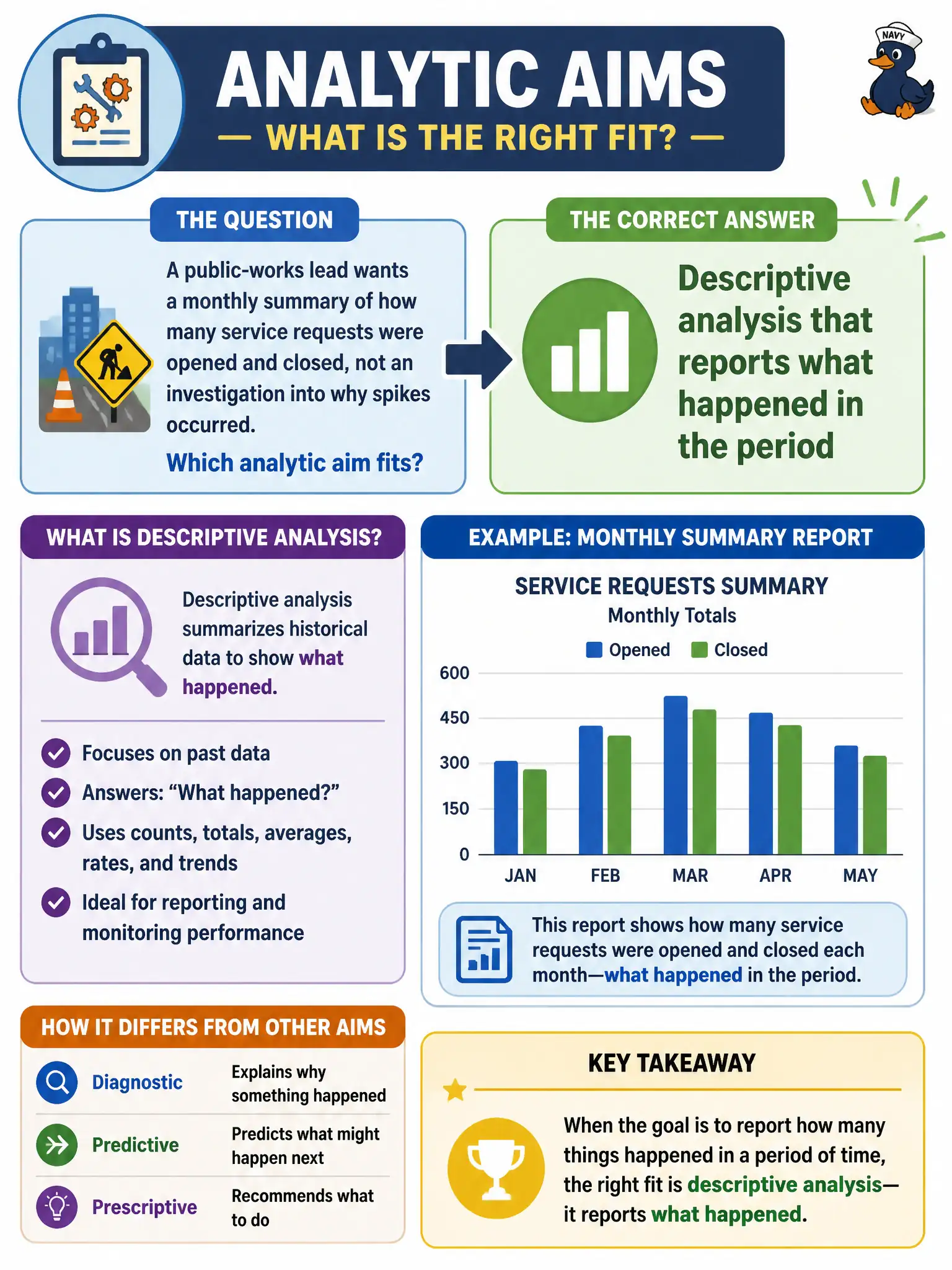
A public-works lead wants a monthly summary of how many service requests were opened and closed, not an investigation into why spikes occurred. Which analytic aim fits?
Select an answer to reveal the explanation.
Short Explanation
A monthly opened-and-closed tally is the scoreboard, not the post-game film. Descriptive work says what happened; digging into why spikes happened is diagnostic and needs different methods and data. Match the aim before grabbing tools.
Full Explanation
A public-works lead who wants a monthly summary of how many service requests were opened and closed is asking for descriptive analysis: reporting what happened in the period with defined counts and time windows. Descriptive work answers “what” without requiring causal investigation, forecasting, or action optimization, and matching the analytic aim prevents overbuilding. Diagnostic analysis that isolates root causes of spikes fails the request by aiming at “why” and needing additional context and structured RCA. Predictive analysis that forecasts next-quarter volume fails by answering a forward-looking question the lead did not ask. Prescriptive analysis that recommends crew reallocation rules fails by jumping to action guidance beyond a period summary. Exam caveat: aims can sequence—descriptive summaries often trigger later diagnostic work—but the immediate request should not be mislabeled as diagnosis or prescription, and definitions of opened and closed must still be clear. Operational check: confirm the decision need is a period summary; deliver opened and closed counts with definitions, filters, and time windows; footnote known data caveats briefly; and only open a diagnostic workstream if stakeholders explicitly ask why a spike occurred.