
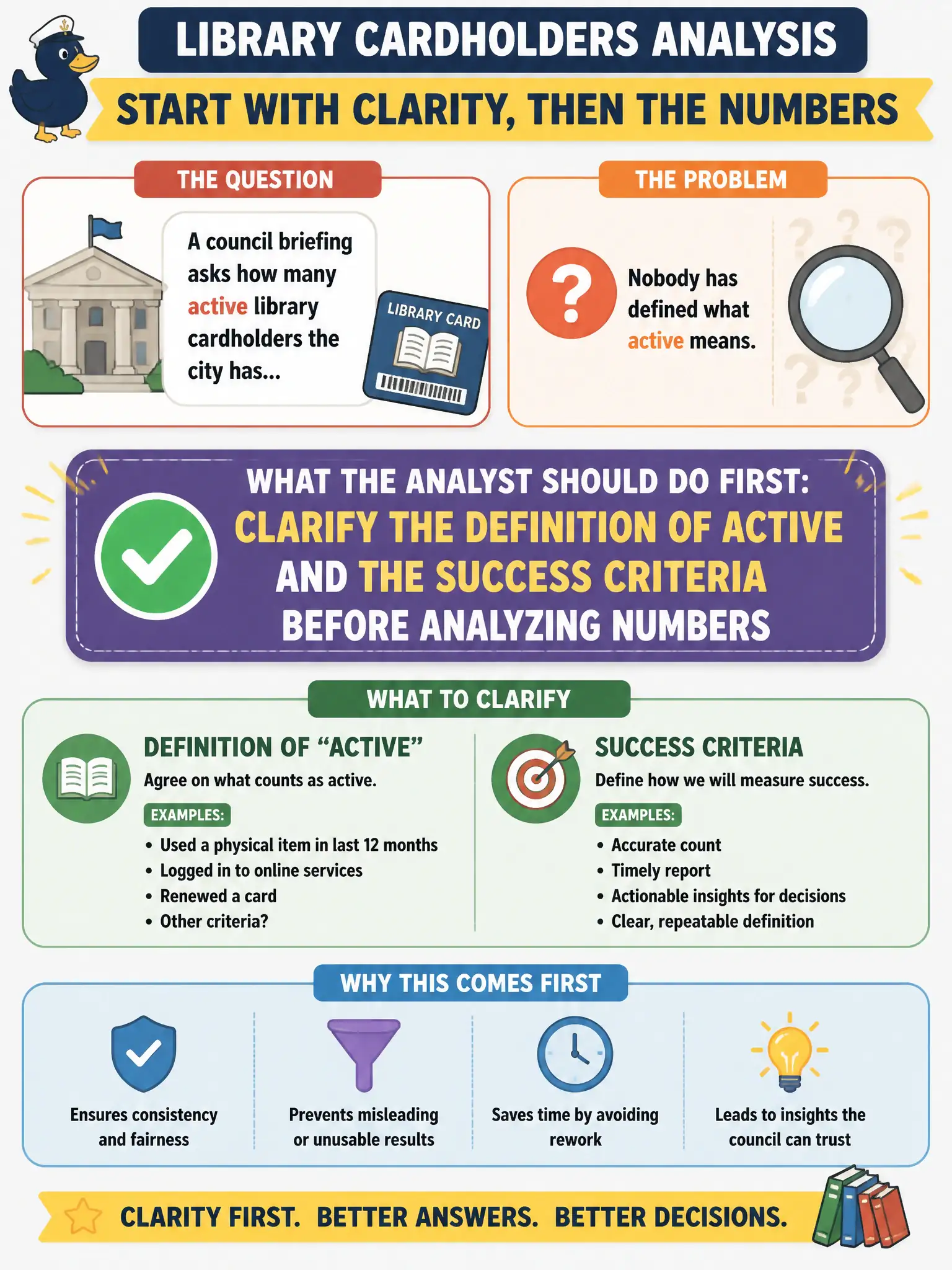
A council briefing asks how many active library cardholders the city has, but nobody has defined what active means. What should the analyst do first?
Select an answer to reveal the explanation.
Short Explanation
Asking for a headcount without defining active is like asking how many cars are on the road without saying whether parked ones count. Start by locking the definition and what good looks like, then touch the data. Otherwise every pivot fights a different question.
Full Explanation
When a council briefing asks how many active library cardholders the city has, but nobody has defined active, the analyst must clarify the definition and success criteria before analyzing numbers. Framing precedes calculation: inclusion rules, inactivity windows, renewals, reciprocal cards, and denominators all change the total, so premature row counts are not comparable or decision-ready for civic funding and service design. Pulling last month’s export and reporting the row count as active fails by silently inventing a definition that cannot be defended under scrutiny. Building a predictive renewal model before clarifying terms fails by escalating complexity without answering the framed question. Publishing five alternate definitions for council to pick after the vote fails by transferring analytic design into a political scramble and still leaving accountability without a chosen frame. Exam caveat: clarification can be lightweight—document the agreed definition, time window, and exclusions—but skipping it produces conflicting briefings that damage civic trust. Operational check: write a one-page metric definition for active cardholder, get steward or service-owner confirmation, compute against that definition, footnote the definition on the council slide, and store the definition in the governed glossary for reuse.