
Besides payment, why does accurate designation of principal versus other diagnoses matter under UHDDS?
Select an answer to reveal the explanation.
Short Explanation
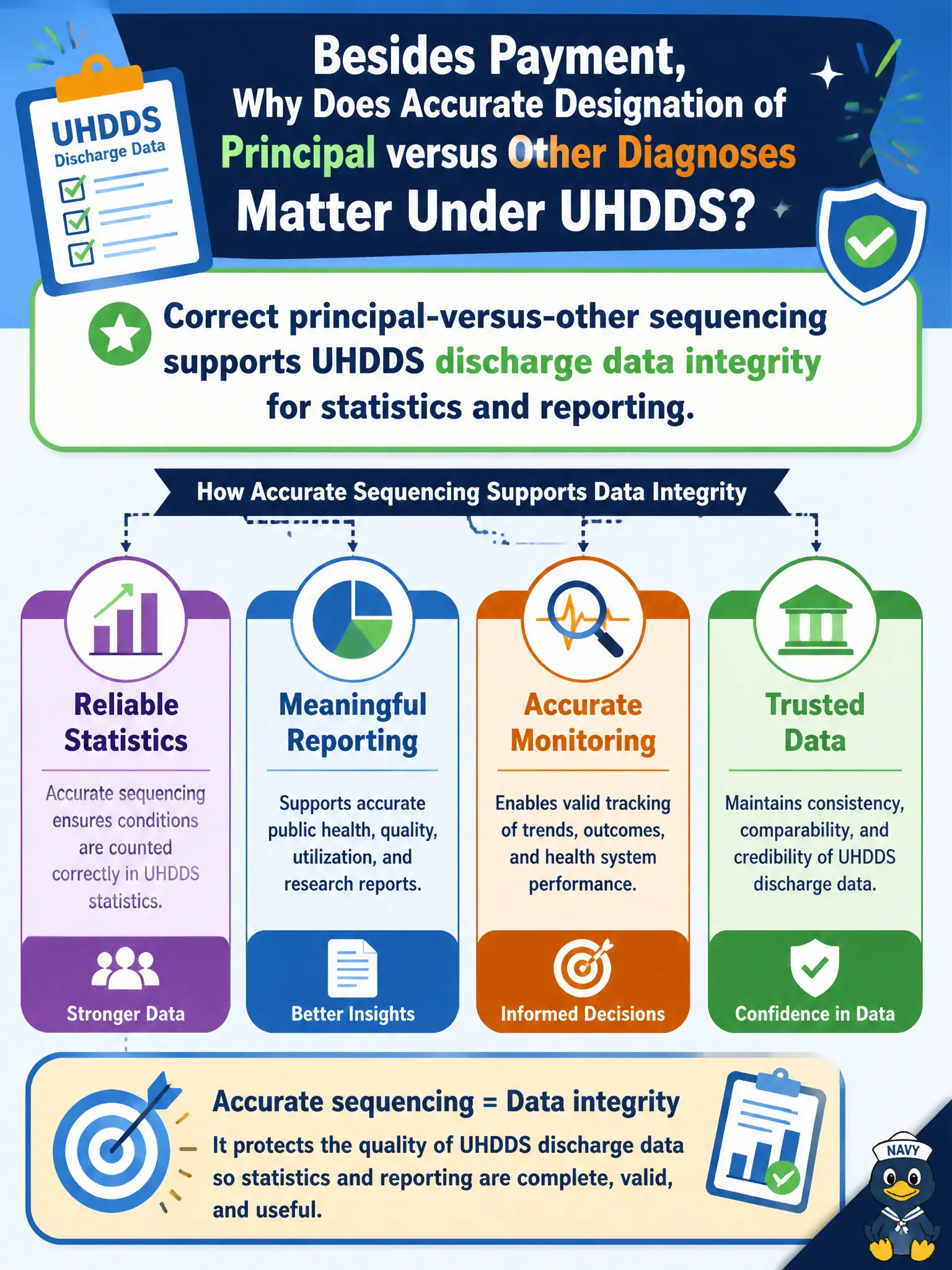
Principal versus other is not just a money shuffle—UHDDS uses that designation for clean discharge data. Get the main reason in the principal seat and the rest in their proper lane. Sequence is data quality, not decoration.
Full Explanation
Besides payment, accurate designation of principal versus other diagnoses under UHDDS matters because correct sequencing supports discharge data integrity for statistics and public reporting at county hospitals. Civic planners and quality programs read principal diagnosis as the main reason for admission after study. Believing UHDDS ignores sequence as long as codes appear somewhere discards definitional structure. Claiming only the business office uses diagnosis sequence while HIM abstracts may be unordered splits what should be one coherent dataset. Limiting principal designation importance to commercial payers erases UHDDS statistical purpose. Exam caveat: sequence is a data-quality requirement, not merely a payer preference. Operational check: validate principal against after-study reason for admission, place other diagnoses per UHDDS criteria, reconcile claim and abstract sequencing, and include principal accuracy in external data audits. Keep UHDDS definitions visible at the desk so civic discharge abstracts remain comparable, auditable, and faithful to care actually delivered this stay. Re-read the authenticated record before finalizing whenever tools, payers, or dashboards push a result the documentation does not support.