
Why must hospital abstractors report discharge disposition accurately for UHDDS compliance?
Select an answer to reveal the explanation.
Short Explanation
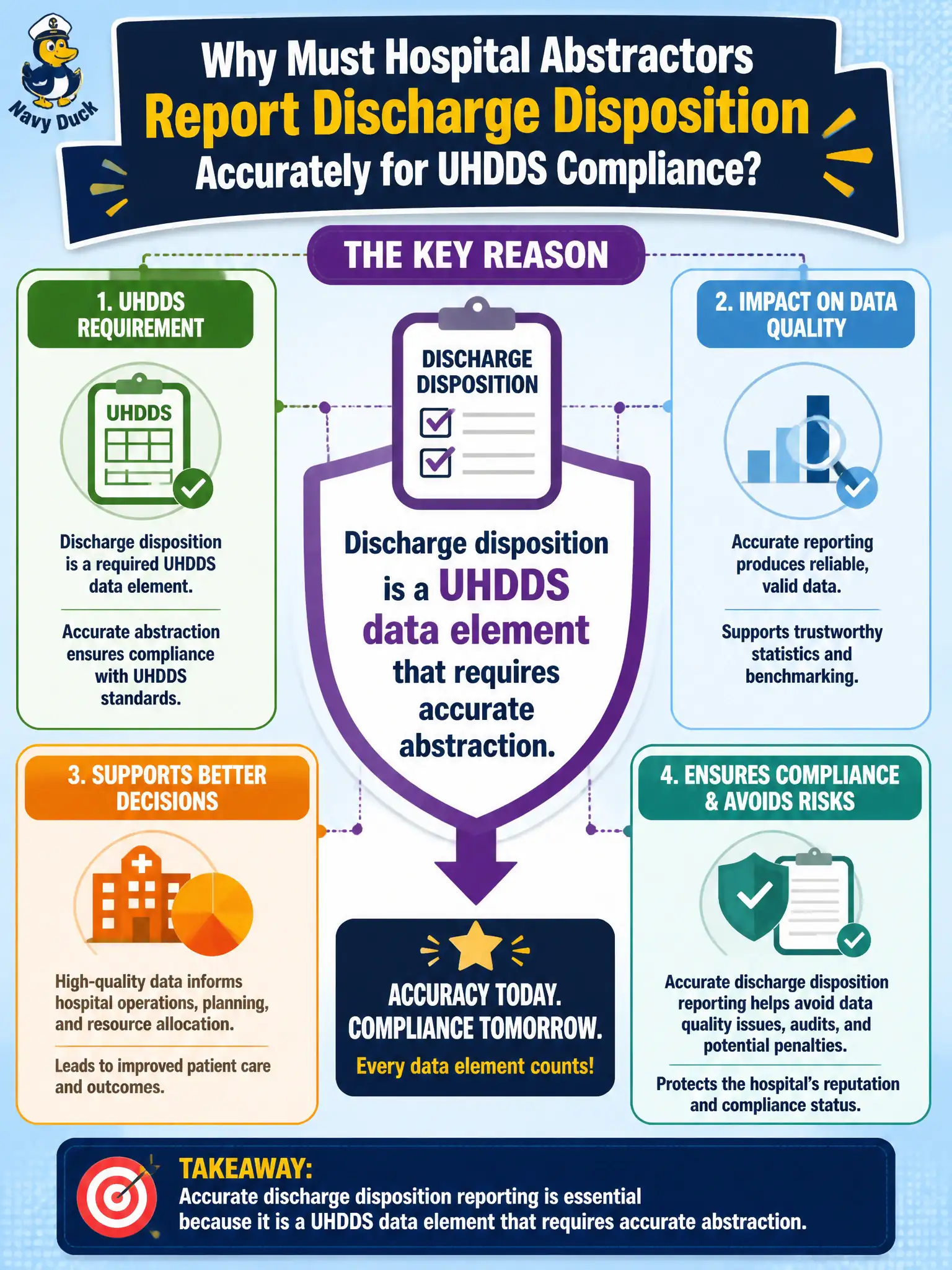
Where the patient went after discharge is not a side note—it is a UHDDS data element. Abstract it accurately every time, not only when something dramatic happened. Good disposition data keeps the discharge dataset honest.
Full Explanation
Hospital abstractors must report discharge disposition accurately because disposition is a UHDDS data element required for civic discharge datasets, continuity metrics, and transfer analytics. Communities and public programs rely on knowing whether patients went home, to IRF, SNF, hospice, or elsewhere. Treating disposition as optional free text for social work notes demotes a standard data element to casual narrative. Claiming disposition codes are used only by ambulance vendors erases hospital reporting duties. Requiring disposition only when the patient expires invents a narrow exception and leaves live discharges unabstracted. Exam caveat: disposition accuracy is UHDDS compliance, not optional color commentary. Operational check: capture disposition from the discharge order and case-management notes, validate against transfer paperwork, correct mismatches before final abstract, and include disposition accuracy in HIM data-quality audits. Keep UHDDS definitions visible at the desk so civic discharge abstracts remain comparable, auditable, and faithful to care actually delivered this stay. Re-read the authenticated record before finalizing whenever tools, payers, or dashboards push a result the documentation does not support.