
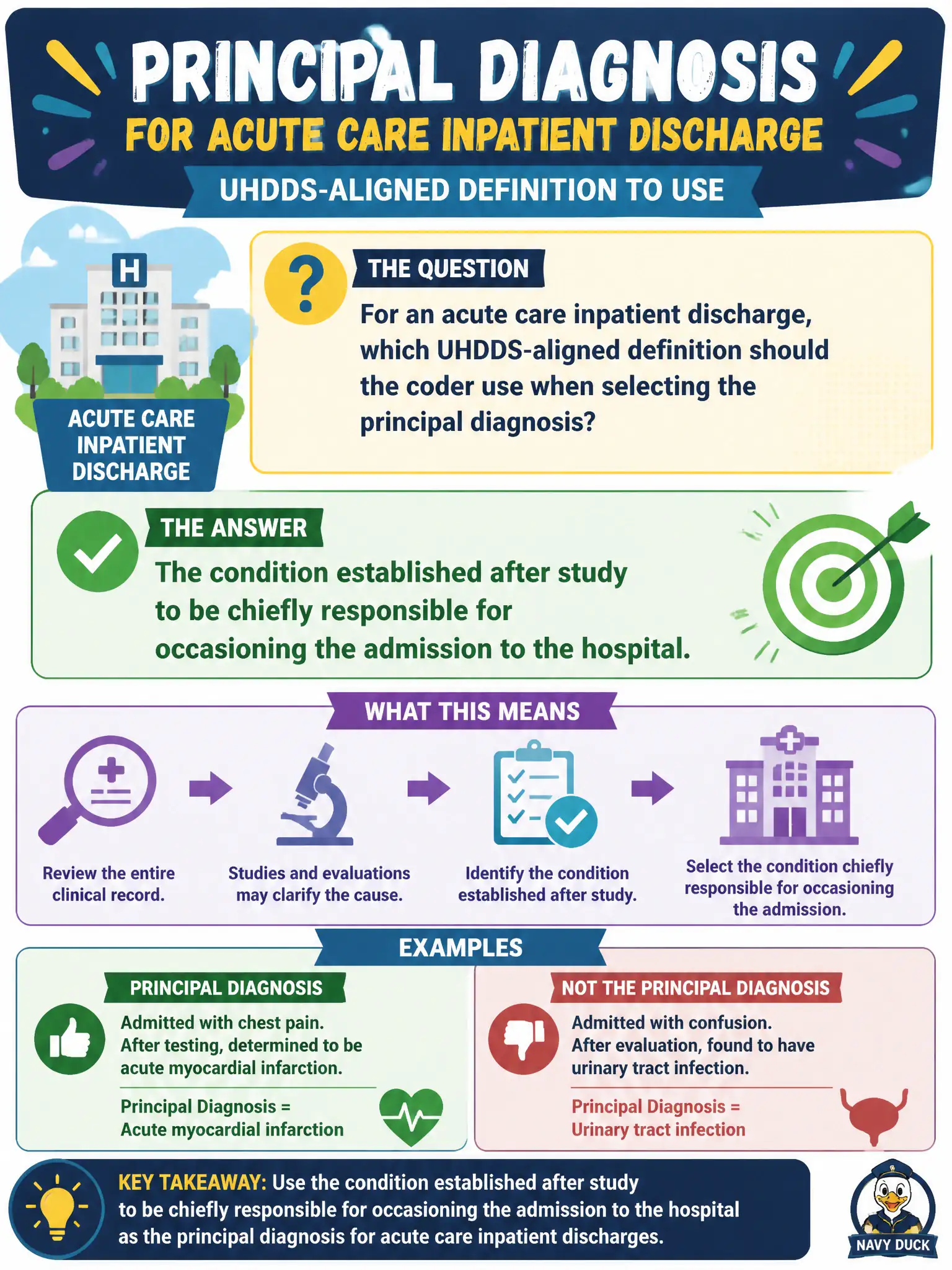
For an acute care inpatient discharge, which UHDDS-aligned definition should the coder use when selecting the principal diagnosis?
Select an answer to reveal the explanation.
Short Explanation
UHDDS principal diagnosis is not “whatever paid best” or “whatever was first on the ED sheet.” It is the condition after study that mainly caused the admission. Think reason-for-stay after the workup, not the loudest billing code.
Full Explanation
For an acute-care inpatient discharge at a county hospital, UHDDS-aligned principal diagnosis selection uses the condition established after study to be chiefly responsible for occasioning the admission. That after-study definition anchors civic discharge statistics and payment integrity to what truly drove hospitalization, not to the first impression on an ED face sheet. Choosing the first ED face-sheet diagnosis regardless of later findings abandons the after-study concept when workup changes the picture. Treating any discharge-summary problem-list entry as principal confuses a list of issues with the single chiefly responsible condition. Selecting whichever documented diagnosis yields the highest-weighted MS-DRG is payment-driven sequencing, not UHDDS logic. Exam caveat: UHDDS principal-diagnosis definition is clinical and chronological after study; DRG weight is an outcome of correct sequencing, not the selection criterion. Operational check: reconcile H&P, progress notes, operative findings, and discharge summary; identify the condition that occasioned admission after study; sequence that as principal; and sample abstracts where ED impressions differ from final diagnoses. Keep UHDDS definitions visible at the desk so civic discharge abstracts remain comparable, auditable, and faithful to care actually delivered this stay.