
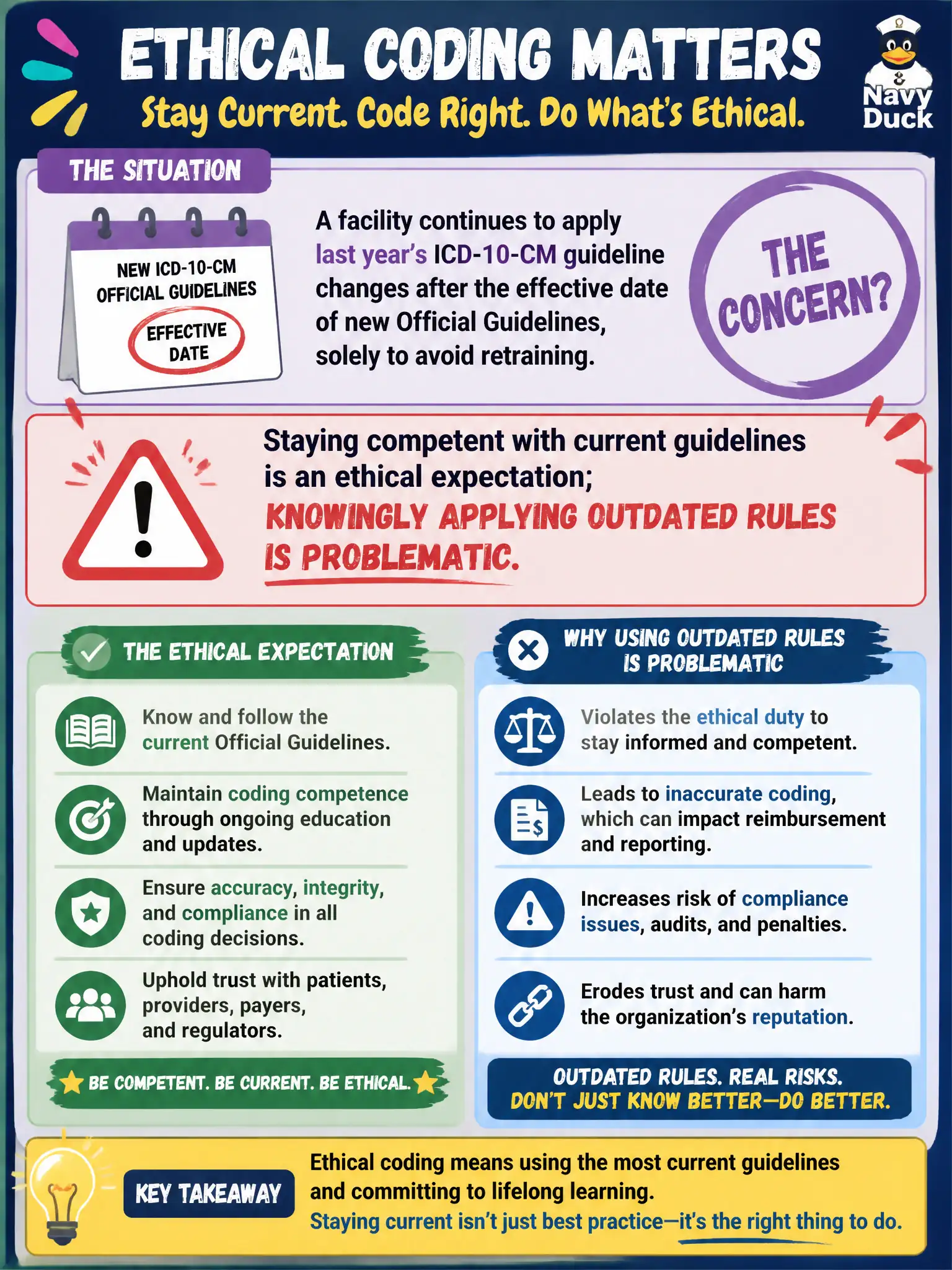
A facility continues to apply last year’s ICD-10-CM guideline changes after the effective date of new Official Guidelines, solely to avoid retraining. From an ethical coding perspective, what is the concern?
Select an answer to reveal the explanation.
Short Explanation
Guidelines have birthdays—when the new ones start, last year’s playbook is retired. Ethical coders keep learning so current rules drive the codes. Skipping updates to avoid training is an ethics miss, not a shortcut.
Full Explanation
From an ethical coding perspective, a civic facility that keeps applying last year's ICD-10-CM guideline changes after new Official Guidelines take effect solely to avoid retraining fails the expectation to stay competent with current rules. Public abstracts must reflect the guideline year in force, not institutional inertia. Treating continuing education as optional once credentialed undermines professional standards. Using older guidelines whenever they produce a higher-paying DRG is opportunistic noncompliance. Shifting all responsibility for guideline currency to the encoder vendor ignores the coder's independent ethical duty. Exam caveat: effective-dated guideline updates are binding; convenience is not a delay authority. Operational check: calendar October and other update effective dates, retrain before go-live, verify encoder content matches the new year, and audit early-period claims for outdated guideline application. Ethical coding in public facilities means the record and Official Guidelines outrank productivity, CMI, or dashboard pressure every time the two conflict. Re-read the authenticated record before finalizing whenever tools, payers, or dashboards push a result the documentation does not support.