
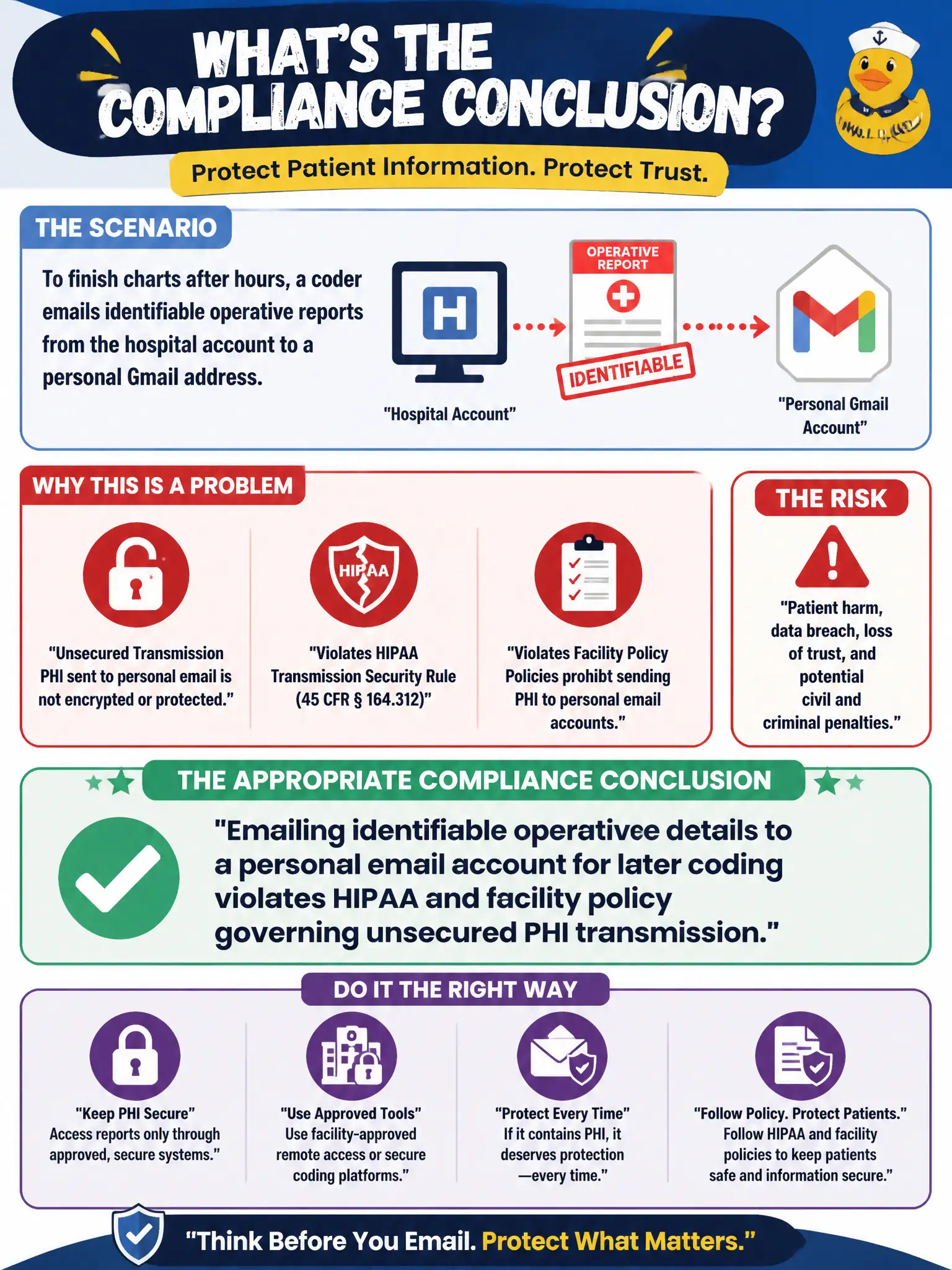
To finish charts after hours, a coder emails identifiable operative reports from the hospital account to a personal Gmail address. What is the appropriate compliance conclusion?
Select an answer to reveal the explanation.
Short Explanation
Personal Gmail is not a coding inbox. Shipping identifiable operative details there for later is an unsecured PHI send—full stop. Use approved remote access instead of a private email account.
Full Explanation
Emailing identifiable operative reports from a county hospital account to a personal Gmail address to finish charts after hours violates HIPAA and facility policy on unsecured PHI transmission. Civic HIM workflows must keep ePHI inside approved systems, not personal webmail. Deleting personal email within 24 hours does not undo an impermissible disclosure or create a safe harbor. Claiming operative reports cease to be PHI after discharge is false—identifiers and clinical detail remain protected. Asserting only paper mail can violate HIPAA invents an electronic exemption that does not exist. Exam caveat: convenience workflows are not authorization pathways; personal email is not an approved remote coding channel. Operational check: revoke ad-hoc forwarding, require approved remote access for after-hours work, investigate the transmission as a potential breach incident, retrain the coder, and monitor outbound email for PHI patterns. Sustain civic accountability by pairing correct code assignment with transparent denial, quality, and privacy escalation paths so public reporting and payment integrity move together. Re-read the authenticated record before finalizing whenever tools, payers, or dashboards push a result the documentation does not support.