
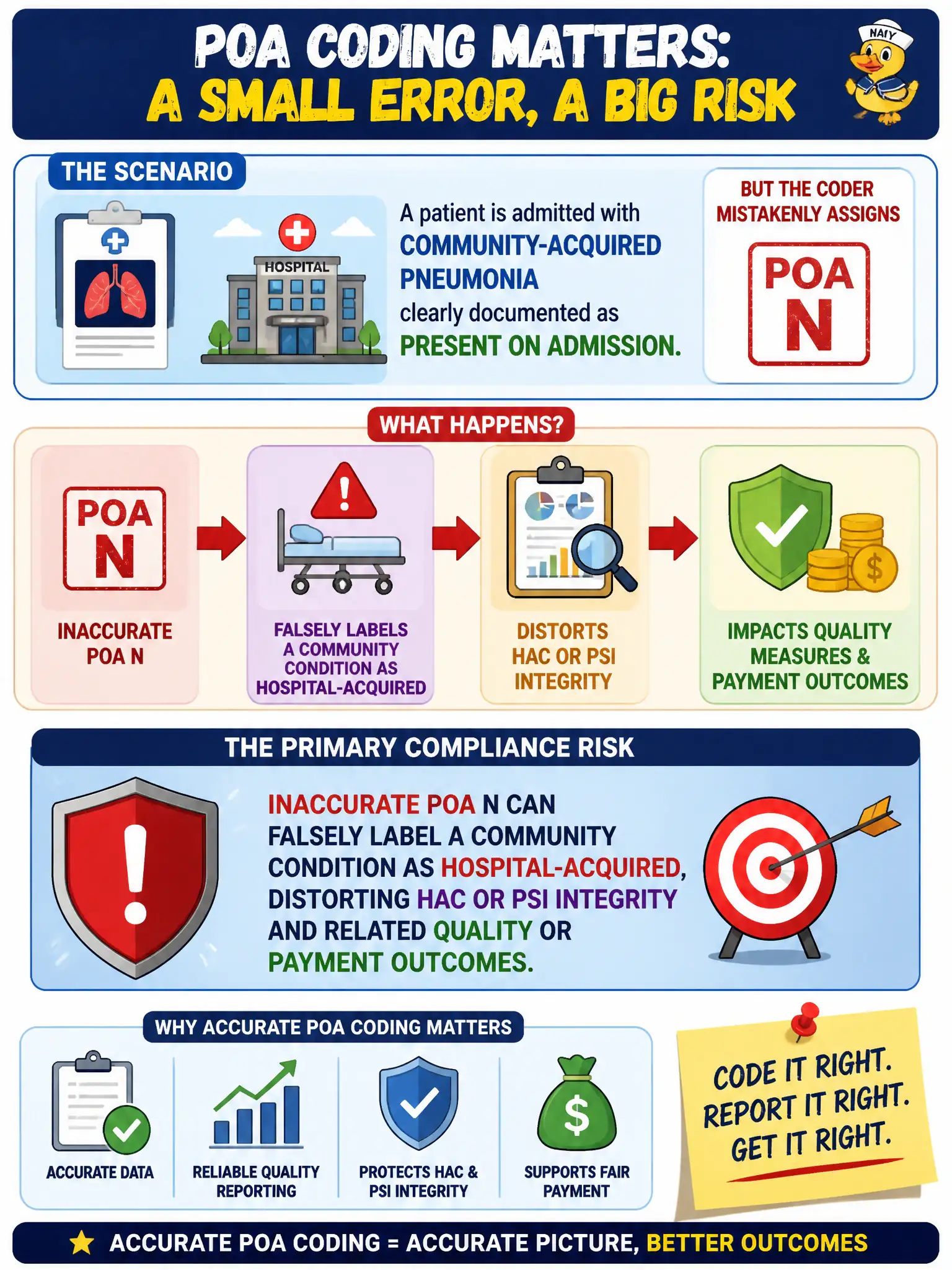
A patient is admitted with community-acquired pneumonia clearly documented as present on admission, but the coder mistakenly assigns POA N. What is the primary compliance risk?
Select an answer to reveal the explanation.
Short Explanation
Marking a pneumonia that walked in the door as not present on admission makes the hospital look like it caused it. Wrong POA is how community problems get dressed up as hospital-acquired. Fix the indicator—do not invent a new disease story.
Full Explanation
Mistakenly assigning POA N to community-acquired pneumonia that was clearly present on admission at a civic hospital can falsely label a community condition as hospital-acquired, distorting HAC or PSI integrity and related quality or payment outcomes. Correct POA is a public-trust data element: communities rely on hospitals not to invent nosocomial events through abstracting errors. Assuming the claim will automatically fail NCCI edits for all secondary diagnoses misattributes POA errors to procedure-bundling logic. Believing principal diagnosis selection becomes optional when POA is wrong confuses two independent coding constructs. Claiming POA errors only affect outpatient APC claims ignores the inpatient quality and HAC uses of POA. Exam caveat: POA indicators are inpatient quality and payment-integrity tools; wrong N on a present-on-admission condition manufactures a false hospital-acquired signal. Operational check: reconcile admission H&P, ED notes, and first assessments before setting POA; correct POA N to Y when community onset is clear; query when chronology conflicts; and sample POA accuracy in coding quality reviews for pneumonia and other HAC-sensitive diagnoses across civic inpatient service lines. Sustain civic accountability by pairing correct code assignment with transparent denial, quality, and privacy escalation paths so public reporting and payment integrity move together.