
A county hospital inpatient coder abstracts a workers' compensation claim for a workplace fall. The WC payer returns the claim asking for additional external-cause detail that was not required on the facility's Medicare inpatient claims. What is the most appropriate coding response?
Select an answer to reveal the explanation.
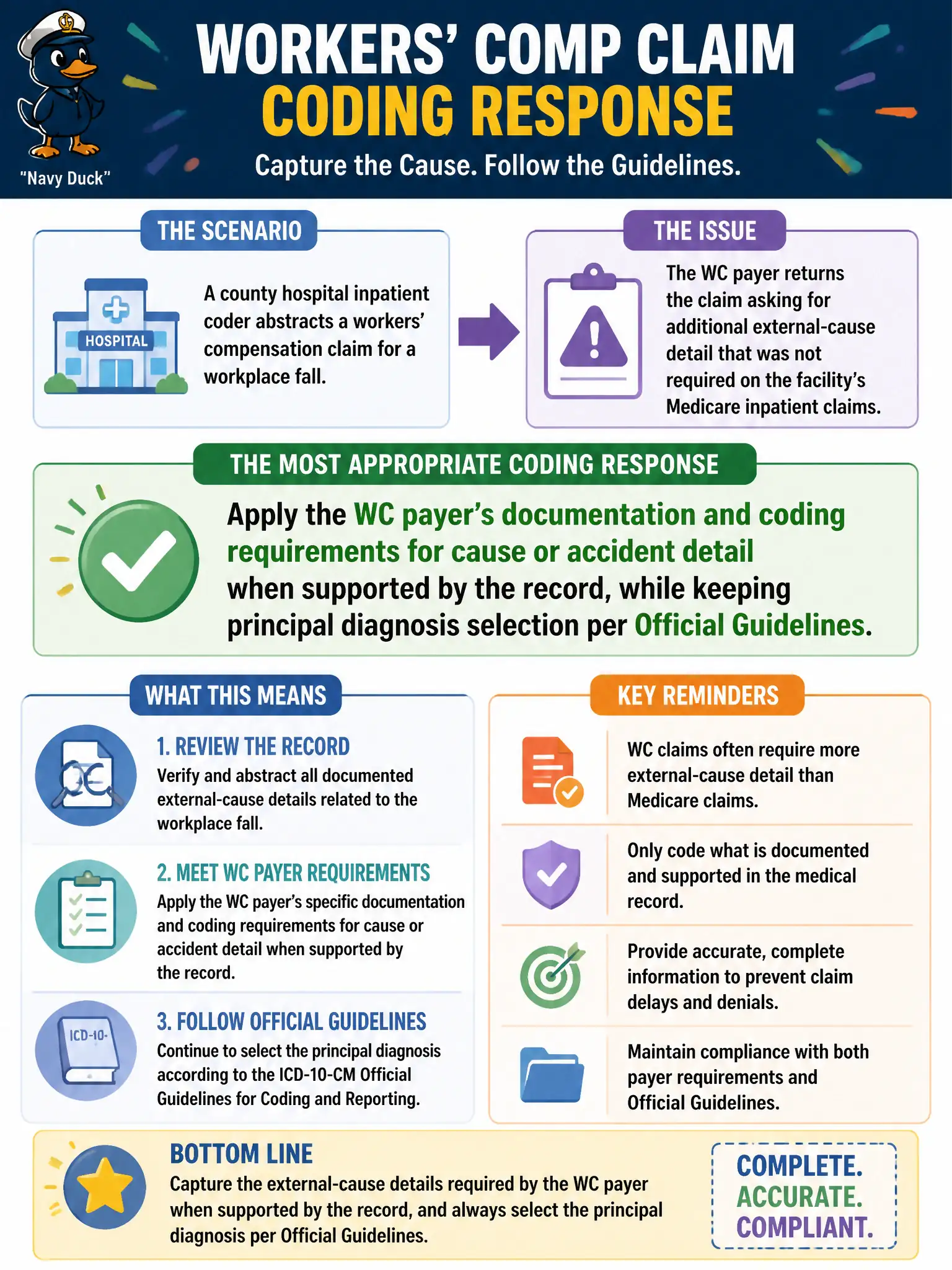
Short Explanation
Workers' comp is not Medicare in a different hat—those plans often want the how and where of the accident spelled out. If the chart supports it, add the cause detail they ask for, but do not rewrite the principal diagnosis just to get a check. Think of it like filling the extra fields on a special form, not inventing a new story.
Full Explanation
In a county hospital inpatient setting, workers' compensation and liability payers often demand external-cause, place-of-occurrence, or accident detail that traditional Medicare inpatient claims do not always require for payment. The correct response is to meet those WC documentation and coding expectations when the health record supports the additional codes, while still selecting the principal diagnosis under Official Guidelines rather than inventing a payer-friendly story. Civic facilities owe both accurate public-payer abstracts and honest occupational-injury reporting: adding supported cause detail is cooperation with a legitimate payer rule, not a rewrite of clinical sequencing. Ignoring the WC request because Official Guidelines never force external cause for every payer misses the separate concept of payer-specific reporting requirements layered on top of guidelines. Changing the principal diagnosis to an external-cause code so the claim pays faster confuses supplemental circumstance coding with principal-diagnosis selection and can reverse the reason for admission. Deleting injury diagnoses and billing only unspecified pain codes to avoid scrutiny is deliberate undercoding that falsifies the clinical picture and harms both compliance and care data. Exam caveat: Official Guidelines remain the sequencing authority; payer edits never authorize unsupported codes or principal-diagnosis substitution. Operational check: compare the WC denial or development letter to the injury narrative and ED/admission notes, add supported external-cause or accident codes per payer policy, confirm principal diagnosis still reflects the condition chiefly responsible for admission, and document the appeal or resubmission trail for HIM compliance review. Sustain civic accountability by pairing correct code assignment with transparent denial, quality, and privacy escalation paths so public reporting and payment integrity move together.