
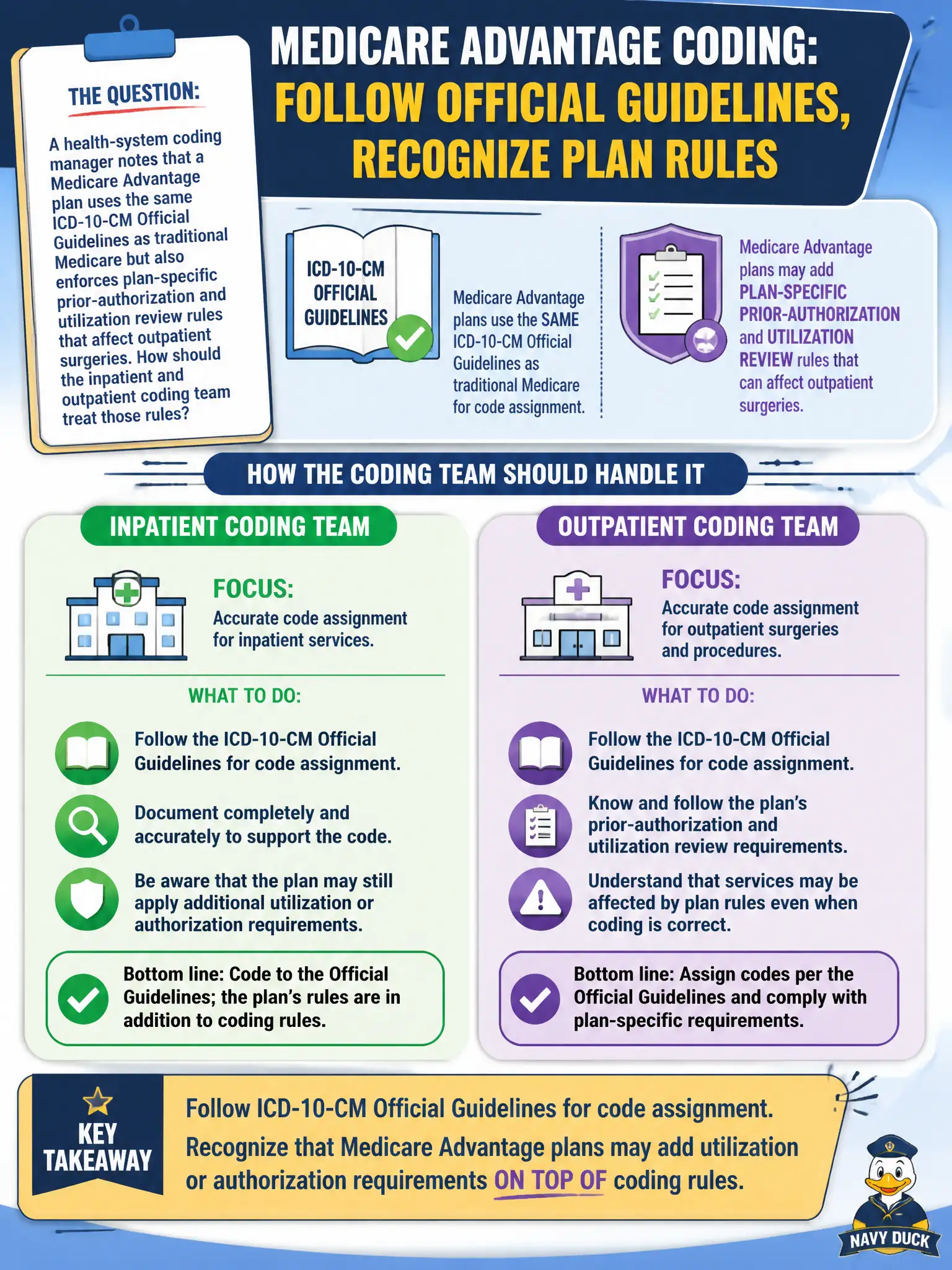
A health-system coding manager notes that a Medicare Advantage plan uses the same ICD-10-CM Official Guidelines as traditional Medicare but also enforces plan-specific prior-authorization and utilization review rules that affect outpatient surgeries. How should the inpatient and outpatient coding team treat those rules?
Select an answer to reveal the explanation.
Short Explanation
Same coding rulebook, extra traffic lights. Medicare Advantage usually still rides Official Guidelines for how you pick codes, but the plan can still demand authorizations or utilization steps before it pays. Do not swap coding guidelines for plan policy—or pretend plan policy does not exist.
Full Explanation
A municipal health-system coding team should treat Medicare Advantage plans as following the same ICD-10-CM Official Guidelines for code assignment that Fee-for-Service Medicare uses, while recognizing that the plan may still impose prior authorization, utilization review, or coverage gates on outpatient surgeries and other services. Civic hospitals protect beneficiaries and public trust when they keep coding ethics intact and route authorization or UR issues through utilization management rather than by distorting diagnoses. Treating MA utilization policies as replacements for Official Coding Guidelines collapses two different control layers: utilization may delay or deny payment, but it does not rewrite how codes are chosen from the record. Ignoring plan utilization rules because only Fee-for-Service guidance supposedly applies leaves the facility exposed to avoidable denials and misses the contractual reality of MA products. Coding only unspecified diagnoses so UR cannot challenge specificity is intentional undercoding that weakens medical necessity and quality data. Exam caveat: same guideline book for code selection does not mean identical coverage or authorization pathways across traditional Medicare and MA. Operational check: assign codes from documentation and Official Guidelines, then verify authorization status and plan policy with UM or patient access before final outpatient surgery billing, and escalate denials with clinical evidence rather than by watering down specificity. Sustain civic accountability by pairing correct code assignment with transparent denial, quality, and privacy escalation paths so public reporting and payment integrity move together.