
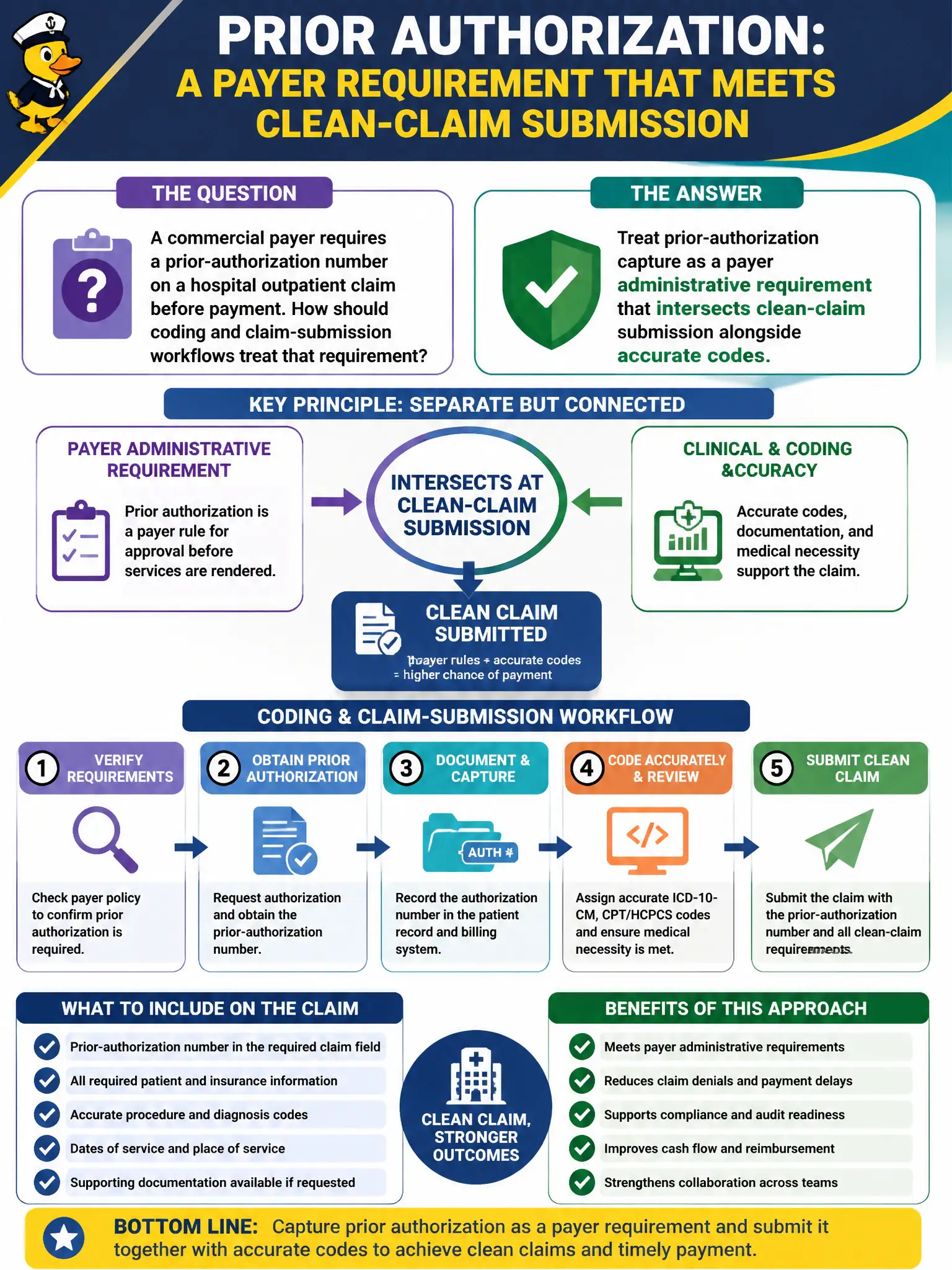
A commercial payer requires a prior-authorization number on a hospital outpatient claim before payment. How should coding and claim-submission workflows treat that requirement?
Select an answer to reveal the explanation.
Short Explanation
Clean claims need the right codes and the right paperwork stamps. If the payer wants a prior-auth number on an outpatient claim, that administrative rule rides along with coding — you do not fake a number or flip the patient to inpatient to dodge it. Capture the auth; keep the codes honest.
Full Explanation
When a commercial payer requires a prior-authorization number on a hospital outpatient claim before payment, coding and claim-submission workflows should treat prior-authorization capture as a payer administrative requirement that intersects clean-claim submission alongside accurate codes. Codes alone do not guarantee payment when authorization artifacts are mandatory. Skipping authorization numbers because CPT codes alone always guarantee payment ignores contract and payer rules. Changing outpatient codes to inpatient codes to avoid authorization edits manipulates bill type and is improper. Entering a placeholder authorization number so the claim passes scrubbing is falsification of administrative data. Exam caveat: authorization is not a coding guideline substitute, but clean-claim processes for municipal outpatient departments must capture required auth identifiers without altering clinical code assignment. Operational check: verify auth status and number before claim drop, keep codes documentation-true, and never invent auth numbers to clear edits. This discipline protects patients, supports accurate public reporting for municipal hospitals, and keeps the coded abstract defensible when auditors compare codes to the authenticated record.