
A state Medicaid program applies billing edits for a hospital claim that differ from Medicare Medically Unlikely Edits. What should the coding specialist recognize?
Select an answer to reveal the explanation.
Short Explanation
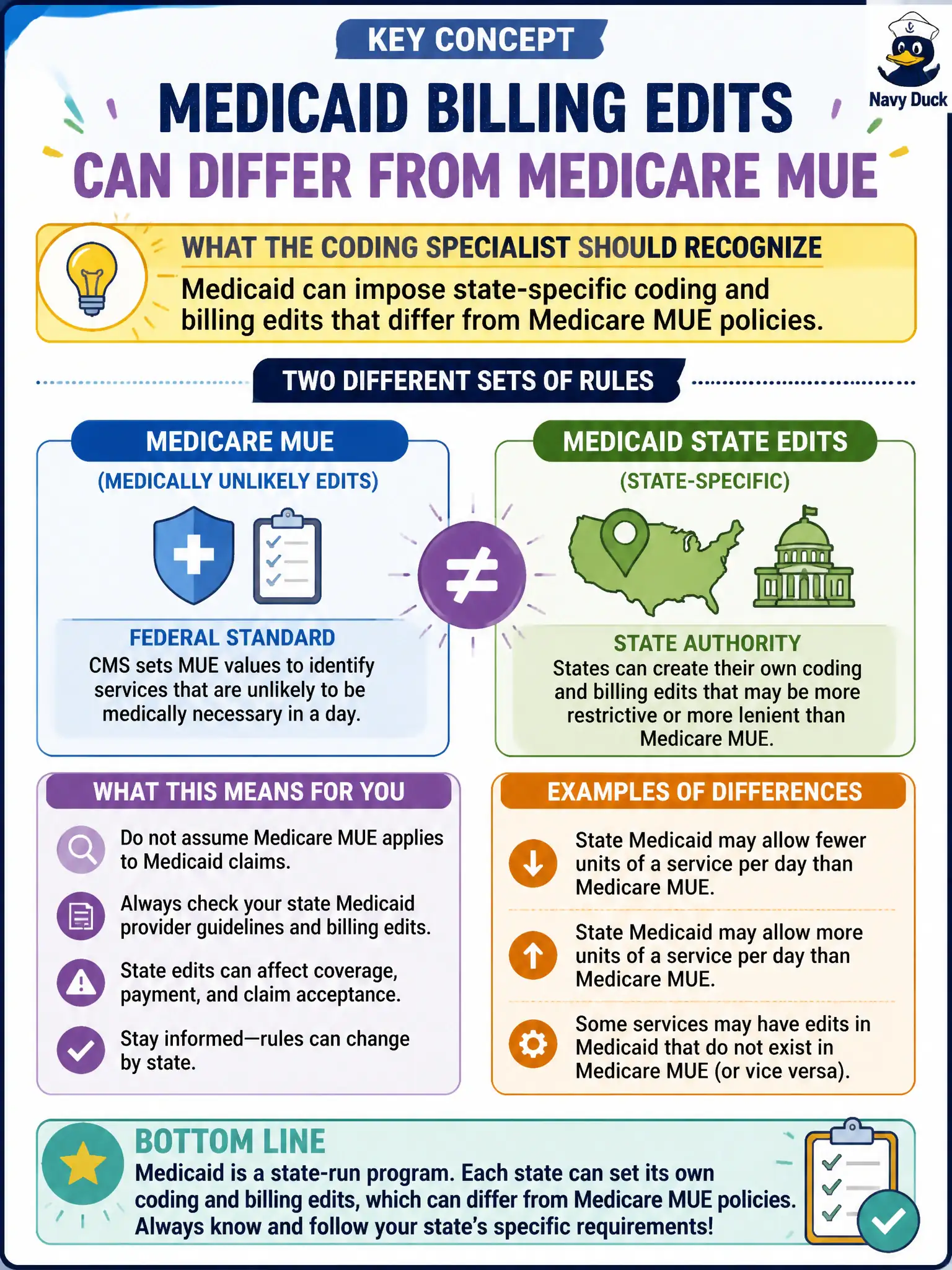
Medicaid is not a photocopy of Medicare. States can bolt on their own billing edits, so a unit count that sails past Medicare MUEs might still bounce. Know your state Medicaid rules when the payer is Medicaid.
Full Explanation
A state Medicaid program may apply billing edits for a hospital claim that differ from Medicare Medically Unlikely Edits. Coding specialists should recognize that Medicaid can impose state-specific coding and billing edits distinct from Medicare MUE policies. State Medicaid is not required to mirror Medicare MUEs in every circumstance. Hospital coders may not disregard Medicaid edits merely because Medicare would allow the units; the payer of record's rules apply to that claim. MUEs are not limited only to professional fee claims and never to facility claims; edit applicability depends on payer policy and claim type. Exam caveat: CCS-style payer questions test the separation of Official Coding Guidelines from payer-specific edits—know both layers for civic safety-net hospitals with large Medicaid volume. Operational check: when the payer is Medicaid, consult state-specific edit and billing manuals for unit limits, resolve documentation for medically necessary units, and do not assume Medicare MUE logic will pass. This discipline protects patients, supports accurate public reporting for municipal hospitals, and keeps the coded abstract defensible when auditors compare codes to the authenticated record.