
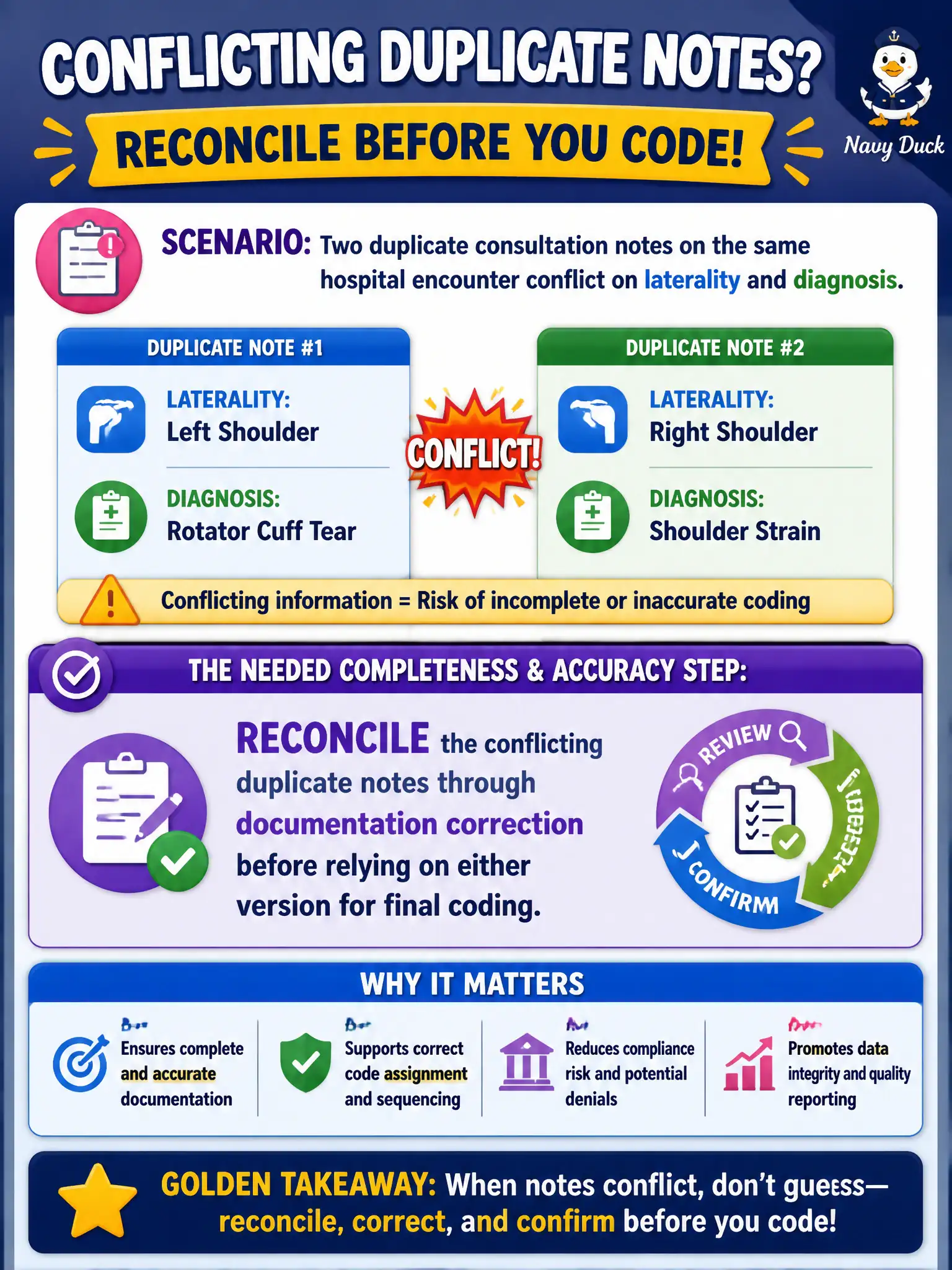
Two duplicate consultation notes on the same hospital encounter conflict on laterality and diagnosis. What completeness and accuracy step is needed?
Select an answer to reveal the explanation.
Short Explanation
Duplicate conflicting notes are two GPS routes that disagree — you do not drive both ways at once. Reconcile the conflict so the chart tells one accurate story, then code. Leaving both unreconciled just freezes the error in place.
Full Explanation
Two duplicate consultation notes on the same hospital encounter that conflict on laterality and diagnosis require reconciliation through documentation correction before either version can be relied on for final coding. The chart must tell one accurate clinical story. Averaging the two notes and coding a blended diagnosis invents a hybrid that neither consult fully supports. Keeping both conflicting notes permanently without reconciliation leaves an unresolved integrity defect that makes any code selection arbitrary. Always trusting the longer note regardless of clinical consistency substitutes word count for accuracy. Exam caveat: duplicate imports and copy-forward errors are common in EHRs—treat conflicts as completeness/accuracy deficiencies, not as a menu of optional truths. Operational check for civic HIM: flag the duplicate conflict, obtain provider correction or retraction of the erroneous version, and code laterality and diagnosis only after the record is reconciled. This discipline protects patients, supports accurate public reporting for municipal hospitals, and keeps the coded abstract defensible when auditors compare codes to the authenticated record. This discipline protects patients, supports accurate public reporting for municipal hospitals, and keeps the coded abstract defensible when auditors compare codes to the authenticated record.