
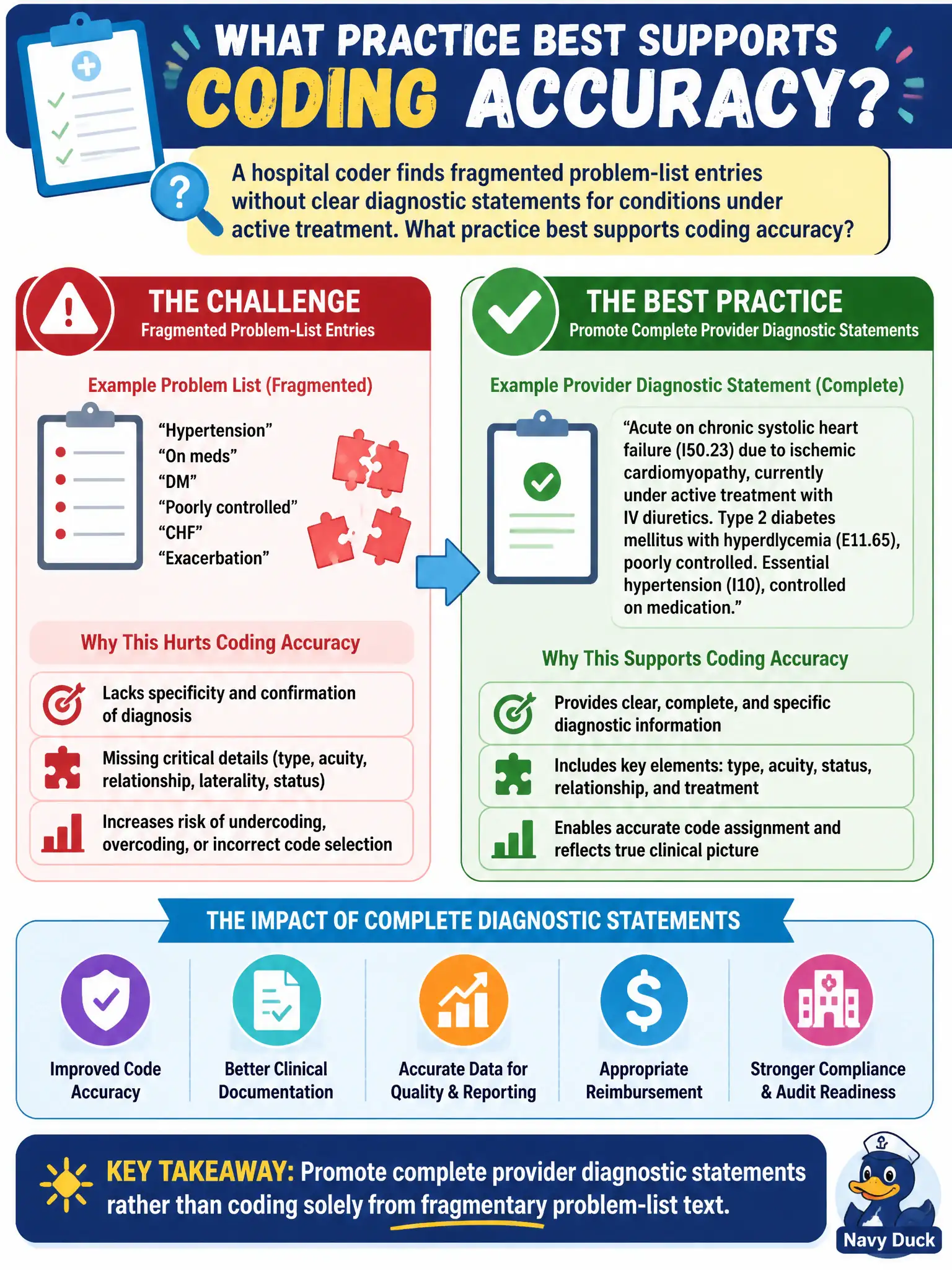
A hospital coder finds fragmented problem-list entries without clear diagnostic statements for conditions under active treatment. What practice best supports coding accuracy?
Select an answer to reveal the explanation.
Short Explanation
Fragment notes are puzzle pieces; a complete diagnostic statement is the finished picture. Coding accuracy improves when providers document clear diagnoses — not when you stretch a vague problem-list line into a code. Push for complete statements.
Full Explanation
When a hospital coder finds fragmented problem-list entries without clear diagnostic statements for conditions under active treatment, the practice that best supports coding accuracy is promoting complete provider diagnostic statements rather than coding solely from fragmentary problem-list text. Clear diagnoses in progress notes and discharge documentation are the reliable basis for ICD-10-CM assignment. Coding every problem-list string as a confirmed secondary diagnosis overreads fragments and copy-forward debris. Ignoring all diagnoses not written as ICD code numbers by the provider is incorrect; providers document clinically, and coders map to codes. Replacing clinical documentation with encoder suggestions alone abandons the legal record. Exam caveat: problem lists are clues and sometimes valid sources when they contain clear provider diagnoses, but fragments without diagnostic clarity should trigger clarification rather than automatic coding. Operational check in civic EHR environments: translate active treatment into a request for complete diagnostic statements, then code from authenticated clarity rather than shorthand problem-list tokens. This discipline protects patients, supports accurate public reporting for municipal hospitals, and keeps the coded abstract defensible when auditors compare codes to the authenticated record.