
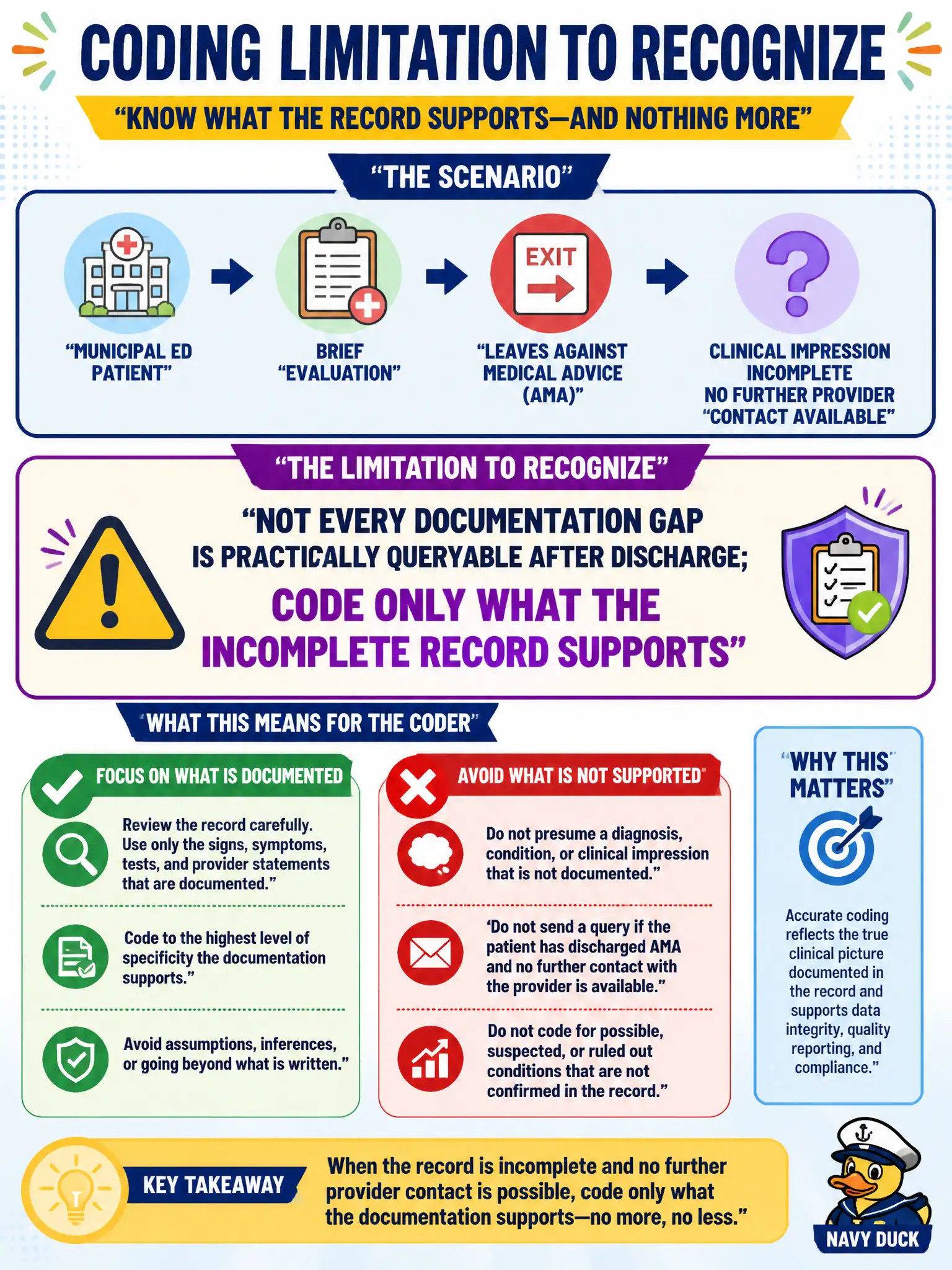
A municipal ED patient leaves against medical advice after a brief evaluation, and the clinical impression remains incomplete with no further provider contact available. What limitation should the coder recognize?
Select an answer to reveal the explanation.
Short Explanation
Queries need a reachable provider and enough clinical meat to ask a fair question. An AMA walk-out with a thin impression is often a documentation limit, not a puzzle you solve by guessing. Code what is there; do not manufacture specificity that never existed.
Full Explanation
A municipal ED patient who leaves against medical advice after a brief evaluation may leave an incomplete clinical impression with no further provider contact available. Coders should recognize that not every documentation gap is practically queryable after discharge; code only what the incomplete record supports. Inventing a principal diagnosis from the chief complaint triage note alone to force a specific code fabricates diagnostic certainty the provider never established. Holding the outpatient account indefinitely until the patient returns for a complete workup is usually operationally unrealistic and not a coding integrity requirement. Assigning the most severe related diagnosis so quality metrics look complete is fraudulent completion. Exam caveat: AMA and incomplete ED encounters still require coding of available documented conditions and reasons for visit within ethical limits—do not overreach. Operational check: abstract authenticated ED provider impressions and services rendered, omit unsupported specificity, and close per facility incomplete-encounter rules without inventing diagnoses. This discipline protects patients, supports accurate public reporting for municipal hospitals, and keeps the coded abstract defensible when auditors compare codes to the authenticated record.