
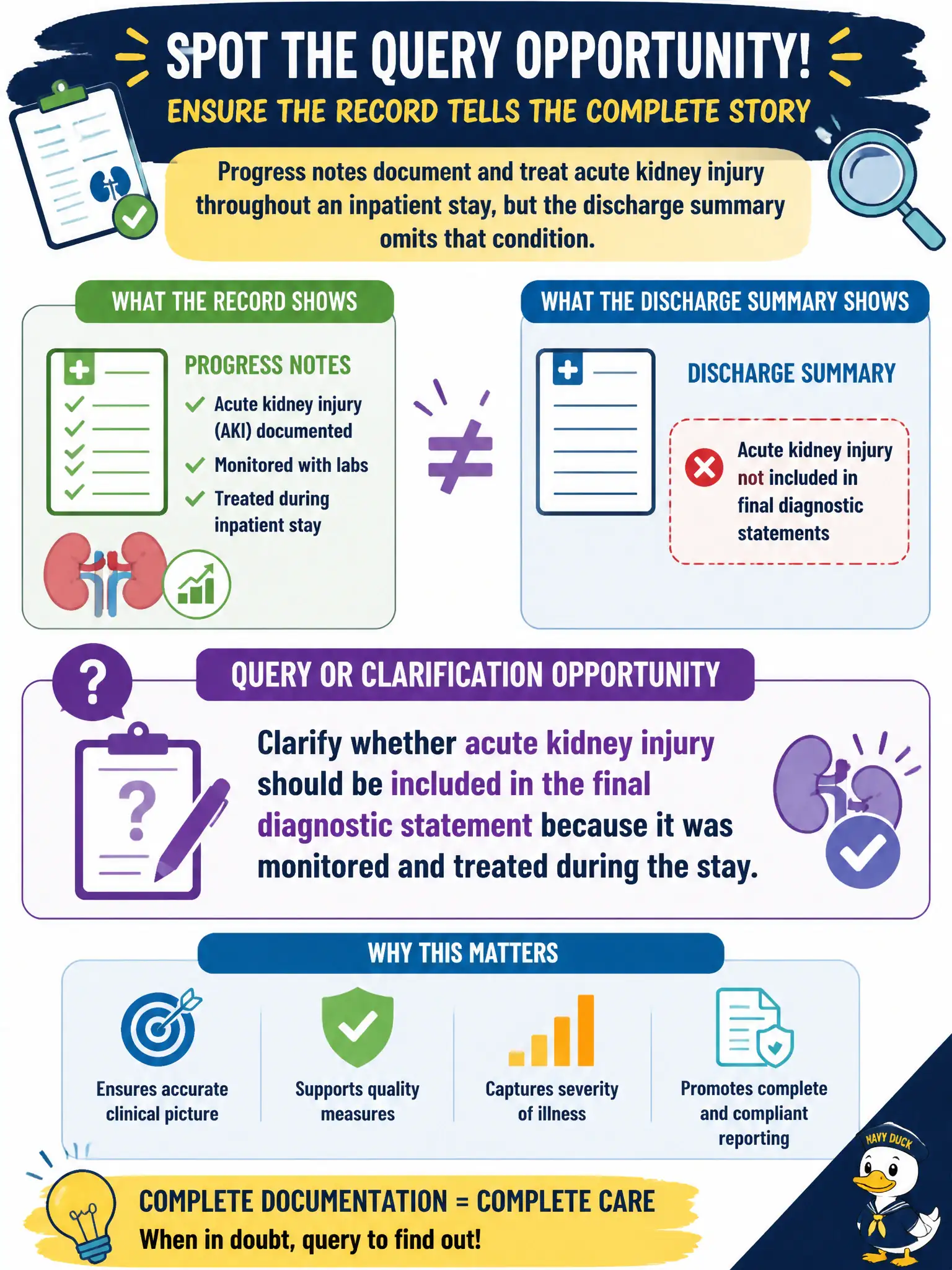
Progress notes document and treat acute kidney injury throughout an inpatient stay, but the discharge summary omits that condition. What query or clarification opportunity exists?
Select an answer to reveal the explanation.
Short Explanation
The discharge summary is the closing credits, but the movie already showed the subplot. If AKI was treated all stay and then vanishes from the final statement, that incompleteness is worth clarifying — not silently ignoring or auto-adding without process. Ask so the final list matches the care given.
Full Explanation
Progress notes that document and treat acute kidney injury throughout an inpatient stay while the discharge summary omits that condition create a clarification opportunity: clarify whether acute kidney injury should be included in the final diagnostic statement because it was monitored and treated during the stay. Coding only what appears on the discharge summary and discarding progress-note diagnoses can underreport clinically significant conditions that meet UHDDS criteria. Adding acute kidney injury without review because every abnormal creatinine must be coded skips validation and may report transient lab blips without diagnostic support. Removing all secondary diagnoses to keep the discharge summary as the sole source destroys required reporting rather than reconciling sources. Exam caveat: many facilities expect the discharge summary to reflect treated conditions; compliant queries help complete that statement without leading. Operational check in county medical stays: list AKI references and treatments across progress notes, compare to the discharge summary, and query inclusion when omission appears inconsistent with care provided. This discipline protects patients, supports accurate public reporting for municipal hospitals, and keeps the coded abstract defensible when auditors compare codes to the authenticated record.