
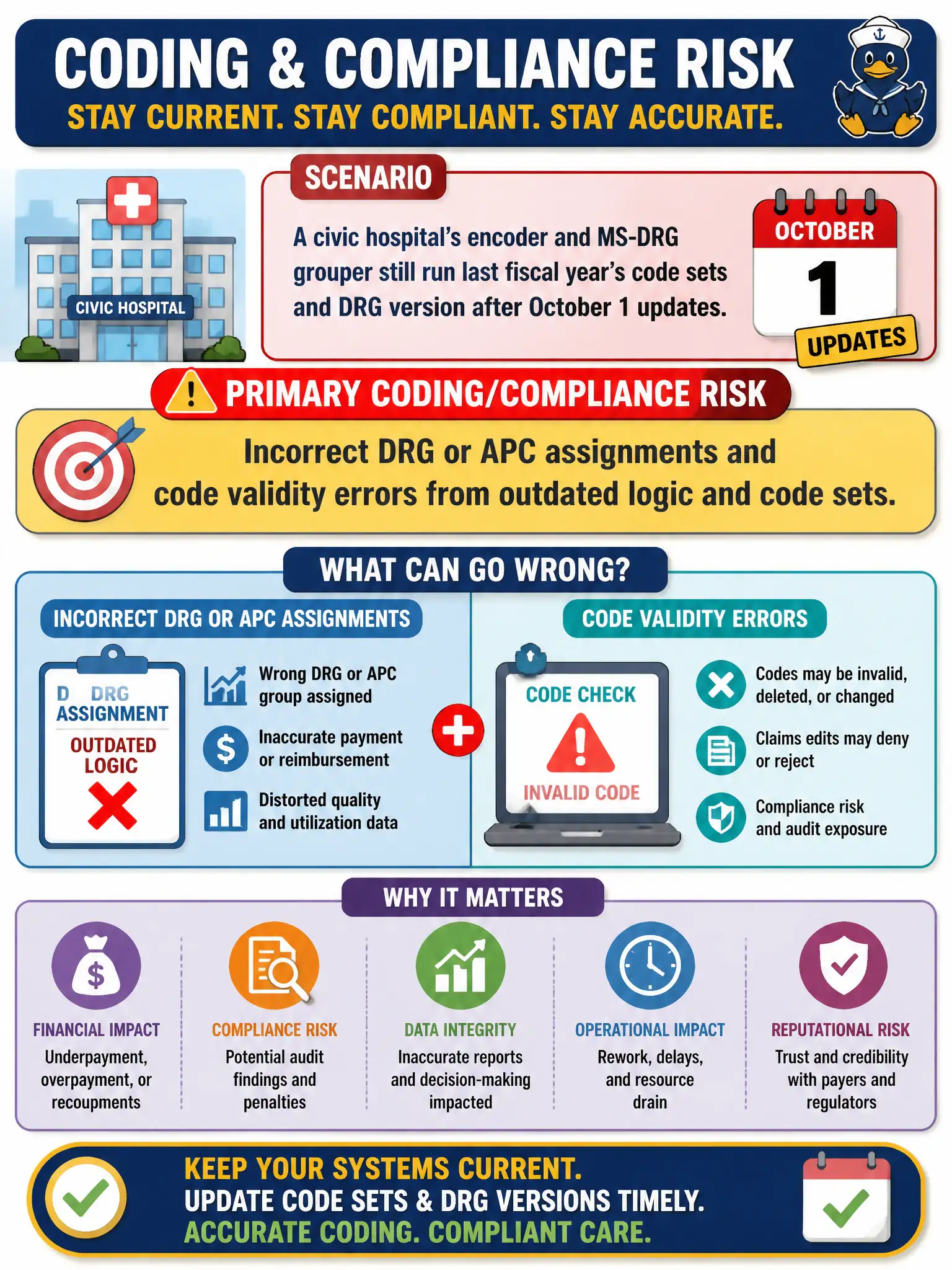
A civic hospital’s encoder and MS-DRG grouper still run last fiscal year’s code sets and DRG version after October 1 updates. What is the primary coding/compliance risk?
Select an answer to reveal the explanation.
Short Explanation
Coding tools have a calendar. If the grouper is still living in last year’s fiscal year, it’ll sort today’s cases with yesterday’s rules—and that’s how wrong DRGs sneak out the door.
Full Explanation
When a civic hospital's encoder and MS-DRG grouper still run last fiscal year's code sets and DRG version after October 1 updates, the primary coding and compliance risk is incorrect DRG or APC assignments and code validity errors from outdated logic and code sets. Public payment integrity depends on fiscal-year currency. Believing older groupers always pay higher and process faster is wishful and often false. Assuming an outdated encoder grants HIPAA Safe Harbor for stored PHI confuses tool versions with breach safe-harbor encryption. Claiming outdated tools eliminate the need for POA indicators invents a nonexistent waiver. Exam caveat: code set and grouper version alignment to the discharge/service fiscal rules is mandatory. Operational check: validate encoder/grouper version at fiscal year start, test sample claims for new codes and DRG logic, block production on stale versions, and document IT sign-off before coding continues under new rules. Treat encoders, groupers, and CAC as assistants inside civic HIM: useful for speed, never a substitute for documentation review, Official Guidelines, or PHI safeguards. Re-read the authenticated record before finalizing whenever tools, payers, or dashboards push a result the documentation does not support.