
After codes and required patient data are entered, which statement best describes the role of grouper software in hospital reimbursement classification?
Select an answer to reveal the explanation.
Short Explanation
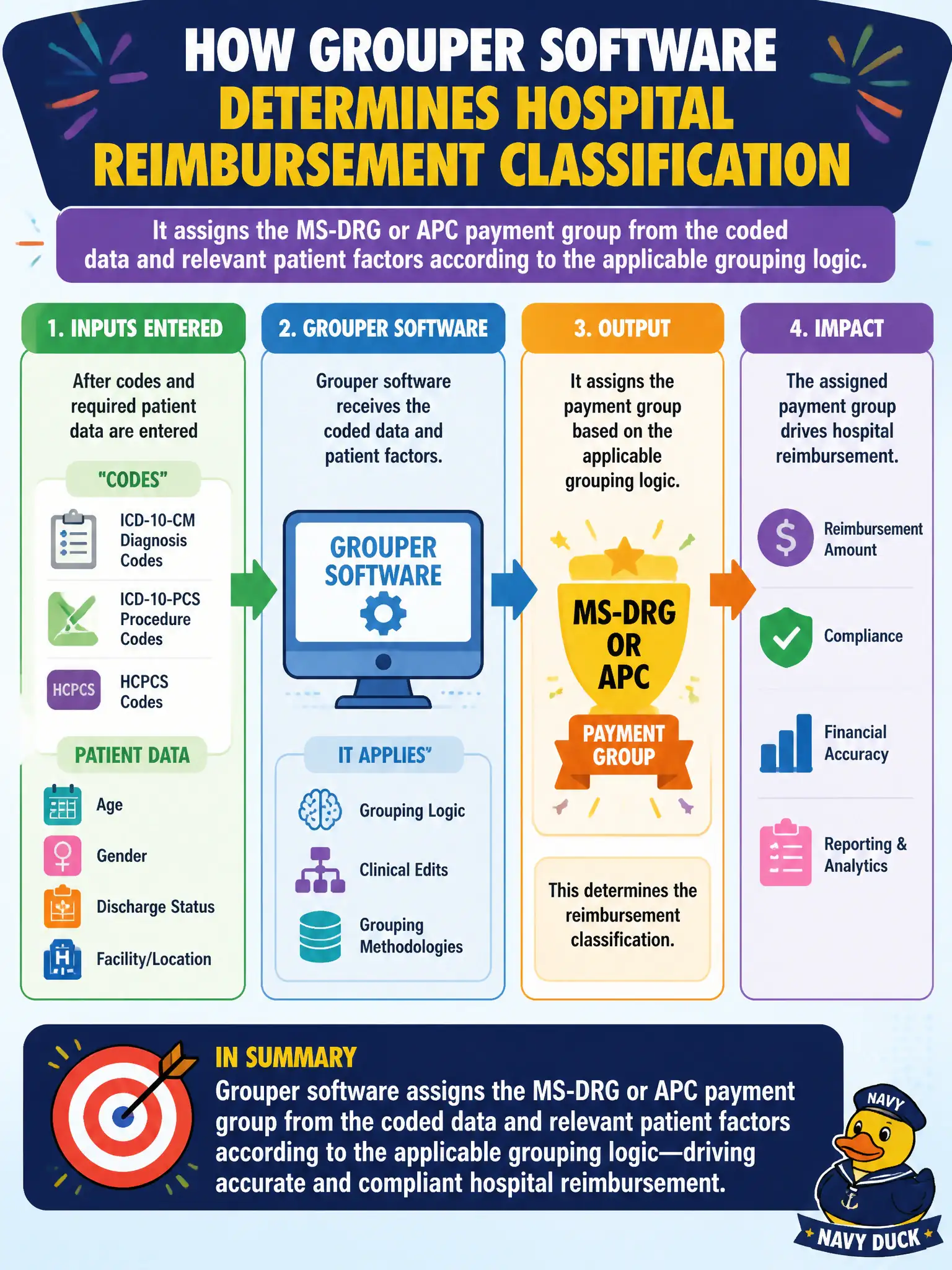
Once you’ve coded the case, the grouper is the sorting machine that drops it into an MS-DRG or APC bucket based on those codes and a few patient facts. It doesn’t rewrite the guidelines—it groups what you fed it.
Full Explanation
After codes and required patient data are entered, grouper software assigns the MS-DRG or APC payment group from the coded data and relevant patient factors according to applicable grouping logic. In civic revenue cycle, the grouper is a classification engine—not a substitute clinician or guideline author. Claiming it replaces ICD-10-CM Official Guidelines by inventing principal diagnoses from lab values alone misstates its role. Saying it encrypts PHI for HITECH safe harbor and does not affect payment grouping confuses security tools with reimbursement grouping. Limiting it to printing paper UB-04 forms without calculating DRG or APC assignments ignores modern grouping functions. Exam caveat: garbage-in codes produce garbage-out groups; the grouper does not heal bad coding. Operational check: complete accurate codes and POA/other required data before relying on final group, recalculate after coding changes, and investigate unexpected DRG/APC shifts against documentation rather than forcing codes to chase a group. Treat encoders, groupers, and CAC as assistants inside civic HIM: useful for speed, never a substitute for documentation review, Official Guidelines, or PHI safeguards. Re-read the authenticated record before finalizing whenever tools, payers, or dashboards push a result the documentation does not support.