
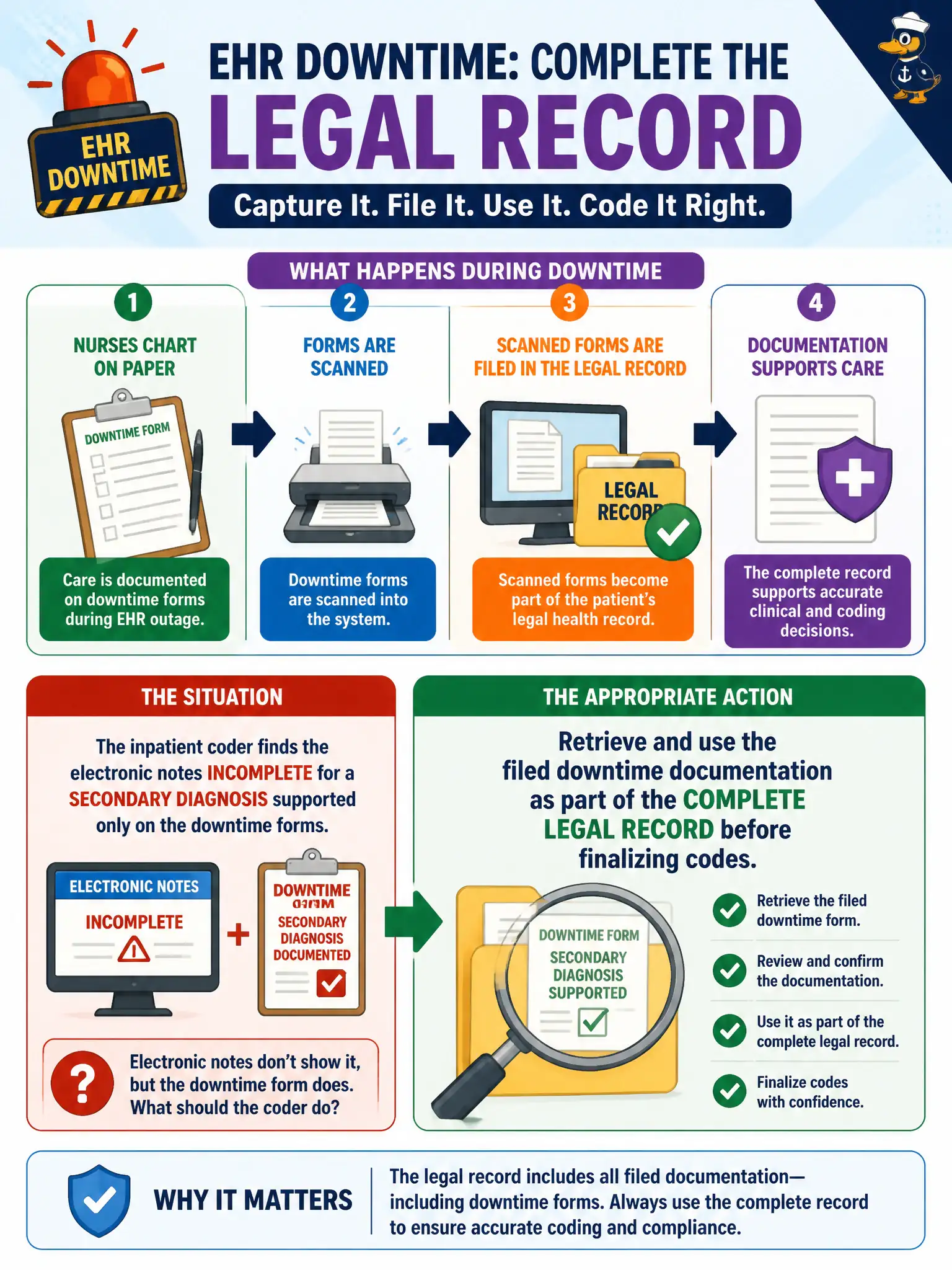
During an EHR downtime, nurses chart on paper; those forms are later scanned into the legal record. The inpatient coder finds the electronic notes incomplete for a secondary diagnosis supported only on the downtime forms. What is the appropriate action?
Select an answer to reveal the explanation.
Short Explanation
Downtime paper is still part of the story once it’s filed into the record—like chapters that got written by hand and then stuck back in the book. Pull those pages before you lock the codes.
Full Explanation
During EHR downtime at a municipal hospital, nurses chart on paper and those forms are later scanned into the legal record; if electronic notes are incomplete for a secondary diagnosis supported only on downtime forms, the coder must retrieve and use the filed downtime documentation as part of the complete legal record before finalizing codes. Civic continuity of documentation includes the paper chapters written when systems fail. Coding only native electronic notes and discarding downtime forms as scratch paper ignores filed legal content. Estimating the missing diagnosis from MS-DRG histories of similar patients invents clinical facts. Waiting indefinitely without coding because paper charting supposedly voids the encounter misstates downtime procedure. Exam caveat: filed downtime documentation is in-scope for coding once part of the legal record. Operational check: know downtime form locations and scan timelines, hold incomplete charts until forms file when policy requires, code from the combined electronic plus downtime content, and escalate missing scans to HIM operations. Treat encoders, groupers, and CAC as assistants inside civic HIM: useful for speed, never a substitute for documentation review, Official Guidelines, or PHI safeguards.