
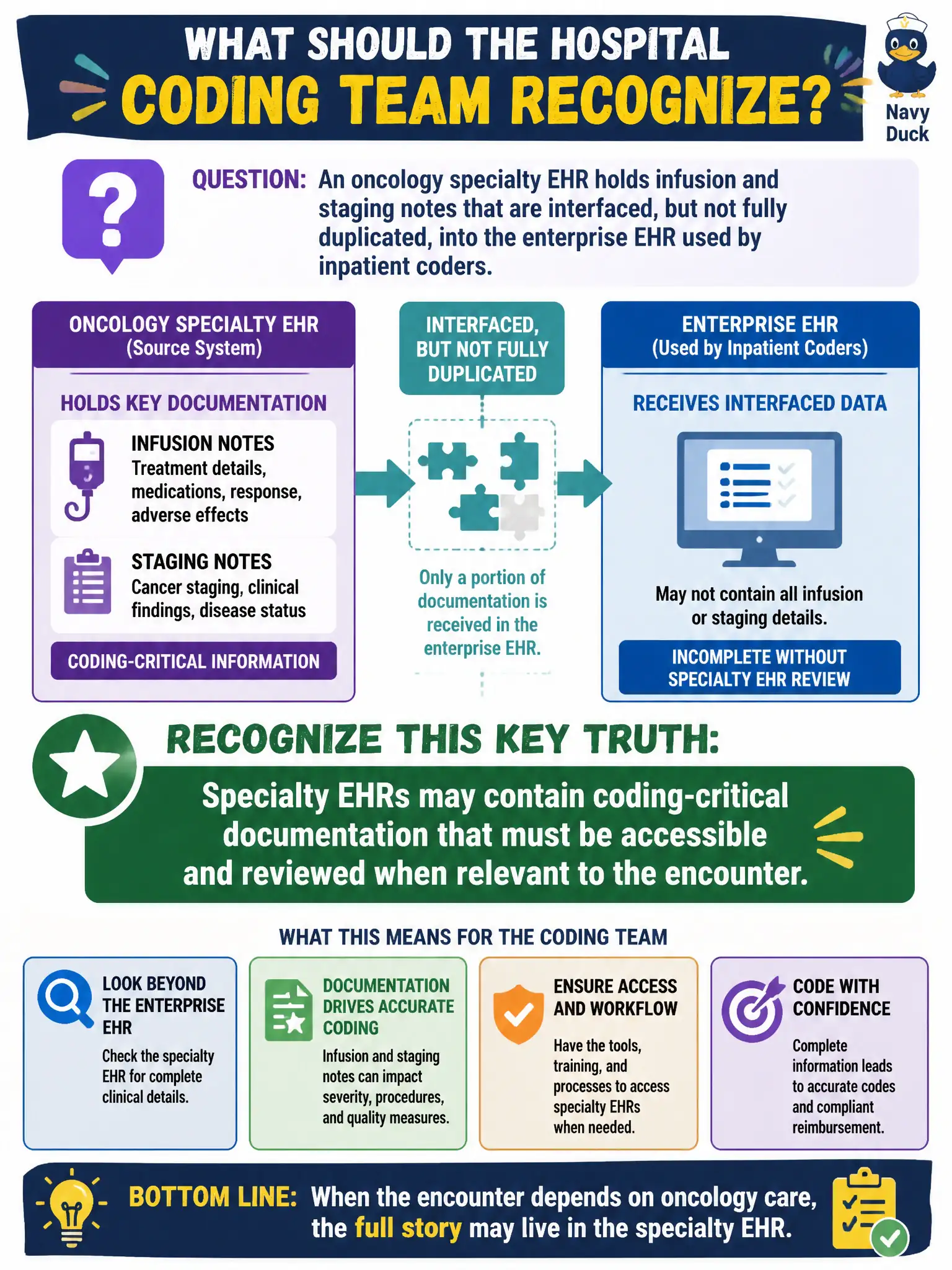
An oncology specialty EHR holds infusion and staging notes that are interfaced, but not fully duplicated, into the enterprise EHR used by inpatient coders. What should the hospital coding team recognize?
Select an answer to reveal the explanation.
Short Explanation
Picture a side office with the real chemo notes while the main hallway chart only has a short summary. If coding-critical detail lives in that specialty EHR, you still have to get to it—interfaces don’t mean “ignore the specialty system.”
Full Explanation
When an oncology specialty EHR holds infusion and staging notes that are interfaced but not fully duplicated into the enterprise EHR used by inpatient coders at a civic cancer program, the coding team must recognize that specialty EHRs may contain coding-critical documentation requiring access and review when relevant. Public oncology care often spans systems; missing specialty detail under-codes complexity of care. Ignoring specialty systems because only the enterprise summary screen is supposedly billable documentation risks incomplete abstracts. Claiming interfaced specialty notes never affect ICD-10-CM sequencing excuses skipping clinically decisive content. Treating oncology specialty systems as replacements for UHDDS abstracting rules conflates source systems with definitional standards. Exam caveat: if clinically relevant documentation lives in a specialty EHR, coders need a retrieval path. Operational check: maintain access or complete interface feeds for infusion/staging notes, require review when oncology inpatient coding depends on them, escalate incomplete interfaces, and keep UHDDS/guideline rules as the abstracting authority. Treat encoders, groupers, and CAC as assistants inside civic HIM: useful for speed, never a substitute for documentation review, Official Guidelines, or PHI safeguards.