
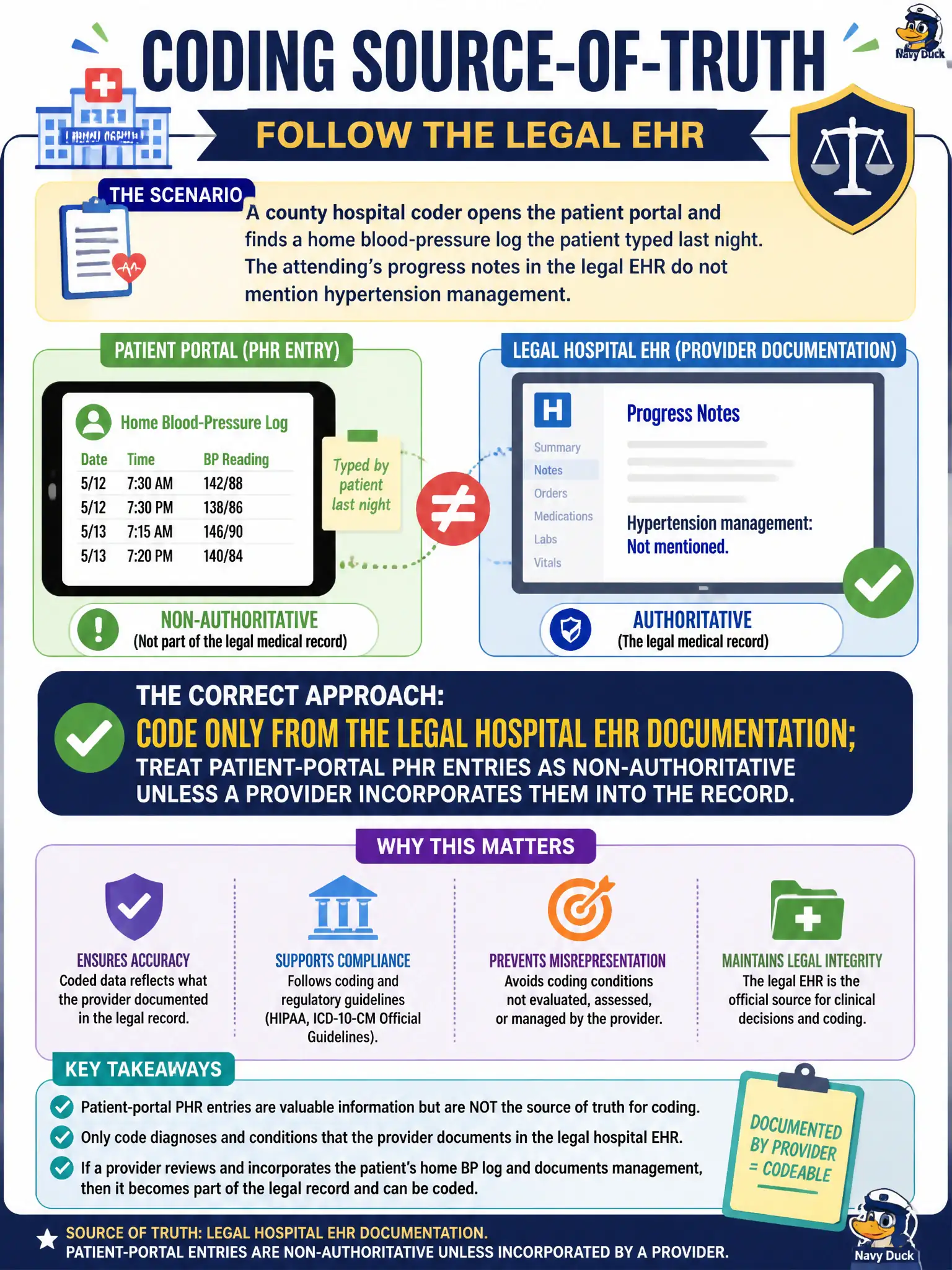
A county hospital coder opens the patient portal and finds a home blood-pressure log the patient typed last night. The attending’s progress notes in the legal EHR do not mention hypertension management. What is the correct coding source-of-truth approach?
Select an answer to reveal the explanation.
Short Explanation
Think of the portal like a sticky note the patient left on the fridge—helpful, but not the chart the hospital owns for coding. Coders stick to the legal EHR unless a provider pulls that portal info into the official record.
Full Explanation
When a county hospital coder finds a home blood-pressure log the patient typed into the portal overnight, but attending progress notes in the legal EHR never address hypertension management, coding must rely on the legal hospital EHR documentation; patient-portal PHR entries are non-authoritative unless a provider incorporates them into the record. Civic portals empower patients without quietly rewriting the legal chart. Automatically coding hypertension from the portal log because it sits in an official hospital system confuses patient-entered data with provider documentation. Deleting the portal entry to avoid audit confusion then coding from memory tampers with patient-generated data and invents unsupported codes. Copying portal readings onto the claim without physician review treats portals as equivalent to authenticated EHR documentation. Exam caveat: source-of-truth for facility coding is the legal medical record, not raw PHR entries. Operational check: code from provider notes and authenticated EHR content; if portal data appear clinically material but unaddressed, route a compliant query or CDI review; never bill from unincorporated patient entries alone. Treat encoders, groupers, and CAC as assistants inside civic HIM: useful for speed, never a substitute for documentation review, Official Guidelines, or PHI safeguards.