
Even in a largely electronic hospital, paper consents are scanned into the EHR. How should a facility coder view those scanned artifacts?
Select an answer to reveal the explanation.
Short Explanation
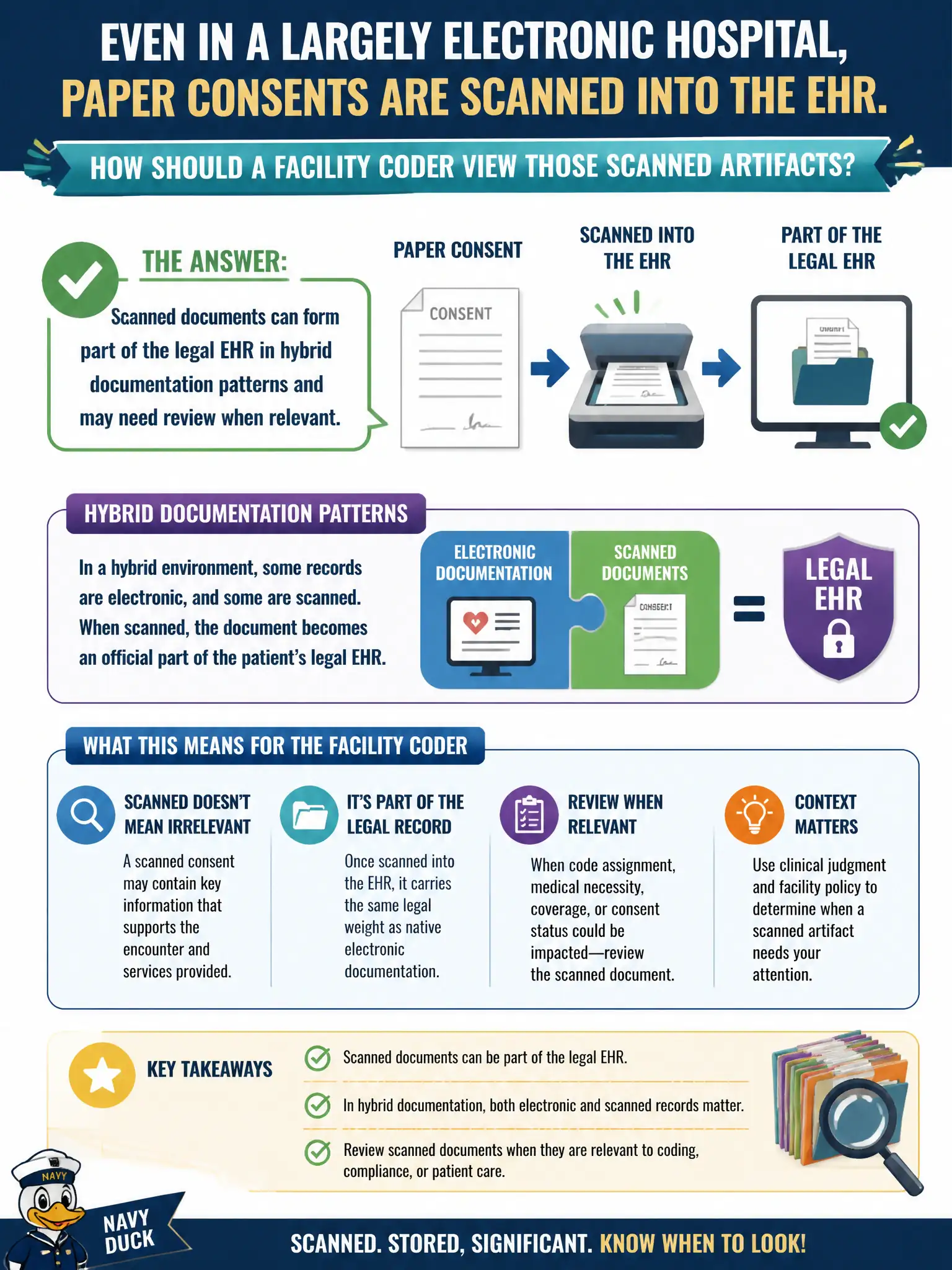
Scanning a consent into the EHR does not make it vanish—it often becomes part of the legal record in a hybrid pattern. Peek at those artifacts when they matter for the case. “Electronic hospital” can still mean paper that got digitized.
Full Explanation
Even in a largely electronic county hospital, paper consents scanned into the EHR can form part of the legal record in hybrid documentation patterns and may need review when relevant to coding or compliance questions. Civic legal EHRs often remain hybrid at the edges. Declaring scanned consents never part of the legal medical record ignores common hybrid policies. Claiming scanning converts the facility into a paper-only medical record reverses the direction of digitization. Ignoring scanned documents because only born-digital notes are supposedly codable risks missing authorization, operative, or clinical content filed as images. Exam caveat: if policy files scans into the legal EHR, coders may need to open them. Operational check: know which scan types are legal-record components, retrieve relevant consents or paper-origin notes before finalizing when material, and coordinate with HIM imaging quality when scans are illegible. Treat encoders, groupers, and CAC as assistants inside civic HIM: useful for speed, never a substitute for documentation review, Official Guidelines, or PHI safeguards. Re-read the authenticated record before finalizing whenever tools, payers, or dashboards push a result the documentation does not support.