
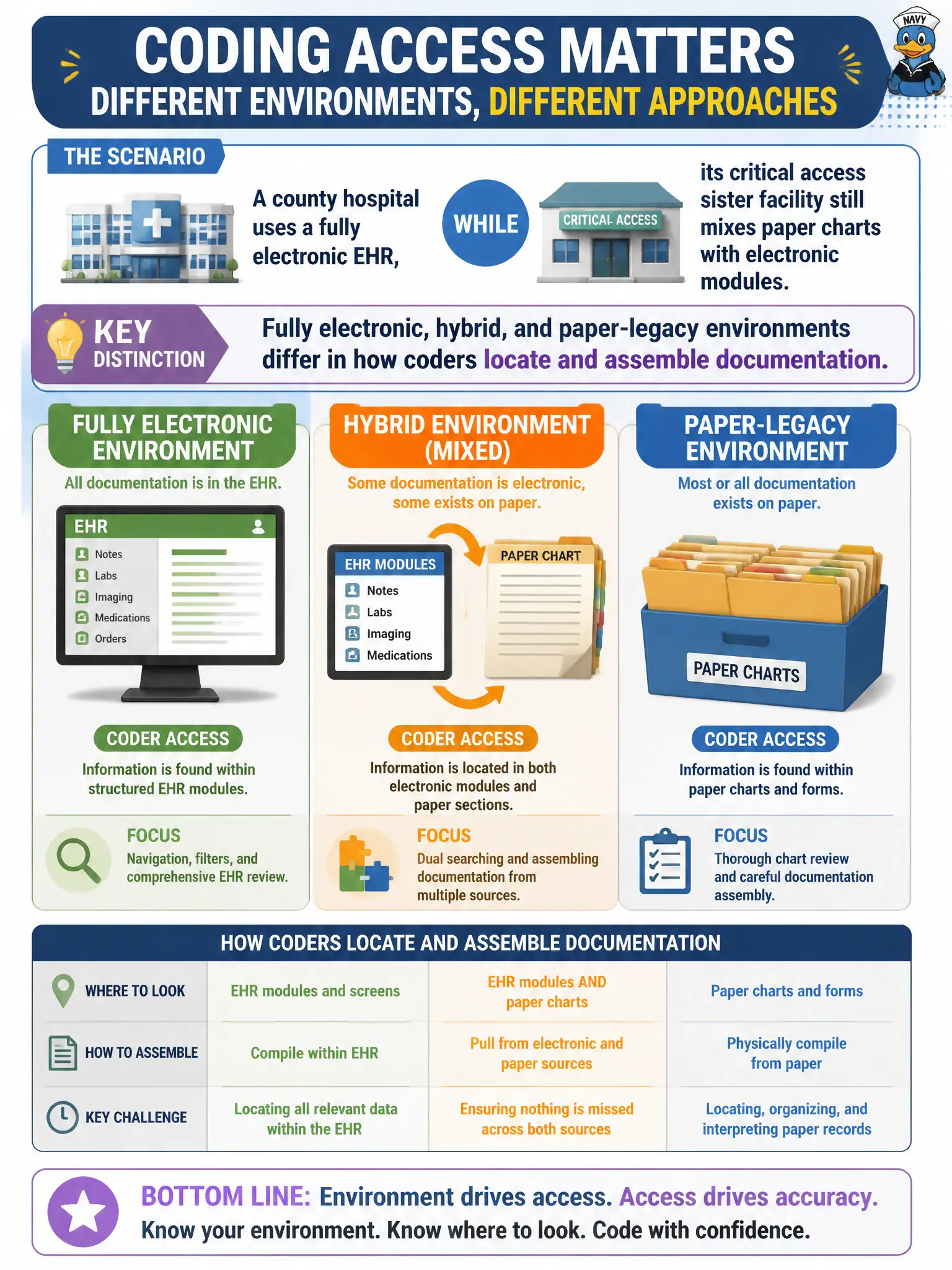
A county hospital uses a fully electronic EHR, while its critical access sister facility still mixes paper charts with electronic modules. For coding access, what distinction should the HIM professional recognize?
Select an answer to reveal the explanation.
Short Explanation
One campus is all-electronic; the sister site is still a paper-and-pixels mix. Coders need different treasure maps for each. Record type changes where you dig for the note—not whether coding still matters.
Full Explanation
A county hospital with a fully electronic EHR and a critical access sister facility that still mixes paper with electronic modules require different coder retrieval workflows: fully electronic, hybrid, and paper-legacy environments differ in how documentation is located and assembled. Civic systems often span uneven digitization; coders must know which treasure map applies on which campus. Treating hybrid and fully electronic records as identical for retrieval ignores paper and scan dependencies. Claiming paper-legacy sites never require coding because claims are manual only confuses claim submission method with the need for coded abstracts. Asserting fully electronic EHRs nationwide prohibit any scanned documents overgeneralizes—many legal EHRs still include scans. Exam caveat: record medium changes assembly workflow, not the duty to code from the complete legal record. Operational check: publish site-specific documentation maps, train float coders on hybrid retrieval, verify downtime/paper filing locations, and do not finalize until the complete record sources for that campus are reviewed. Treat encoders, groupers, and CAC as assistants inside civic HIM: useful for speed, never a substitute for documentation review, Official Guidelines, or PHI safeguards.