
A secondary diagnosis is correctly assigned POA = Y. Does that alone establish it as a CC or MCC?
Select an answer to reveal the explanation.
Short Explanation
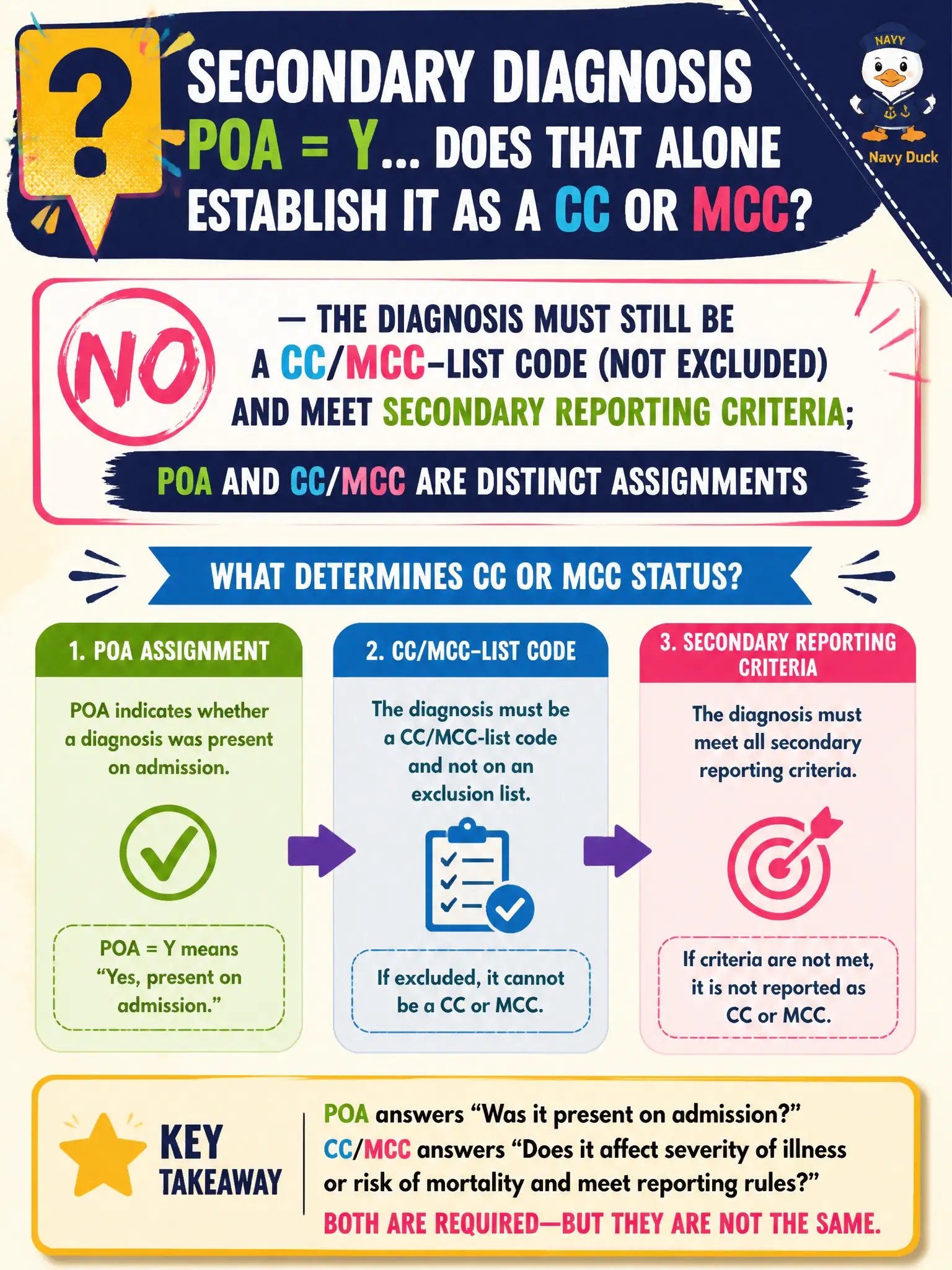
POA answers “was it already there?” CC/MCC answers “does this code move the DRG severity?” Getting POA right is critical for HAC and quality work, but it does not magically create a CC. You still need list logic and reporting criteria.
Full Explanation
A secondary diagnosis correctly assigned POA = Y does not alone establish it as a CC or MCC. The diagnosis must still be a CC/MCC-list code (not excluded) and meet secondary reporting criteria; POA and CC/MCC are distinct assignments. County quality and payment integrity programs must keep these concepts separate. Any POA Yes diagnosis is not automatically an MCC. POA assignment does not substitute for CMS CC/MCC list membership. POA Yes does not convert every secondary into a principal diagnosis. Exam caveat: POA answers “was it present on admission?”; CC/MCC answers “does this code affect severity tier under list logic?” Operational check: on municipal inpatient abstracts, assign POA from admission-period documentation, separately evaluate CC/MCC list and exclusions, and never treat POA = Y as a severity shortcut. Audit charts where staff confuse HAC/POA workflows with CC/MCC capture to prevent dual-concept errors in public reporting. In municipal and county facility practice, record the rationale for the chosen coding path and the rejected alternatives in the abstract notes so auditors and future coders understand the clinical and compliance basis. Re-check the decision if new authenticated documentation arrives before final bill drop, and escalate persistent documentation gaps to CDI or compliance rather than normalizing unsupported shortcuts that would distort civic claims, quality metrics, or case-mix reporting.