
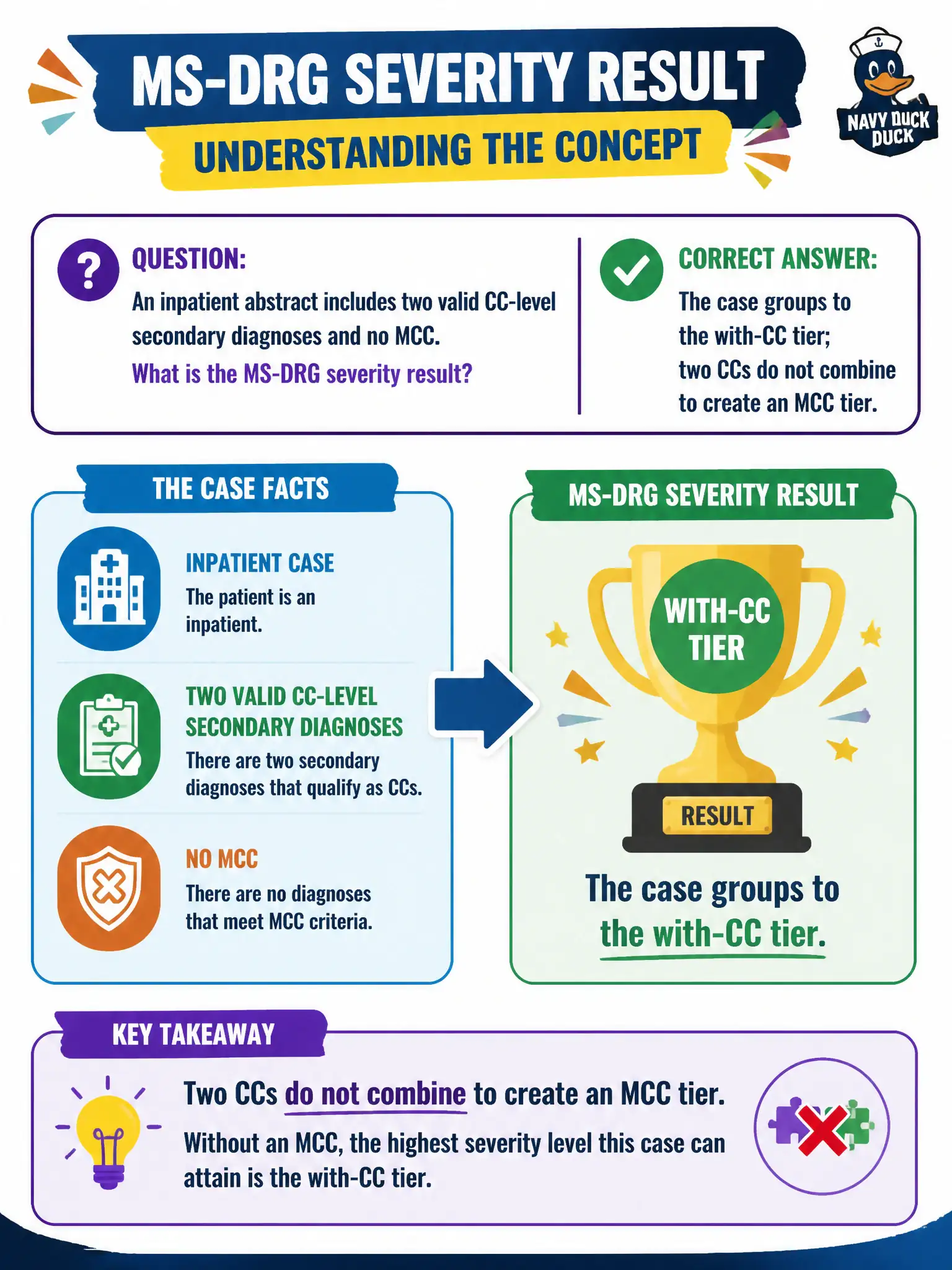
An inpatient abstract includes two valid CC-level secondary diagnoses and no MCC. What is the MS-DRG severity result?
Select an answer to reveal the explanation.
Short Explanation
CCs and MCCs are different shelves, not building blocks. Two CCs do not glue together into an MCC. Without a true MCC on the list for that case, you stay in the CC tier.
Full Explanation
When an inpatient abstract includes two valid CC-level secondary diagnoses and no MCC, the case groups to the with-CC tier; two CCs do not combine to create an MCC tier. Municipal coders must understand that severity tiers are categorical based on CMS lists, not additive CC arithmetic. Any two CCs do not automatically upgrade the case to with-MCC. Multiple CCs do not cancel each other and force a no-CC DRG. CC count does not replace principal diagnosis selection. Exam caveat: no CC/MCC, with CC, and with MCC are list-driven tiers—not sums of CC codes. Operational check: after grouping a county medical stay with multiple CCs, verify the Grouper shows the CC tier unless a true MCC is present; seek MCC-level specificity only when clinically supported; and educate finance partners that stacking CCs does not manufacture MCC payment. Audit misconceptions that “more CCs equal MCC.”. In municipal and county facility practice, record the rationale for the chosen coding path and the rejected alternatives in the abstract notes so auditors and future coders understand the clinical and compliance basis. Re-check the decision if new authenticated documentation arrives before final bill drop, and escalate persistent documentation gaps to CDI or compliance rather than normalizing unsupported shortcuts that would distort civic claims, quality metrics, or case-mix reporting.