
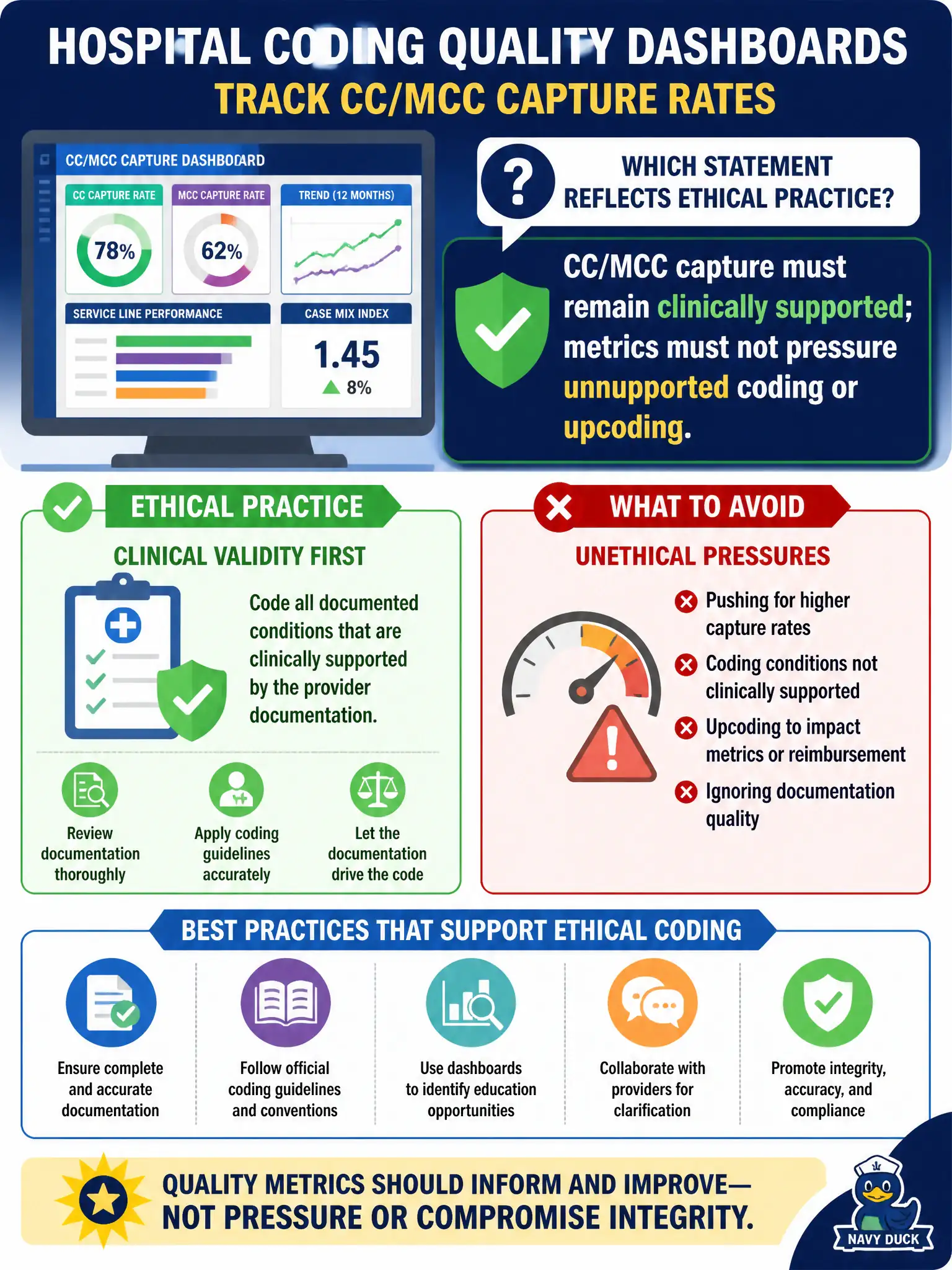
Hospital coding quality dashboards track CC/MCC capture rates. Which statement reflects ethical practice?
Select an answer to reveal the explanation.
Short Explanation
Dashboards are fine for spotting missed, well-documented CCs—but they are not a license to invent severity. If the chart does not support it, do not code it just to hit a percentage. Ethics beat the scoreboard.
Full Explanation
When hospital coding quality dashboards track CC/MCC capture rates, ethical practice requires that CC/MCC capture remain clinically supported and that metrics must not pressure unsupported coding or upcoding. Civic health-system leadership should treat capture rates as education signals, not targets that override Official Guidelines or AHIMA Standards of Ethical Coding. Adding unsupported CC/MCC codes whenever the capture rate falls below target fails ethical and compliance standards. Capture-rate targets do not legally override Official Coding Guidelines. Ethical Standards of Coding do apply to severity capture metrics. Exam caveat: metrics may monitor opportunity; they must never drive fabricated secondary diagnoses. Operational check: pair county CC/MCC dashboards with documentation and query audits, investigate low capture for missed supported conditions, refuse directives to code unsupported severity, and report ethical concerns through compliance channels. Celebrate compliant specificity gains, not rate-at-any-cost behavior, in public hospital quality forums. In municipal and county facility practice, record the rationale for the chosen coding path and the rejected alternatives in the abstract notes so auditors and future coders understand the clinical and compliance basis. Re-check the decision if new authenticated documentation arrives before final bill drop, and escalate persistent documentation gaps to CDI or compliance rather than normalizing unsupported shortcuts that would distort civic claims, quality metrics, or case-mix reporting.