
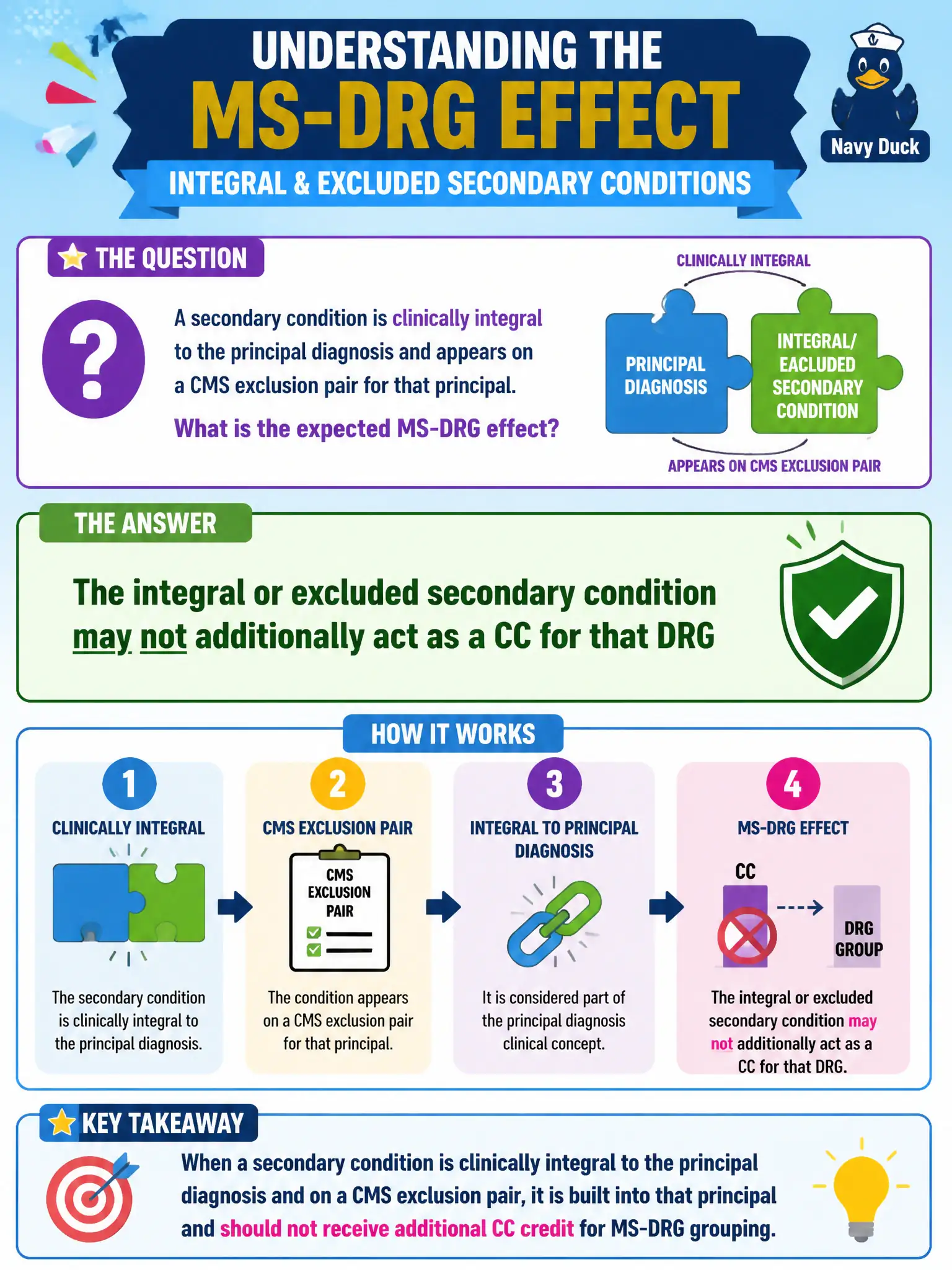
A secondary condition is clinically integral to the principal diagnosis and appears on a CMS exclusion pair for that principal. What is the expected MS-DRG effect?
Select an answer to reveal the explanation.
Short Explanation
If a finding is basically baked into the principal diagnosis—or CMS excludes that pair—you do not get a free CC bump from restating it. Severity lists have exclusion logic for a reason.
Full Explanation
When a secondary condition is clinically integral to the principal diagnosis and appears on a CMS exclusion pair for that principal, the expected MS-DRG effect is that the integral or excluded secondary may not additionally act as a CC for that DRG. Public hospital grouping must respect exclusion logic rather than stacking integral findings for severity. Integral secondaries do not always stack as MCCs on top of the principal. Exclusion logic is not limited to outpatient APCs; it is an inpatient MS-DRG CC/MCC concept. Coders must not report the integral condition as a separate principal diagnosis merely to preserve severity. Exam caveat: understand CC/MCC exclusions for integral conditions tied to the principal diagnosis. Operational check: after tentative coding at the municipal facility, review Grouper exclusion messages, confirm the secondary remains reportable when clinically appropriate for data quality even if it does not elevate tier, and educate that non-payment of a CC tier does not mean the diagnosis was wrongly coded. Do not create dual principals to bypass exclusions. In municipal and county facility practice, record the rationale for the chosen coding path and the rejected alternatives in the abstract notes so auditors and future coders understand the clinical and compliance basis. Re-check the decision if new authenticated documentation arrives before final bill drop, and escalate persistent documentation gaps to CDI or compliance rather than normalizing unsupported shortcuts that would distort civic claims, quality metrics, or case-mix reporting.