
Why must a hospital inpatient coder abstract discharge disposition accurately from the discharge record?
Select an answer to reveal the explanation.
Short Explanation
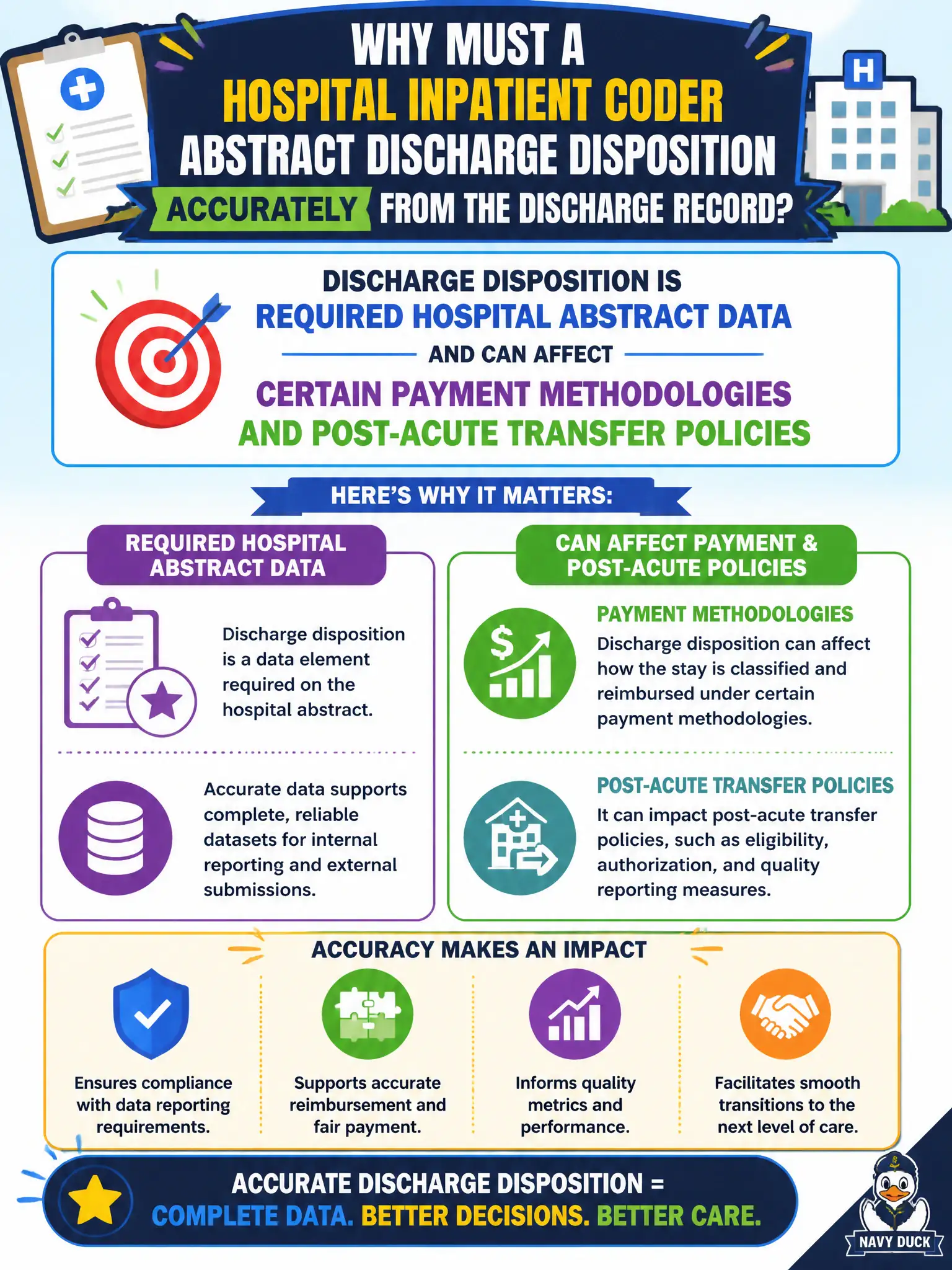
Where the patient goes next—home, SNF, transfer—is not just a nice-to-have checkbox. Disposition rides with the abstract and can change how some payments and transfer rules work. Pull it from the discharge record, not from a guess.
Full Explanation
A hospital inpatient coder must abstract discharge disposition accurately from the discharge record because discharge disposition is required hospital abstract data and can affect certain payment methodologies and post-acute transfer policies. Public hospitals rely on accurate disposition for UB reporting, quality metrics, and IPPS transfer-related payment adjustments that matter to civic budgets. Disposition codes do not replace principal diagnosis selection under UHDDS definitions. Disposition is not used only for professional-fee place-of-service; it is relevant for facility claims and abstracts. Disposition is not optional whenever the MS-DRG weight is already high—reporting completeness does not vary with weight. Exam caveat: disposition is mandatory abstract data with payment and reporting implications, separate from principal diagnosis. Operational check: reconcile disposition from the physician discharge order or summary and case management documentation at the civic facility, correct home-versus-SNF or acute-transfer mismatches before final abstract, and coordinate with utilization review when transfer payment policies may apply. Sample disposition accuracy in coding quality audits for reliable public reporting.