
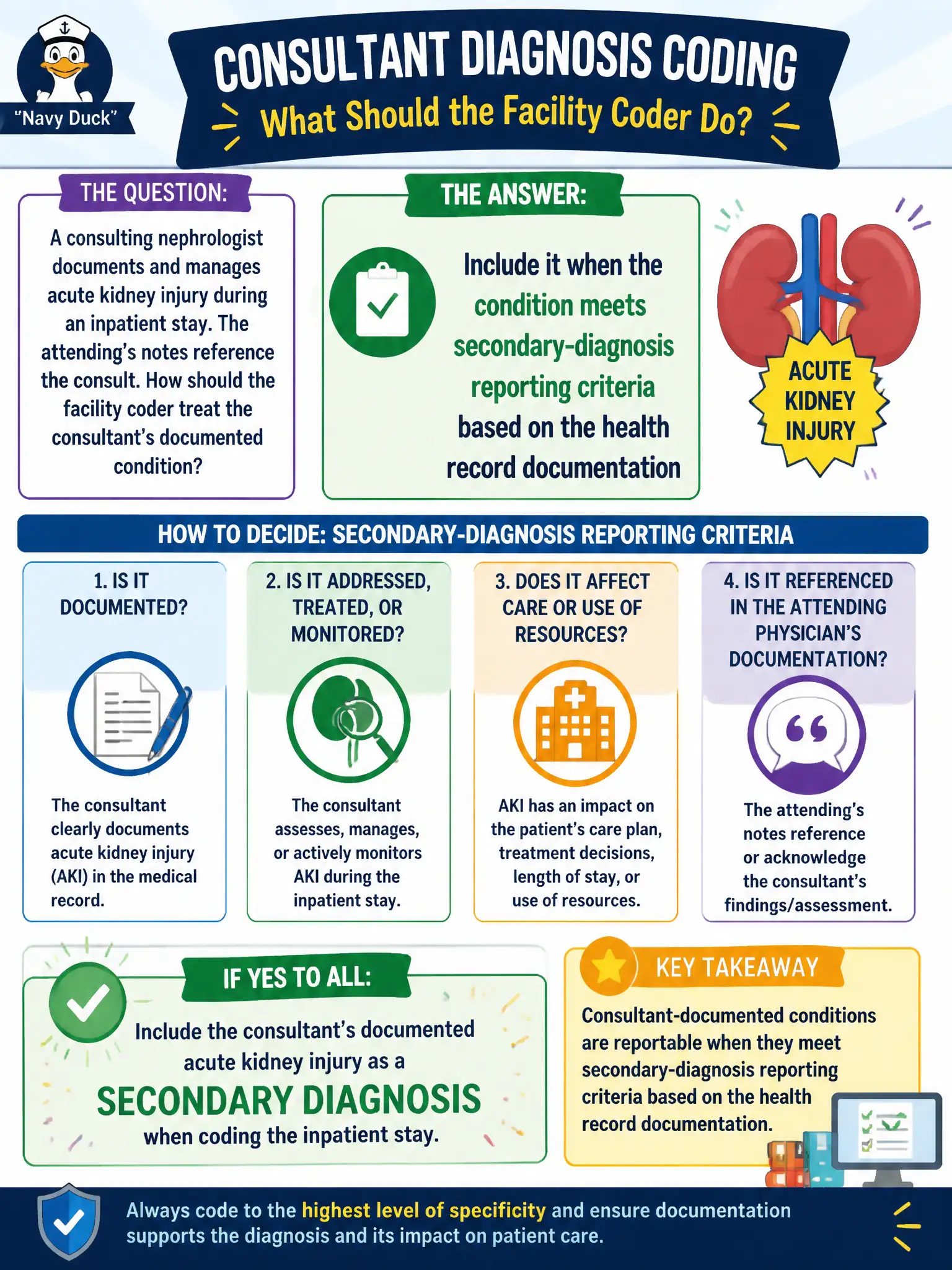
A consulting nephrologist documents and manages acute kidney injury during an inpatient stay. The attending’s notes reference the consult. How should the facility coder treat the consultant’s documented condition?
Select an answer to reveal the explanation.
Short Explanation
Consult notes are part of the hospital record story. If the consultant documents a condition that was evaluated or treated this stay and it meets reporting rules, it belongs in the abstract. You do not need the consultant’s office bill to make that call.
Full Explanation
When a consulting nephrologist documents and manages acute kidney injury during an inpatient stay and the attending’s notes reference the consult, the facility coder should include the condition when it meets secondary-diagnosis reporting criteria based on the health record. Civic inpatient abstracts may use consultant documentation that demonstrates evaluation, treatment, monitoring, or other clinical significance for the encounter. Never coding consultant documentation because only the attending’s problem list counts fails; consultants can establish reportable conditions for the facility stay. Coding it only if it appears on the professional claim for the consultant fails because facility coding is independent of whether a professional claim line exists. Coding it automatically as the principal diagnosis for every medical MS-DRG fails sequencing rules—consultant conditions are often secondary, not automatically principal. Exam caveat: secondary reporting criteria matter more than who wrote the note; consultant notes are valid sources when criteria are met. Operational check: review consult and attending documentation in the county chart, confirm UHDDS-like secondary criteria, assign POA appropriately, and do not ignore clinically managed AKI solely because a consultant authored it. Query if attending integration is unclear under facility policy.