
A hospital coder reviews an inpatient admission for MS-DRG assignment. Which record source is most useful for abstracting chronic conditions documented as present on admission and comorbid history?
Select an answer to reveal the explanation.
Short Explanation
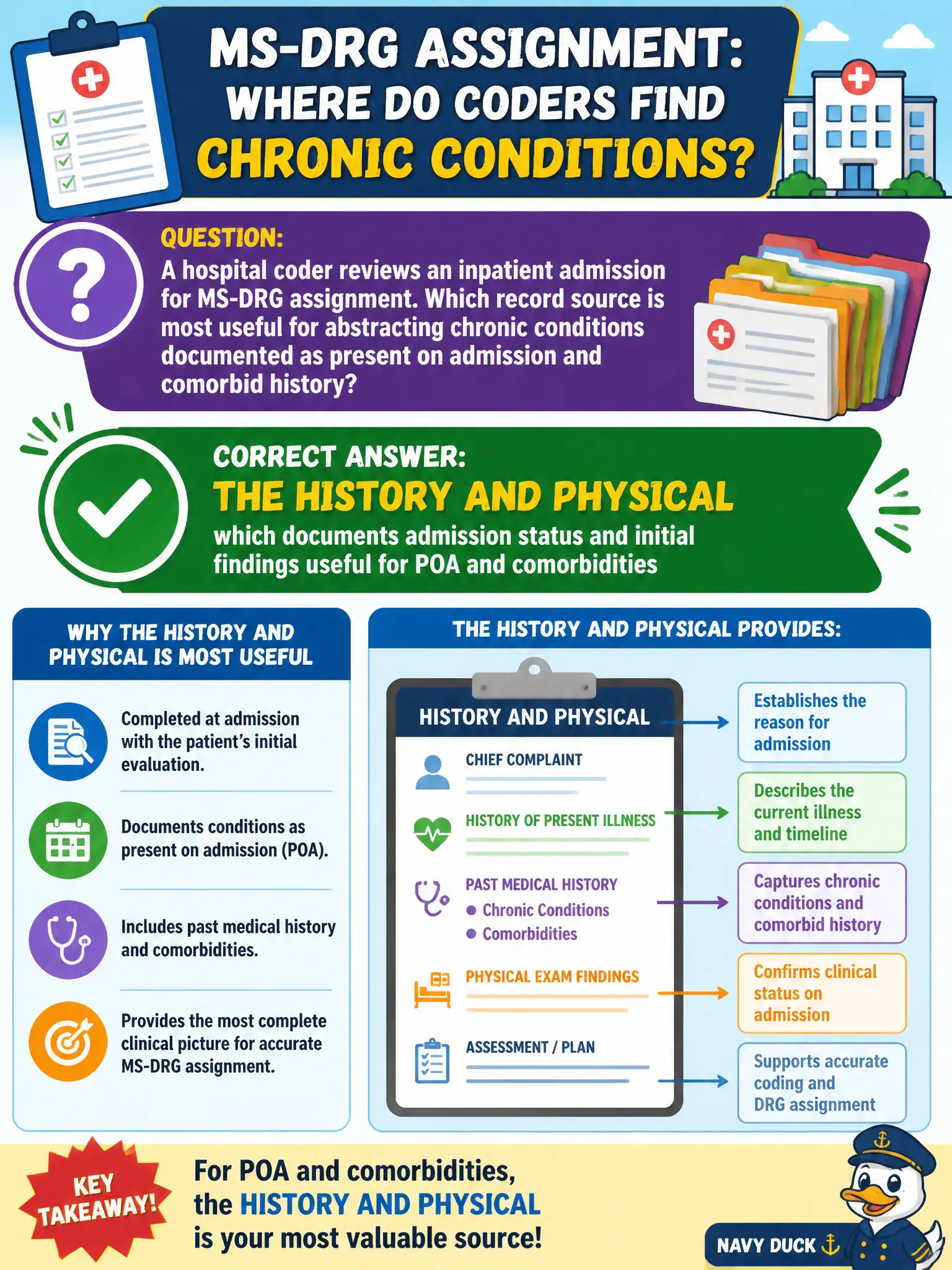
Think of the H&P as the admission snapshot—what was already going on when the patient walked in. Those chronic problems and findings there are gold for POA and comorbidity capture. Later notes add the stay story, but the H&P anchors what was present from day one.
Full Explanation
When reviewing an inpatient admission for MS-DRG assignment, the history and physical is especially useful for abstracting chronic conditions documented as present on admission and comorbid history because it commonly captures admission status and initial findings. County inpatient coders use the H&P with the rest of the record to support POA and comorbidity accuracy for civic reporting. Using only the final coded claim after grouper output fails because POA and comorbidities must be abstracted from clinical documentation, not invented downstream from payment output. The charge master alone fails because billed supplies are not comorbidities. Professional-fee superbills from office visits months after discharge fail as the primary source for the current inpatient POA and comorbidity abstraction. Exam caveat: clinical admission documentation drives POA/comorbidity abstraction; claims and charges do not replace it. Operational check: start municipal inpatient abstraction with the H&P for known chronic conditions and POA clues, corroborate across progress notes and discharge documentation, assign POA carefully, and never backfill comorbidities from chargemaster lines or post-discharge office superbills.