
Why must inpatient coders accurately report operating room procedures that meet coding guidelines?
Select an answer to reveal the explanation.
Short Explanation
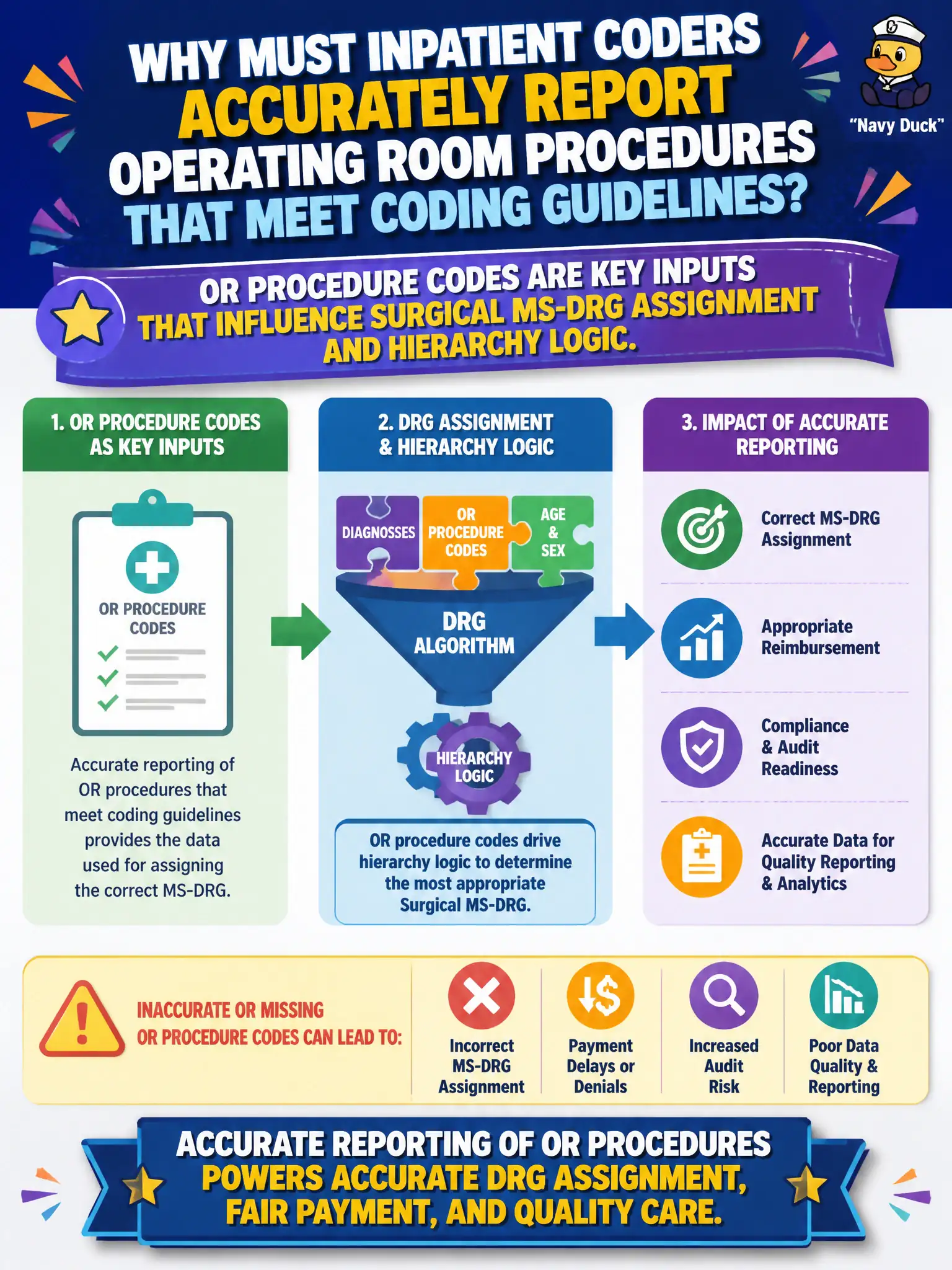
The Grouper cares a lot about what happened in the OR—those procedure codes help steer surgical DRGs. Skip or miscode them and the inpatient payment story can go sideways. They’re not just for the surgeon’s bill.
Full Explanation
Inpatient coders must accurately report operating room procedures that meet coding guidelines because OR procedure codes are key inputs that influence surgical MS-DRG assignment and hierarchy logic when multiple procedures are present. Facility stewardship at a civic hospital means PCS accuracy shapes surgical grouping and public payment fairness for county surgical services. OR procedures are not ignored by the MS-DRG Grouper or reserved only for nursing acuity scoring. They are not limited to professional fee billing; they are central to facility DRG assignment under IPPS. They are not required solely for outpatient APC packaging decisions on inpatient claims—APC packaging is an outpatient concept that does not replace inpatient procedure grouping. Exam caveat: surgical DRG families depend on procedure coding plus diagnoses; do not treat OR codes as optional for facility IPPS. Operational check: abstract ICD-10-PCS from the operative report for county inpatient surgeries, validate root operation, body part, approach, and device, review surgical hierarchy outcomes when multiple OR procedures exist, and correct missing or incorrect PCS before final grouping. Audit procedure-code completeness as part of civic coding quality metrics, not as a professional-billing afterthought, and reconcile hierarchy surprises against the documented operative narrative.