
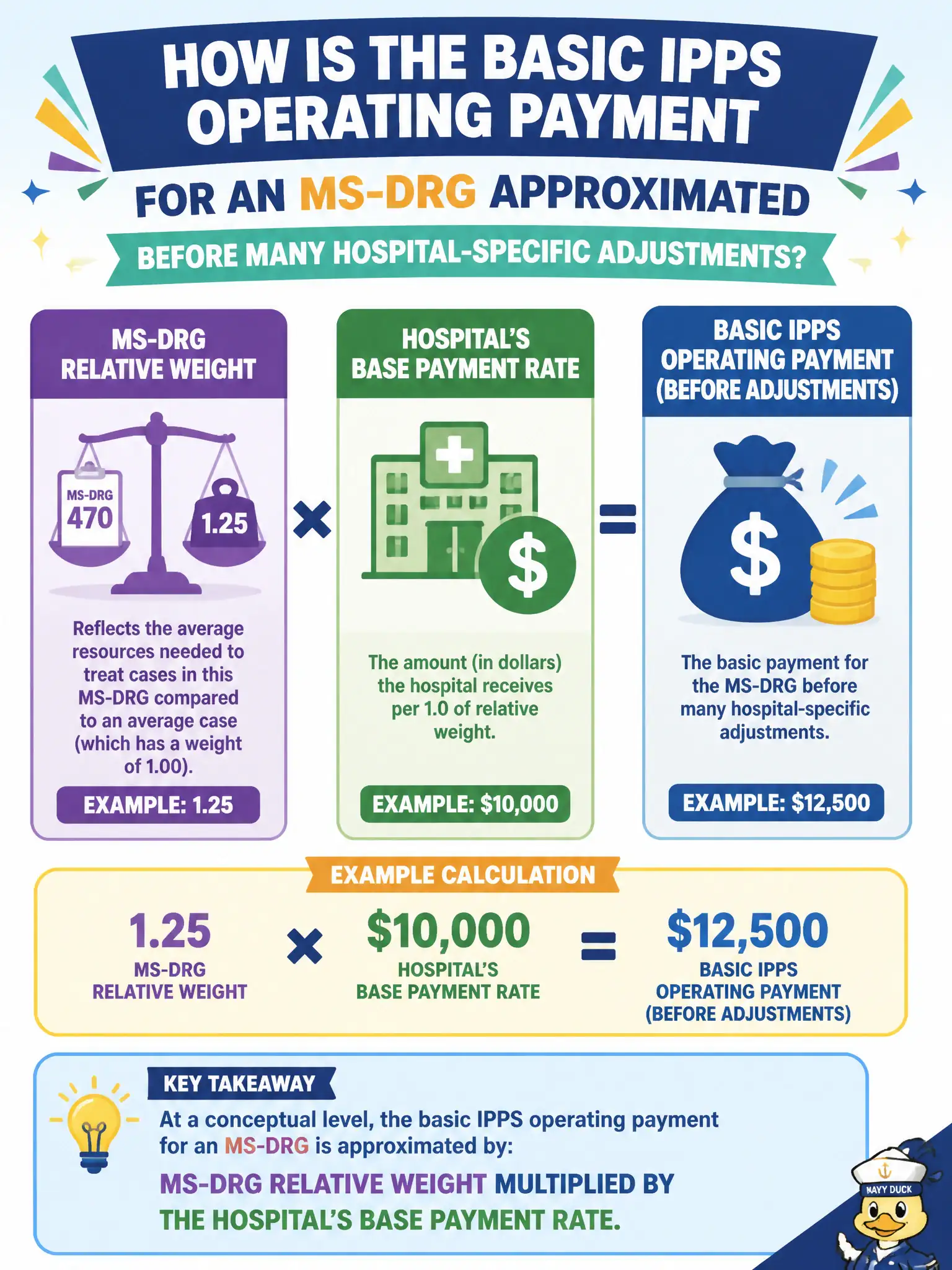
At a conceptual level, how is the basic IPPS operating payment for an MS-DRG approximated before many hospital-specific adjustments?
Select an answer to reveal the explanation.
Short Explanation
Picture the DRG relative weight as a “complexity multiplier” and the hospital rate as the price tag. Multiply them and you’ve got the basic operating payment sketch—before wage index and other add-ons pile on. It’s weight times rate, not charges times coinsurance.
Full Explanation
At a conceptual level, the basic IPPS operating payment for an MS-DRG is approximated as MS-DRG relative weight multiplied by the hospital’s base payment rate, before many hospital-specific adjustments such as wage index, IME, DSH, outliers, and transfer policies. Public hospital finance and coding teams share this model so civic payment expectations stay grounded. Multiplying total charges by the patient’s coinsurance percentage fails as a description of the base prospective DRG operating payment. Multiplying length of stay by a flat per diem with no relative weight fails because IPPS is not a simple per-diem system for the base operating DRG. Multiplying the number of CC/MCC codes by a fixed national dollar amount fails because severity influences which DRG (and weight) is assigned; it is not a separate per-code dollar formula for the base payment. Exam caveat: know weight × base rate as the simplified IPPS construct and keep adjustments conceptually separate. Operational check: when explaining payment variance on a county inpatient account, start from relative weight and base rate, then layer documented adjustments, and tie coding quality to the weight through accurate DRG assignment rather than charge totals or CC counts as dollar multipliers.