
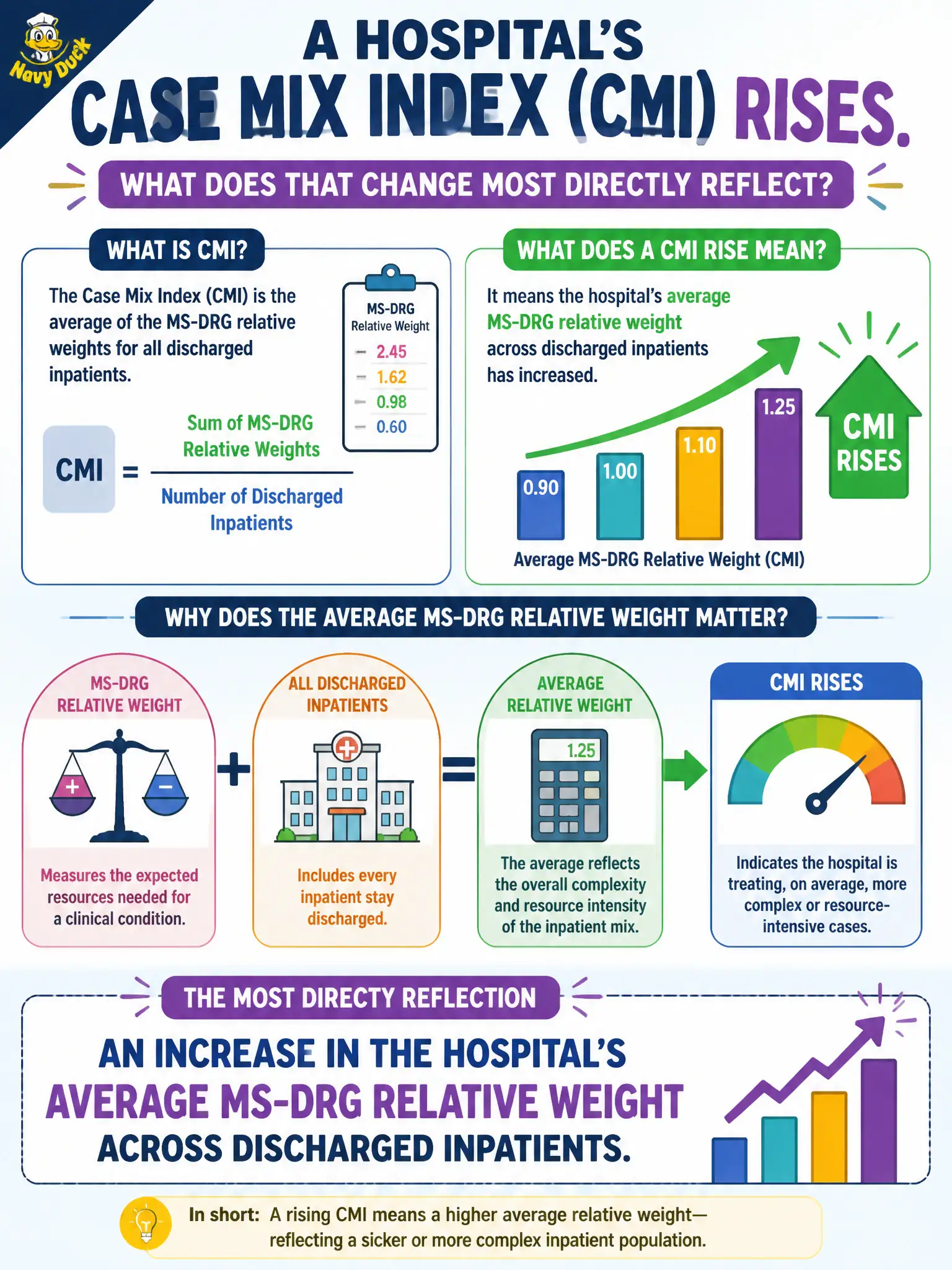
A hospital’s case mix index (CMI) rises. What does that change most directly reflect?
Select an answer to reveal the explanation.
Short Explanation
CMI is basically the hospital’s average “how sick/complex were our inpatients” score based on DRG weights. When that average weight goes up, CMI goes up. Complete, honest coding can move it—upcoding without support cannot.
Full Explanation
A rise in a hospital’s case mix index most directly reflects an increase in the average MS-DRG relative weight across discharged inpatients. For a public or county hospital, CMI is a summary of inpatient complexity as coded and grouped—not a mandate about staffing or a license to code without documentation. Attributing CMI rise solely to more outpatient APC claims fails because CMI is an inpatient relative-weight average, not an outpatient volume metric. Linking CMI change to a mandatory reduction in nursing staffing ratios fails because staffing decisions are operational and regulatory matters separate from the CMI calculation. Assuming CMI rise means automatic approval of all secondary CC/MCC codes without documentation fails ethically and technically; unsupported CC/MCC coding is improper regardless of CMI goals. Exam caveat: define CMI as average inpatient MS-DRG weight and separate it from outpatient volume, staffing policy, and noncompliant coding shortcuts. Operational check: when municipal leadership reviews CMI trends, coding and CDI should explain documentation-driven severity capture, audit CC/MCC support, and reject pressure to inflate weights. Publish transparent metrics showing compliant query and coding practices so civic accountability for case mix remains aligned with clinical truth.