
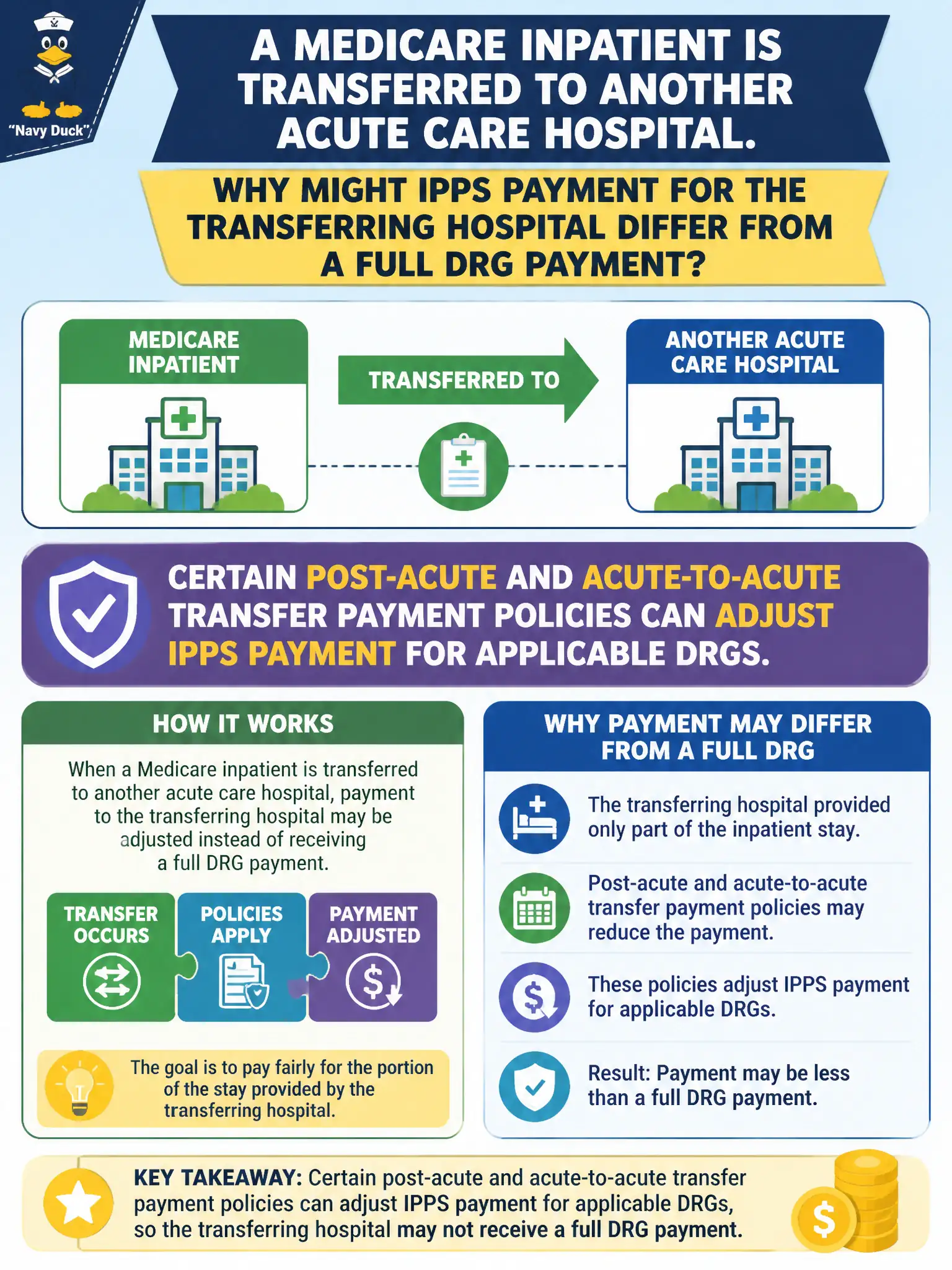
A Medicare inpatient is transferred to another acute care hospital. Why might IPPS payment for the transferring hospital differ from a full DRG payment?
Select an answer to reveal the explanation.
Short Explanation
When a patient moves mid-story to another acute hospital, Medicare doesn’t always hand the first hospital the full novel’s royalty. Transfer payment rules can trim or adjust the DRG pay for certain cases. It’s a payment-policy twist, not “bill nothing.”
Full Explanation
When a Medicare inpatient is transferred to another acute care hospital, IPPS payment for the transferring hospital may differ from a full DRG payment because certain acute-to-acute and post-acute transfer payment policies can adjust payment for applicable DRGs based on length of stay and regulatory rules. County transferring facilities must code the stay completely while understanding that payment methodology—not absent coding—may reduce the transferring hospital’s DRG payment. Assuming all transfers automatically convert to outpatient APC payment fails because the stay remains an inpatient IPPS case subject to transfer adjustments, not OPPS reclassification by default. Believing transfer cases are always paid zero because the receiving hospital bills everything fails; the transferring hospital still has a payable IPPS case under transfer rules. Claiming transfer rules apply only when no principal diagnosis is coded fails because transfer payment adjustments presuppose a coded, grouped inpatient case. Exam caveat: separate transfer payment policy from payment-system conversion and from coding completeness requirements. Operational check: for civic acute-to-acute transfers, finalize accurate principal diagnosis, procedures, and discharge disposition/transfer coding, then review expected transfer payment logic with patient financial services. Do not under-code the transferring stay under the mistaken belief that only the receiving hospital’s claim matters for public program integrity.