
Why should a hospital outpatient coder understand OPPS status indicators?
Select an answer to reveal the explanation.
Short Explanation
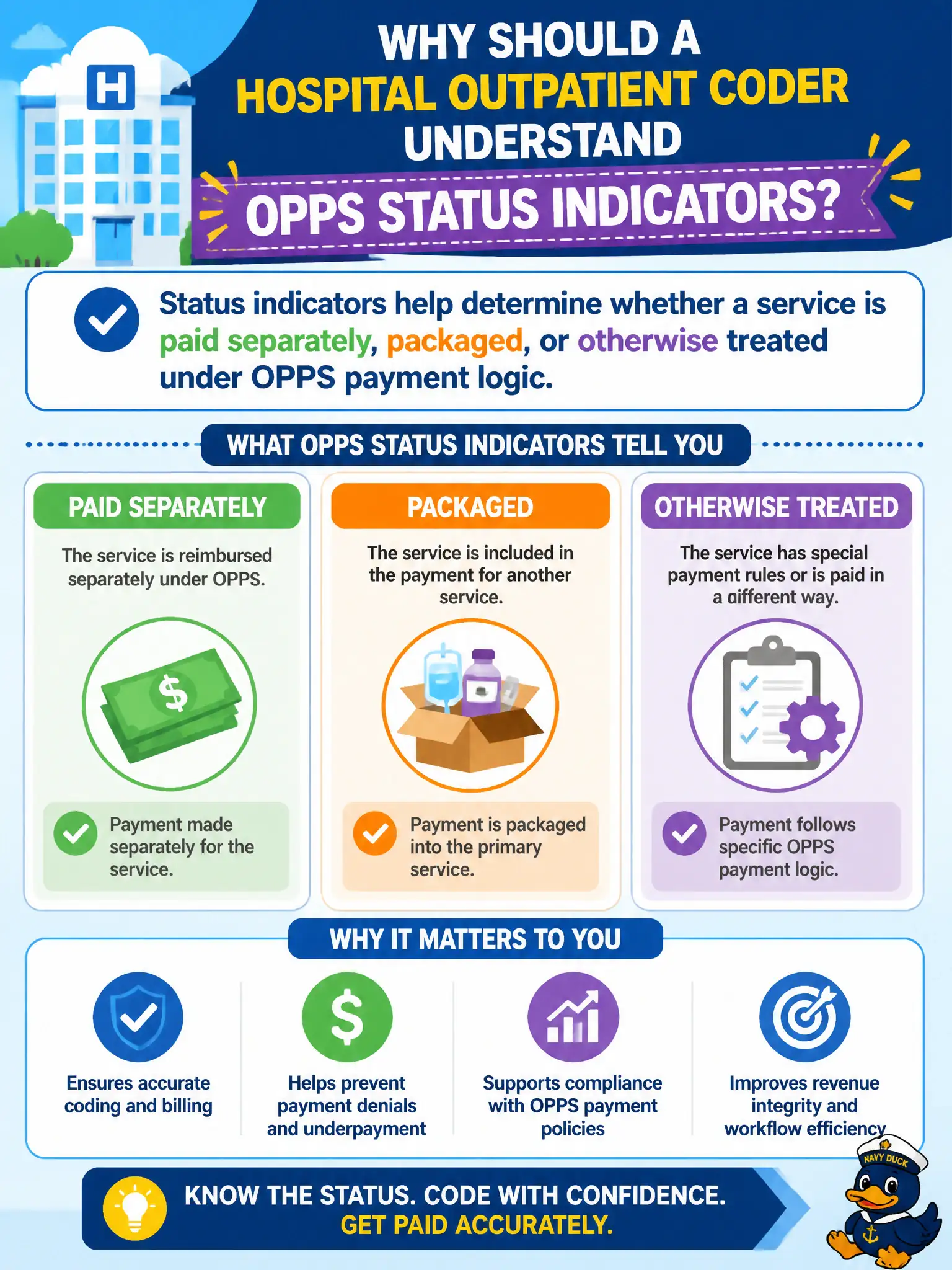
Status indicators are little traffic signs on each OPPS code—separately payable, packaged, or something else. Knowing the sign tells you what payment behavior to expect. They don’t replace CPT and they don’t run the inpatient DRG world.
Full Explanation
Hospital outpatient coders should understand OPPS status indicators because those indicators help determine whether a service is paid separately, packaged, or otherwise treated under OPPS payment logic. At a county facility, status-indicator literacy prevents surprise denials and incorrect department expectations about which HCPCS/CPT lines drive separate APC payment. Status indicators do not replace CPT codes on the outpatient claim; procedure and service codes remain the reported clinical content. They do not apply only to inpatient MS-DRG assignment—that is a different prospective payment system with different drivers. They are not used solely to set present-on-admission values; POA is an inpatient diagnosis attribute unrelated to OPPS status-indicator payment classification. Exam caveat: map status indicators to outpatient payment behavior (separate, packaged, etc.) and keep them distinct from CPT identity, MS-DRG logic, and POA. Operational check: maintain a current OPPS status-indicator reference in the civic outpatient coding workspace, check unfamiliar codes before promising separate payment, and reconcile scrubber outcomes with indicator expectations. Escalate recurring mismatches between charged services and packaged-versus-separate outcomes to revenue integrity for chargemaster and education updates.