
Under hospital OPPS APC payment, what commonly happens to many ancillary outpatient services billed with a significant procedure?
Select an answer to reveal the explanation.
Short Explanation
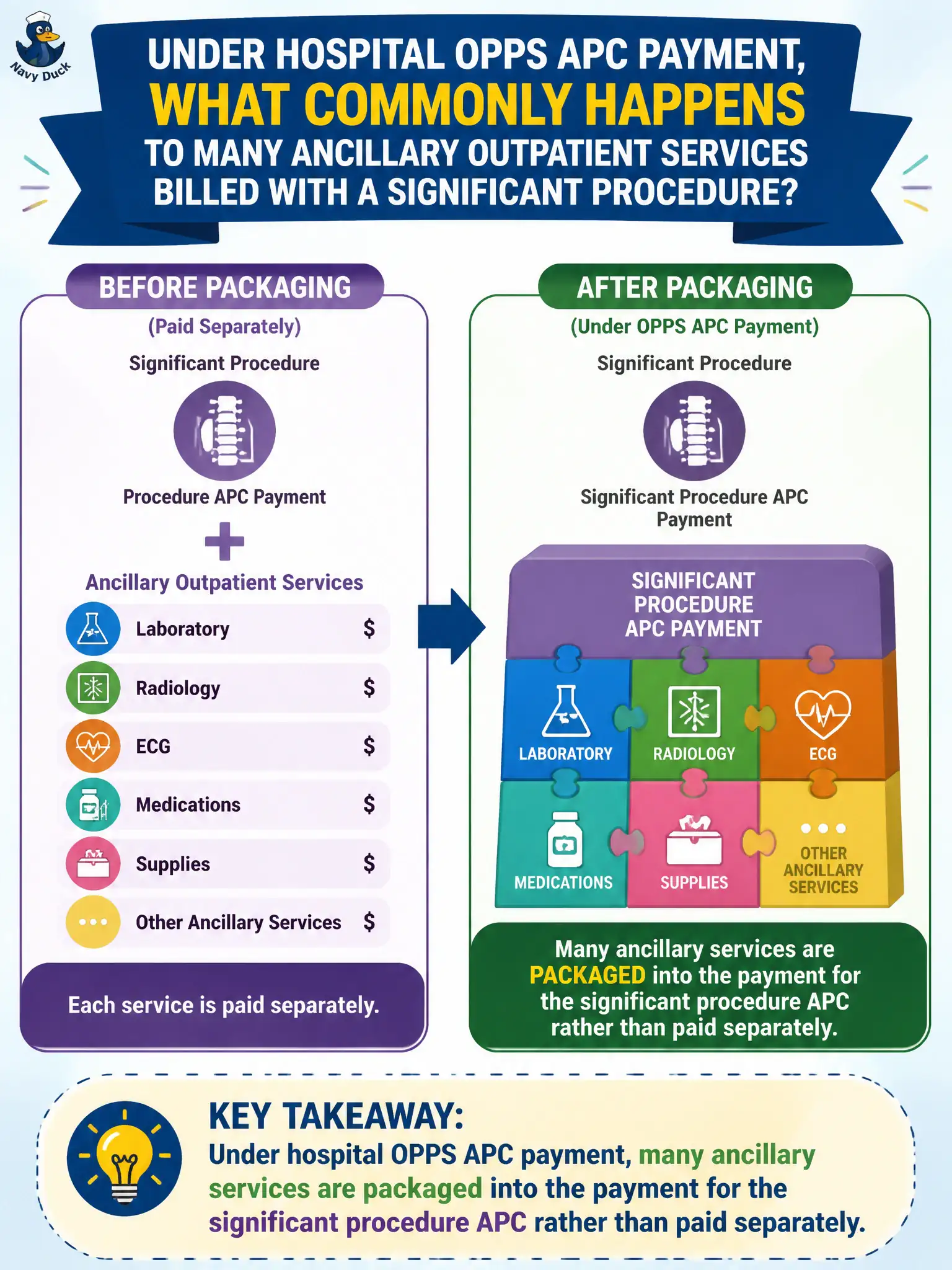
Think of a significant procedure APC as the main entrée—lots of side dishes get rolled into that one plate’s price. Under OPPS packaging, many ancillaries don’t get their own separate check. Coders still report them, but payment often rides with the primary procedure.
Full Explanation
Under hospital OPPS APC payment, many ancillary outpatient services billed with a significant procedure are packaged into the payment for that significant procedure APC rather than paid separately. Civic outpatient coding still reports the ancillaries for data integrity, but payment expectation should follow packaging policy rather than assuming a separate check for every line. Expecting each ancillary to receive its own full APC payment equal to the procedure fails the packaging concept that consolidates payment into the primary significant service. Paying ancillaries under MS-DRG logic fails because MS-DRGs are inpatient grouping, not outpatient APC packaging. Assuming the Grouper deletes ancillaries from the claim fails because packaging affects payment treatment, not automatic deletion of reported services from the claim record. Exam caveat: know packaging versus separately payable APCs, and do not confuse OPPS packaging with inpatient DRG assignment or with claim-line deletion. Operational check: when reviewing municipal outpatient surgery claims, identify significant procedures and expected packaged ancillaries via status indicators and OPPS logic, educate charge capture that reporting still matters, and investigate denials that wrongly assume separate payment for packaged services. Align department expectations with OPPS packaging so public financial forecasts match how APC payment actually behaves.