
How can a documented and correctly coded MCC on the secondary diagnosis list affect inpatient payment?
Select an answer to reveal the explanation.
Short Explanation
An MCC is like upgrading from economy to a higher fare class when the clinical story supports it. If it’s in the chart and coded right, the Grouper may move the case to a richer severity tier. No documentation, no upgrade—and it never swaps inpatient for outpatient.
Full Explanation
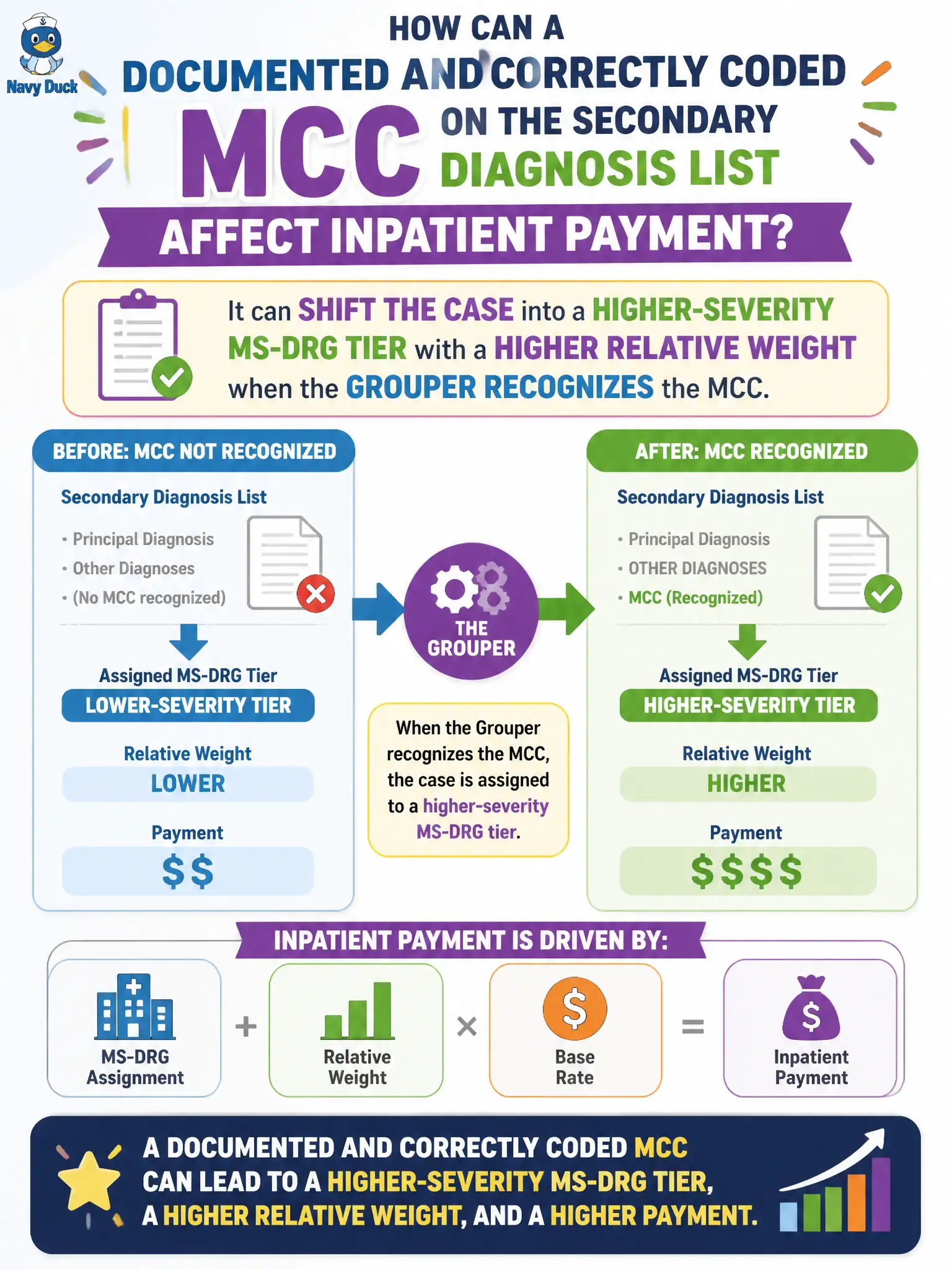
A documented and correctly coded major complication or comorbidity on the secondary diagnosis list can shift an inpatient case into a higher-severity MS-DRG tier with a higher relative weight when the Grouper recognizes the MCC. For county hospitals, ethical capture of true MCC conditions supports fair payment and accurate case-mix reporting without fabricating severity. Assuming an MCC always converts the claim from inpatient to outpatient APC payment fails because MCC logic operates within IPPS severity tiers, not by changing the payment system to OPPS. Claiming an MCC replaces the need for a principal diagnosis fails because every inpatient case still requires an allowable principal diagnosis; MCCs are secondary severity influencers. Believing an MCC automatically adds an outlier payment regardless of cost fails because outliers depend on cost thresholds relative to DRG payment, not merely on MCC presence. Exam caveat: separate severity-tier effects of CC/MCC from payment-system conversion and from outlier methodology. Operational check: code an MCC at a civic facility only with clear provider documentation meeting Official Guidelines; query when indicators exist but documentation is unclear; never add unsupported MCCs for weight. After grouping, confirm the severity tier change matches the documented MCC and that outlier status, if any, is evaluated separately on cost—not assumed from the MCC code alone.