
Under the inpatient prospective payment system, which statement best describes what drives MS-DRG assignment?
Select an answer to reveal the explanation.
Short Explanation
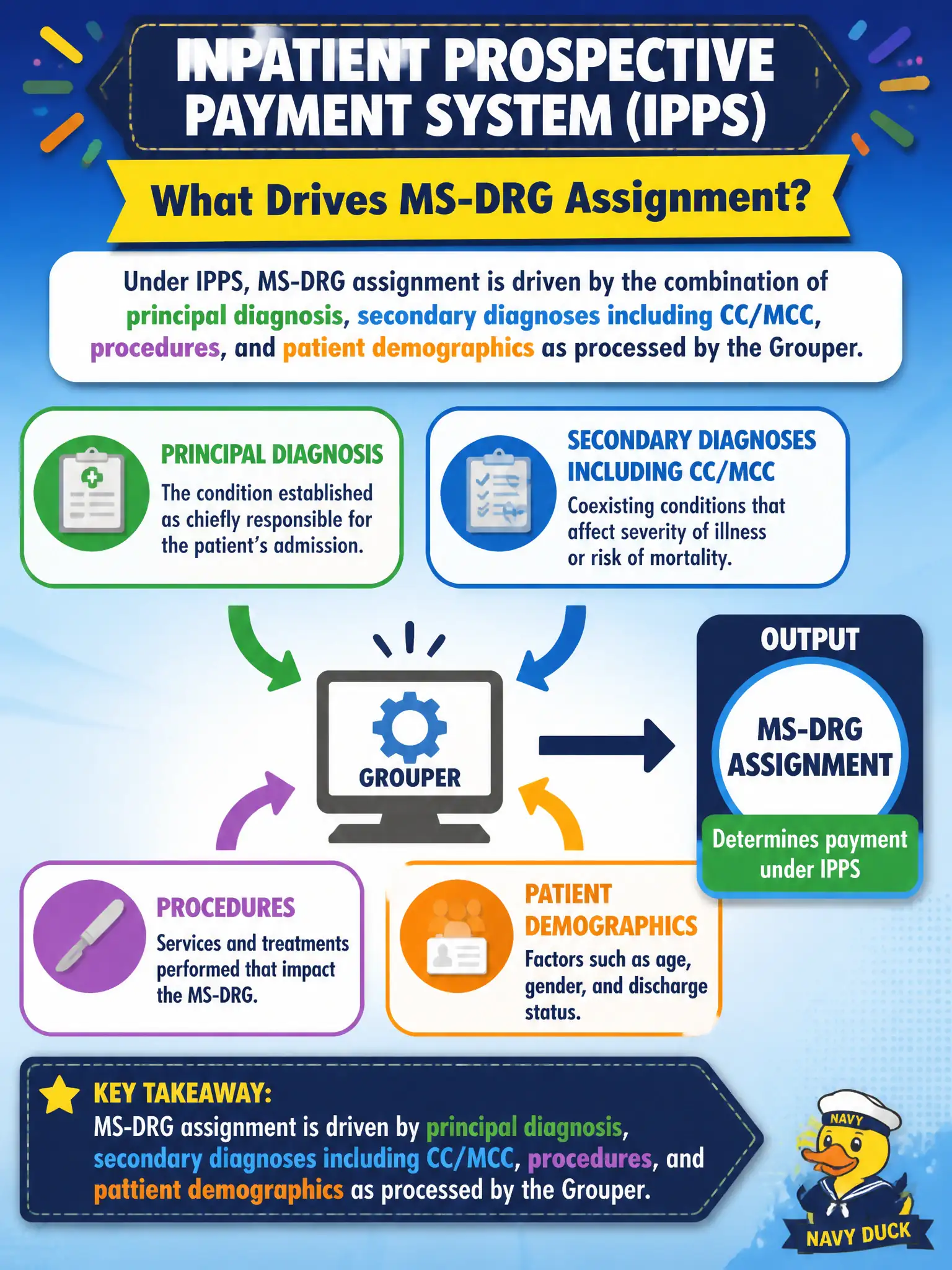
MS-DRGs aren’t picked by who signed the chart or how big the bill looks—they’re built from what you code. Principal diagnosis, complications/comorbidities, procedures, and basic demographics feed the Grouper. Accurate coding is what steers the DRG.
Full Explanation
Under the inpatient prospective payment system, MS-DRG assignment is driven by principal diagnosis, secondary diagnoses including CC/MCC, procedures, and patient demographics as processed by the Grouper. Accurate coding at a public hospital therefore directly shapes the DRG, relative weight, and facility payment for civic inpatient care. Assigning the DRG solely from the attending physician’s specialty fails because specialty does not replace coded clinical data in Grouper logic. Using only length of stay and discharge disposition without diagnosis codes fails because those elements may affect some payment adjustments but do not by themselves assign the MS-DRG. Using only total hospital charges fails because IPPS is a prospective DRG system, not a charge-based payment for the base operating DRG. Exam caveat: CCS tests whether you know Grouper inputs—diagnoses, procedures, demographics—versus superficial claim fields like specialty or charges. Operational check: before finalizing a county inpatient abstract, validate principal and secondary diagnoses, CC/MCC support, significant procedures, and demographic accuracy, then review Grouper output. Investigate unexpected DRG shifts against documentation rather than assuming charge totals or physician specialty explain payment. Maintain coding quality metrics tied to DRG accuracy for transparent public hospital reporting.