
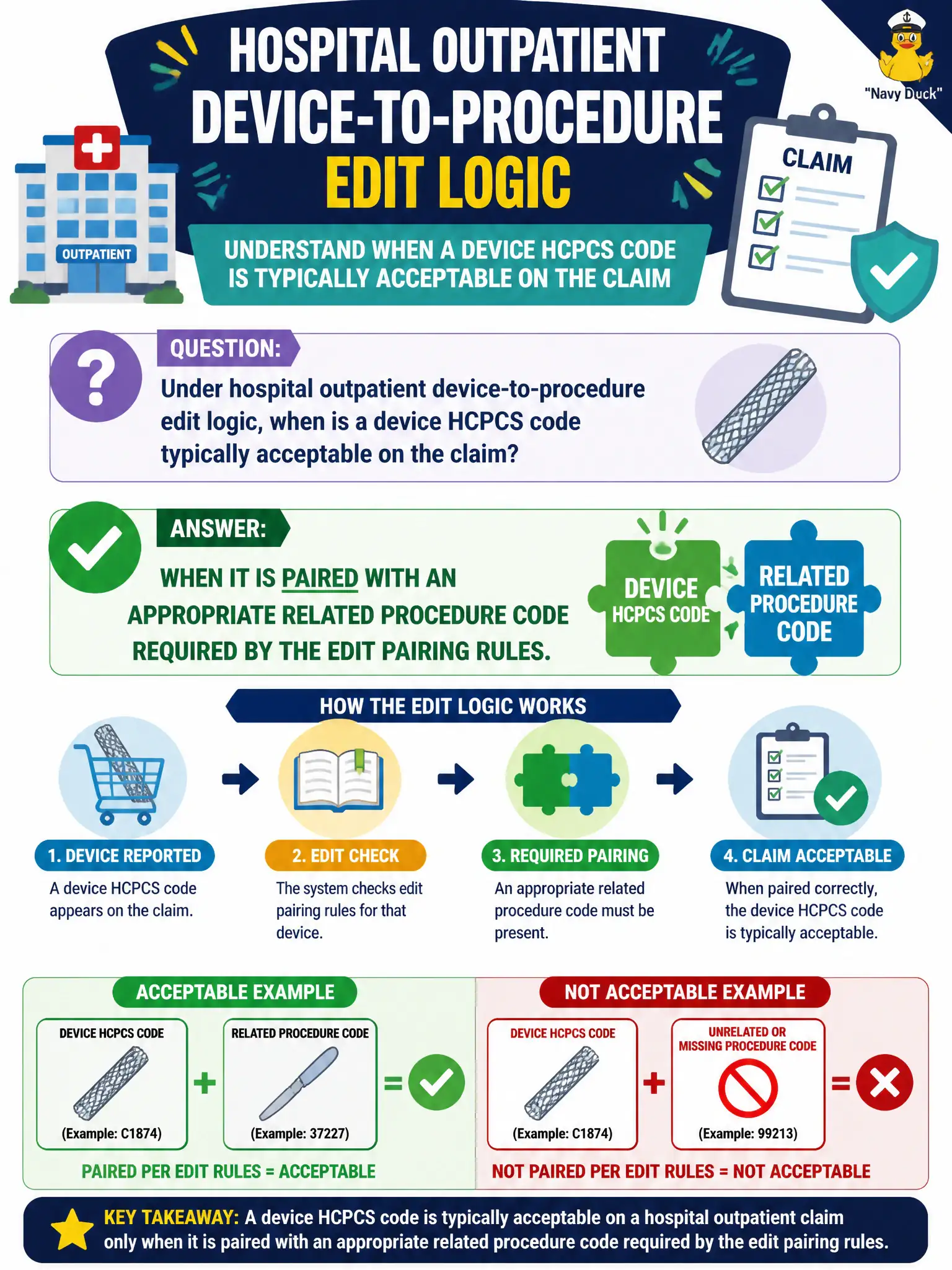
Under hospital outpatient device-to-procedure edit logic, when is a device HCPCS code typically acceptable on the claim?
Select an answer to reveal the explanation.
Short Explanation
Some device codes are like headphones that only work when plugged into the right jack—the matching procedure. Cost alone or “we opened the package” doesn’t satisfy the edit. Pair the device HCPCS with the procedure the edit expects.
Full Explanation
Under hospital outpatient device-to-procedure edit logic, a device HCPCS code is typically acceptable when paired with the related procedure code required by the edit’s pairing rules. Public hospital OPPS claims must show that the device belongs with a matching interventional or implant procedure, not that a supply merely existed in the room. Accepting the device whenever supply cost exceeds a local dollar threshold fails because cost alone does not satisfy CMS-style pairing requirements. Requiring the device to appear on the inpatient MS-DRG surgical hierarchy fails because that hierarchy is an inpatient grouping concept, not outpatient device-to-procedure edit logic. Coding the device whenever nursing notes that a supply was opened fails because opened-package documentation without the required procedure pairing does not meet the edit. Exam caveat: device edits are about correct HCPCS-to-procedure relationships under outpatient rules, not inpatient DRG tools or local cost cutoffs. Operational check: in the county cath lab or OR outpatient accounts, verify the procedure code that justifies the device line, correct missing or mismatched procedures from the operative documentation, and do not force device codes through on cost or supply-opened notes alone. Educate charge capture so implant stickers and device HCPCS align with documented procedures before civic claims reach the scrubber.