
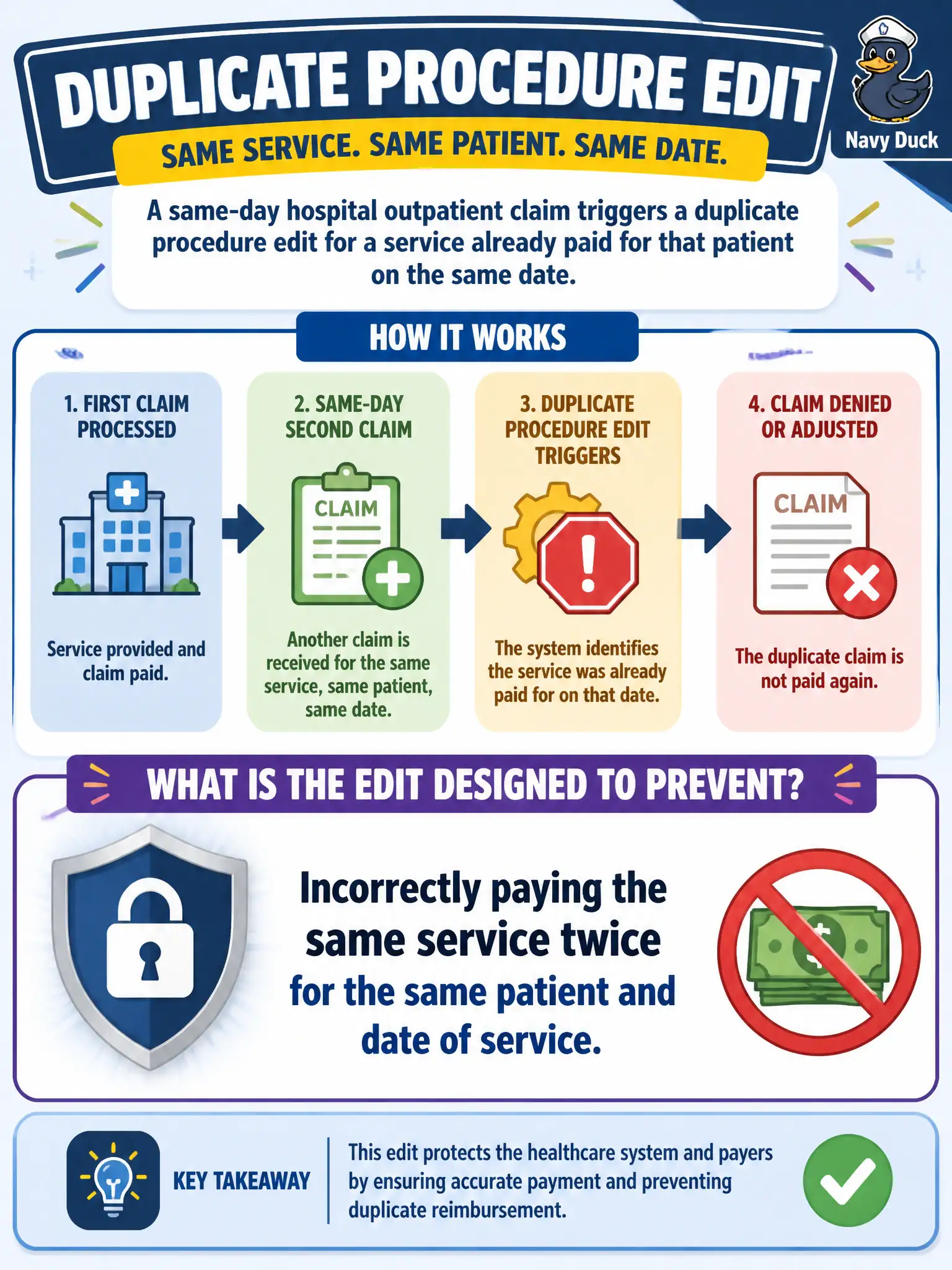
A same-day hospital outpatient claim triggers a duplicate procedure edit for a service already paid for that patient on the same date. What is the edit designed to prevent?
Select an answer to reveal the explanation.
Short Explanation
Duplicate edits are the system’s way of saying “we already bought this once today.” They’re about not paying the identical service twice—not about forbidding every second procedure ever. Check whether it’s a true duplicate or a distinct, separately billable service.
Full Explanation
A same-day duplicate procedure edit is designed to prevent incorrectly paying the same service twice for the same patient and date of service. County outpatient billing integrity depends on catching true duplicates—resubmissions, duplicate charge capture, or identical lines—before public payers disburse twice for one service. Interpreting the edit as a ban on any second procedure at a different anatomical site fails because clinically distinct, separately documented procedures may be appropriate and are not the same as duplicate payment for an identical service. Treating it as a rule that eliminates all E/M when a procedure is reported fails because E/M with procedures is a separate reporting concept governed by documentation and modifiers, not duplicate-procedure logic. Linking the edit to a prohibition on ICD-10-CM secondary diagnoses fails because diagnosis reporting rules are unrelated to duplicate service payment prevention. Exam caveat: duplicate edits address repetition of the same payable service, not every multi-procedure or multi-diagnosis outpatient day. Operational check: when the civic scrubber flags a duplicate, compare claim history, account numbers, and documentation for the date of service; suppress true duplicates; and if a second distinct service exists, ensure documentation and coding differentiate it appropriately before resubmission. Log outcomes so revenue integrity can distinguish duplicate capture from legitimate same-day multi-service outpatient care.