
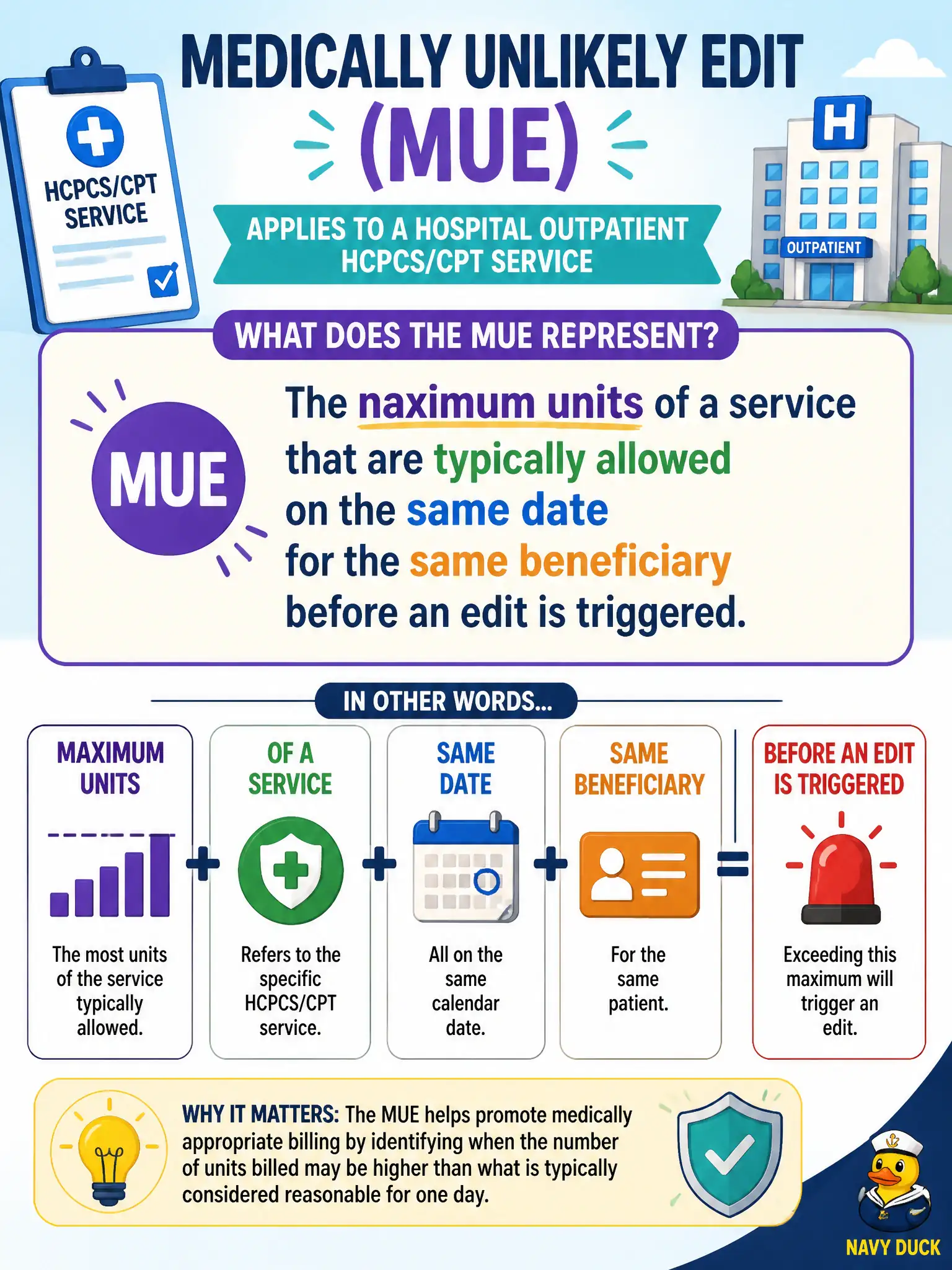
A Medically Unlikely Edit (MUE) applies to a hospital outpatient HCPCS/CPT service. What does the MUE represent?
Select an answer to reveal the explanation.
Short Explanation
MUEs are the 'that many units looks unlikely' ceiling. Blow past the max units for the same patient/same day and the edit lights up—it's not a minimum billable floor or a diagnosis list.
Full Explanation
A Medically Unlikely Edit (MUE) for a hospital outpatient HCPCS/CPT service represents the maximum units of that service typically allowed on the same date for the same beneficiary before an edit is triggered. MUEs curb improbable unit billing that exceeds clinical reasonableness. Understanding MUEs as maximum-unit edits—not minimum billable quantities or diagnosis lists—keeps municipal outpatient unit reporting within credible bounds and reduces avoidable reject cycles.
Interpreting an MUE as the minimum units that must be billed before payment is allowed fails by concept—it is a maximum reasonableness threshold, not a floor that forces higher units. Treating an MUE as a list of ICD-10-CM codes that prove medical necessity fails—that confuses MUEs with LCD/NCD coverage diagnosis criteria. Requiring modifier 25 on every laboratory code because of MUEs fails—modifier 25 addresses significant separately identifiable E/M services, not laboratory unit caps.
Exam caveat: some MUEs adjudicate as claim-line edits versus date-of-service edits, and value levels differ in how strictly they can be overridden; exceeding an MUE requires strong documentation and only those override approaches payers recognize for medically necessary excess units. Operational check: compare billed units to the MUE; if exceeding, verify medical necessity and documentation; correct over-units rather than hoping the edit will ignore improbable quantities.