
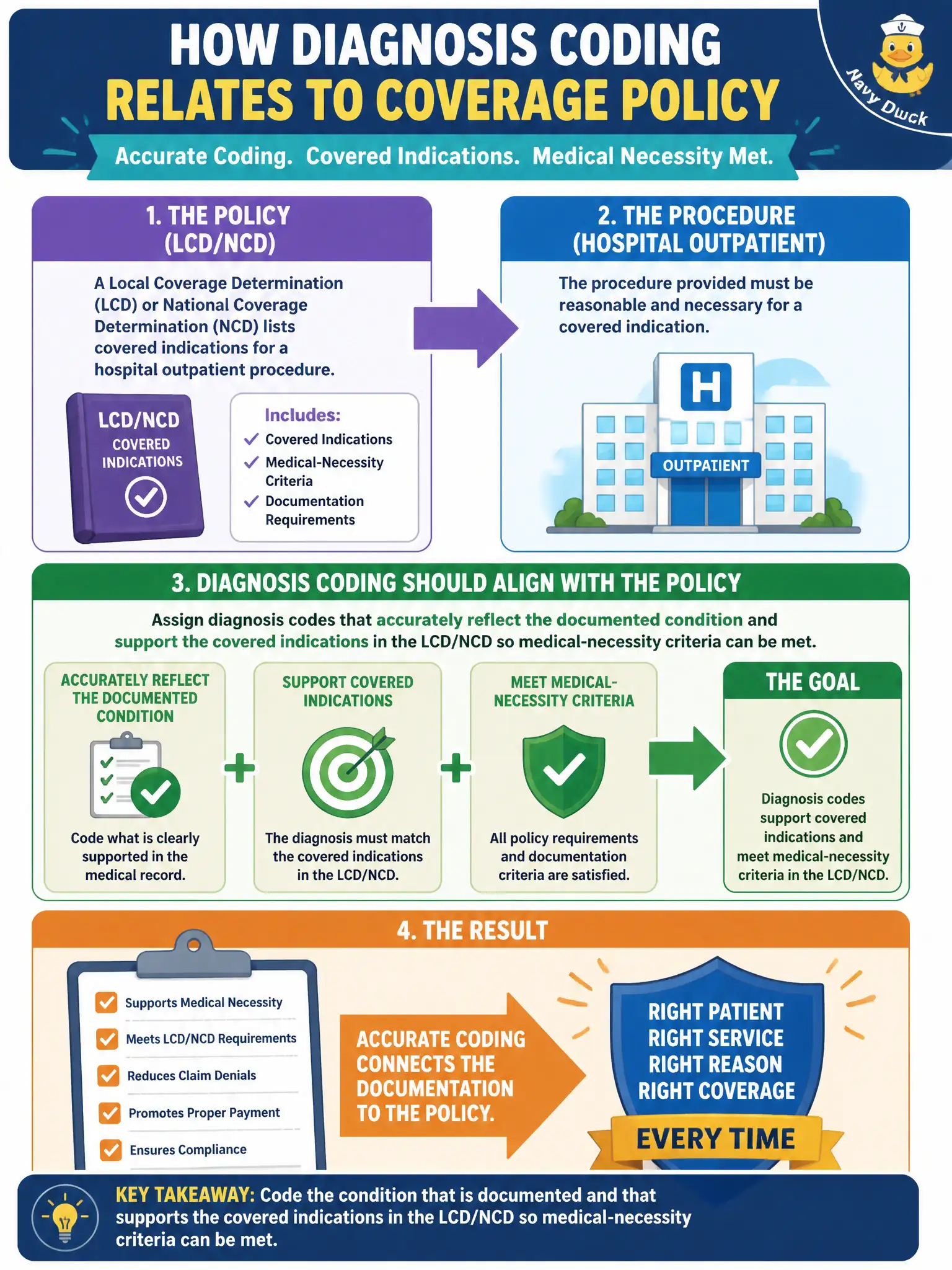
A Local Coverage Determination (LCD) or National Coverage Determination (NCD) lists covered indications for a hospital outpatient procedure. How should diagnosis coding relate to that policy?
Select an answer to reveal the explanation.
Short Explanation
Coverage policies are picky about why you did the procedure. Your diagnosis coding has to match what was wrong and what the LCD/NCD says is payable—CPT alone doesn't carry medical necessity.
Full Explanation
When an LCD or NCD lists covered indications for a hospital outpatient procedure, diagnosis coding should accurately reflect the documented condition and support the covered indications so medical-necessity criteria can be met. Coverage policies link payable procedures to appropriate clinical indications expressed through ICD-10-CM. Aligning truthful diagnoses to LCD/NCD indications protects beneficiaries and civic facilities from medical-necessity denials without coding to the policy instead of the health record.
Choosing diagnosis codes randomly because LCDs and NCDs “ignore ICD-10-CM” fails by concept—coverage determinations routinely use diagnosis criteria to define covered indications. Saying coverage policies apply only to inpatient DRGs fails—outpatient claims are primary LCD/NCD terrain for many procedures and tests. Claiming medical necessity is proven solely by the CPT code with optional diagnosis coding fails—diagnosis support is integral to medical-necessity review when an LCD or NCD exists.
Exam caveat: never assign a covered diagnosis the patient does not have merely to pass an LCD; if documentation lacks a covered indication, address clinical documentation improvement or coverage determination processes—do not fabricate indications. Operational check: read the LCD/NCD covered indications; code the patient’s documented condition accurately; confirm assigned diagnoses support coverage when truly present; escalate noncovered scenarios through proper utilization processes rather than upcoded indications.