
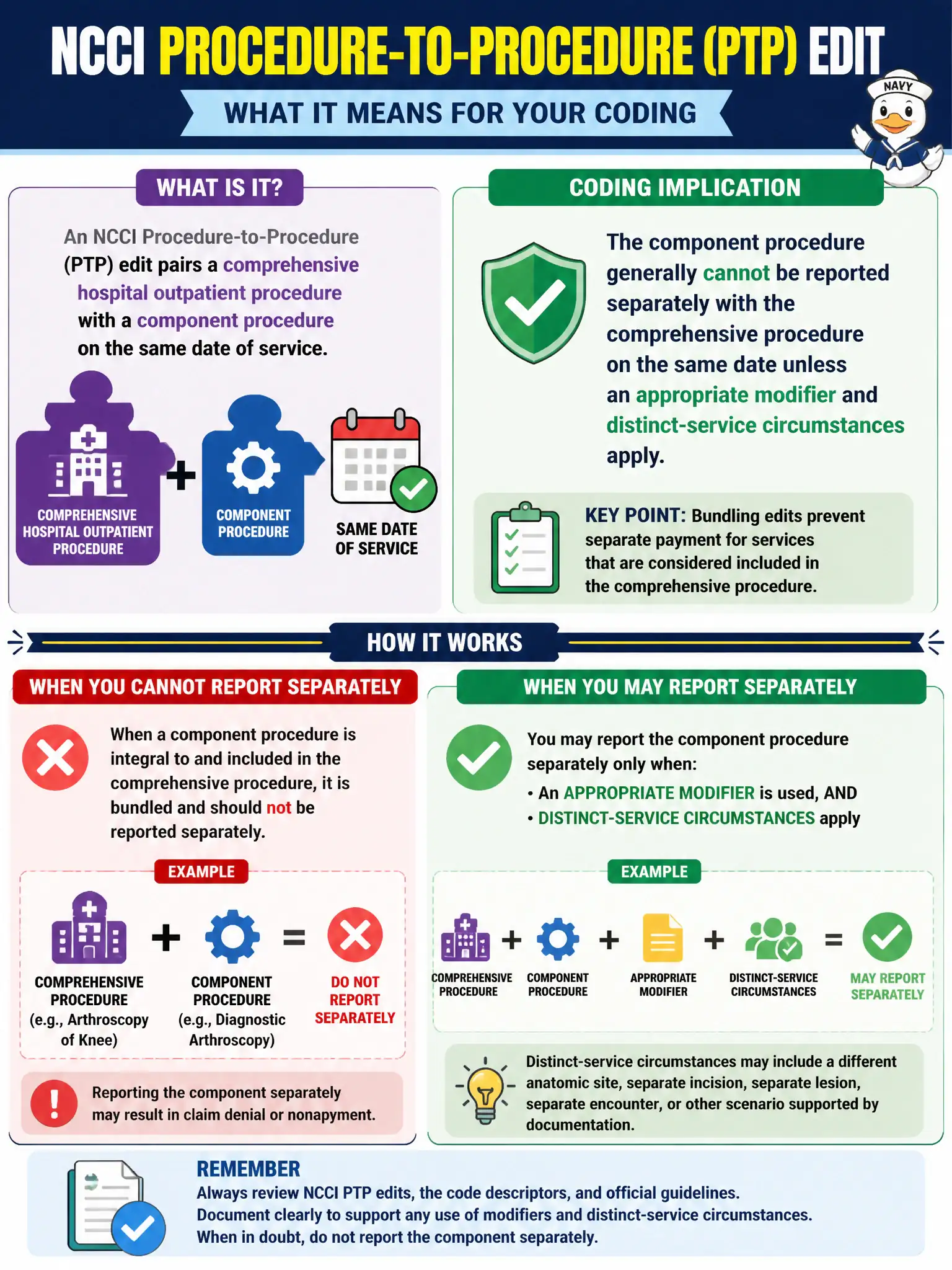
An NCCI Procedure-to-Procedure (PTP) edit pairs a comprehensive hospital outpatient procedure with a component procedure on the same date of service. What is the coding implication?
Select an answer to reveal the explanation.
Short Explanation
PTP edits are the 'don't unbundle the kit' rule. If a little piece is already inside the big procedure that day, you usually don't bill the piece alone—unless a proper modifier and truly distinct service say otherwise.
Full Explanation
An NCCI Procedure-to-Procedure (PTP) edit pairing a comprehensive hospital outpatient procedure with a component procedure on the same date means the component generally cannot be reported separately with the comprehensive procedure unless an appropriate modifier and distinct-service circumstances apply. PTP edits prevent routine unbundling of component work already included in a comprehensive service. Respecting PTP edits preserves compliant civic outpatient billing and prevents systematic overpayment for included work.
Saying both codes may always be billed together without review because NCCI applies only to inpatient DRGs fails by concept—NCCI PTP edits are foundational to hospital outpatient and practitioner billing, not an inpatient-DRG-only tool. Requiring deletion of the comprehensive procedure to keep only the component fails—the comprehensive service is typically the payable code that already includes the component. Claiming PTP edits replace medical-necessity policies fails—NCCI addresses code-pair bundling; covered diagnosis and medical-necessity review remain separately required under LCD/NCD and payer rules.
Exam caveat: PTP modifier indicators tell whether a modifier can ever override the edit; indicator 0 pairs generally cannot be overridden even with a distinct-services modifier. Operational check: identify the comprehensive versus component code; check the PTP modifier indicator; report only the comprehensive code unless distinct-service documentation and an allowed modifier justify separate reporting of the component.