
Why does accurate POA assignment matter for diagnoses linked to hospital-acquired condition (HAC) payment provisions?
Select an answer to reveal the explanation.
Short Explanation
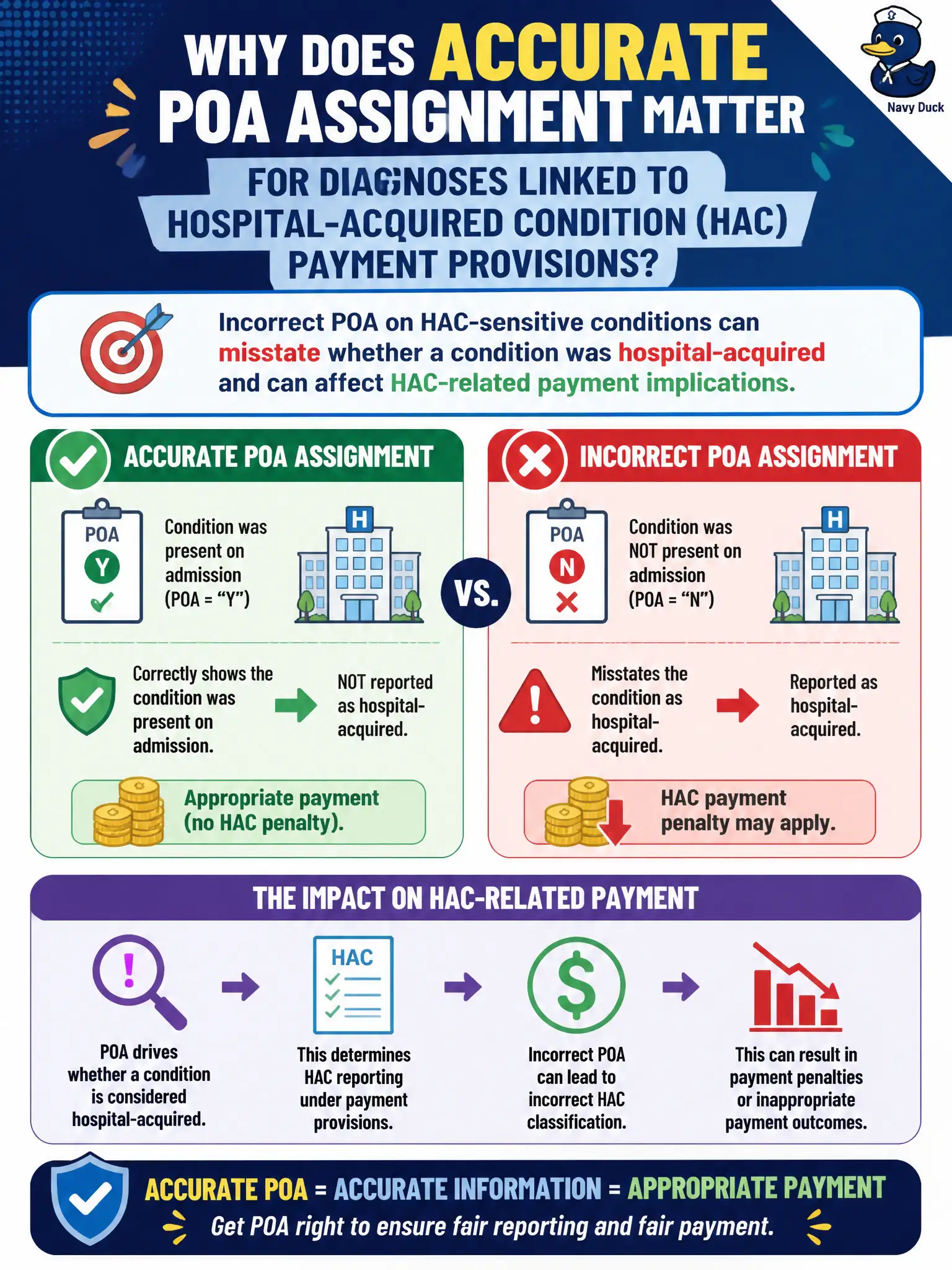
HAC programs care whether the bad event walked in or showed up later. Wrong POA on those sensitive diagnoses can paint a community problem as hospital-acquired—or hide a true hospital-acquired issue—and that can ding payment logic.
Full Explanation
Accurate POA assignment matters for diagnoses linked to hospital-acquired condition (HAC) payment provisions because incorrect POA on HAC-sensitive conditions can misstate whether a condition was hospital-acquired and can affect HAC-related payment implications. POA Y versus N is a hinge for distinguishing community-acquired from hospital-acquired conditions in HAC logic. Faithful POA coding protects patients, payers, and municipal hospitals from false HAC signals that either hide hospital-acquired harm or incorrectly penalize community-acquired disease.
Saying POA values have no relationship to HAC logic and are collected only for research surveys fails by concept—HAC policies depend on POA among other factors to identify hospital-acquired events. Saying HAC rules ignore POA and use only discharge disposition fails—disposition codes do not replace POA for HAC determination. Claiming any POA Y automatically creates an HAC penalty fails because Y indicates present on admission (generally not hospital-acquired for HAC purposes), which is the opposite of an automatic hospital-acquired penalty trigger.
Exam caveat: not every POA N diagnosis is an HAC; only designated HAC-sensitive condition and procedure combinations under current CMS policy are implicated—know the HAC list rather than treating every N as a penalty. Operational check: prioritize POA accuracy on HAC-sensitive diagnoses (certain infections, pressure ulcers, falls with injury, and other listed conditions); validate Y/N with clinical timing in the record; never flip POA to avoid HAC without documentation support.