
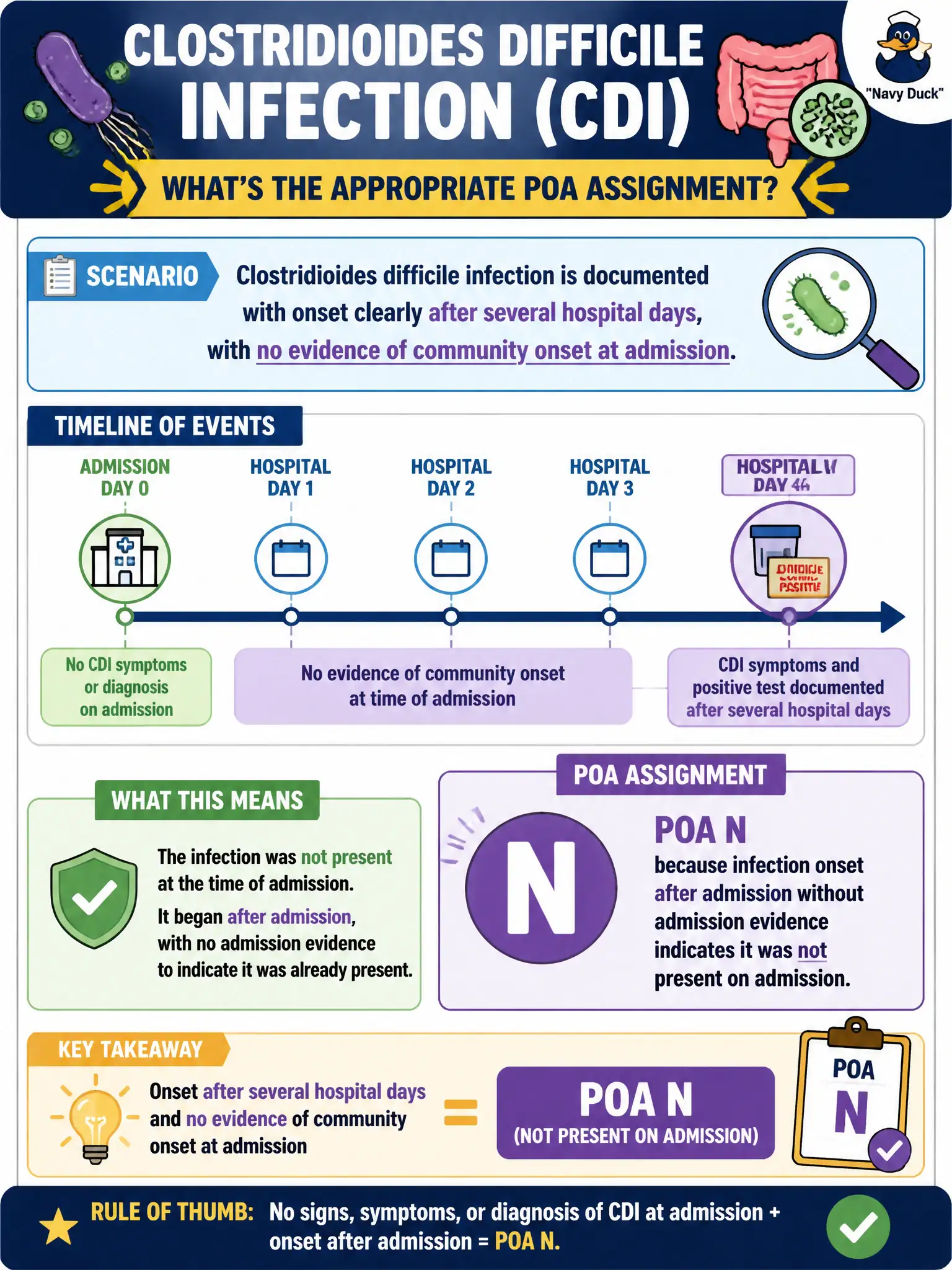
Clostridioides difficile infection is documented with onset clearly after several hospital days, with no evidence of community onset at admission. Which POA assignment is appropriate?
Select an answer to reveal the explanation.
Short Explanation
Hospital-onset C. diff that lights up days into the stay gets POA N. Community-acquired would need signs it was already cooking at admission—timing in the record is the decider.
Full Explanation
Clostridioides difficile infection with onset clearly after several hospital days and no evidence of community onset at admission receives POA N. Hospital-onset C. difficile without admission evidence is not present on admission. Accurate N assignment is critical for civic infection-prevention programs, public reporting, and HAC-related C. difficile measurement that distinguish community-onset from hospital-onset disease.
Assigning POA Y because C. difficile is “always community-acquired for coding purposes” fails by concept—onset timing is case-specific and must follow the record. Using POA W because all infectious diseases are “clinically undetermined by default” fails—W requires a provider determination that it is clinically not possible to determine POA, not a default label for infections. Omitting code and POA because hospital-onset infections are “never reported” fails; hospital-onset infections are reported with POA N when clinically documented and reportable.
Exam caveat: community-onset C. difficile present on admission is Y; do not mark all C. difficile as N by habit, and align coding dates with infection-prevention onset definitions when reconciling discrepancies. Operational check: confirm symptom/lab onset after admission days without admission evidence; code C. difficile infection; assign POA N; coordinate with infection prevention on onset dating used by the facility.